
Gear Oil Battle: Synthetic vs. Conventional – Which Wins?
Gear Oil Face-Off: Which One Keeps Machines Running Longer?

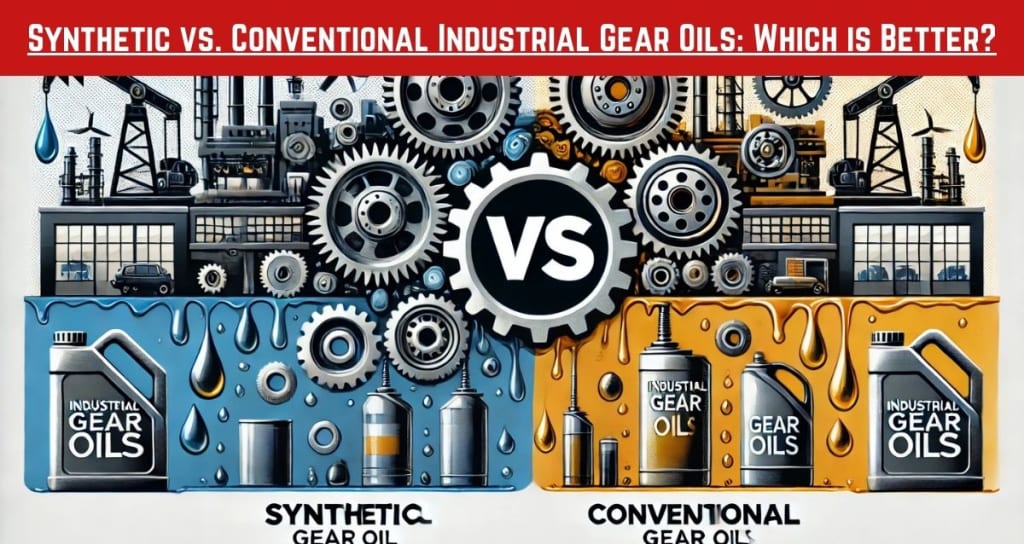
To keep various mechanical operations running smoothly, it is essential to apply industrial gear oils. These oils are crucial to reducing friction, preventing wear, and enhancing the efficiency of mechanical systems. However, as the world is heading towards more efficiency, conventional industrial oil is not enough! New advances are emerging that are providing better benefits. In particular, fully synthetic engine oil is proving to be a promising alternative to conventional oil. But, is the choice between fully synthetic engine oil and industrial gear oils that easy? In this blog, let us discuss both their advantages and disadvantages and help you make an informed decision.
What Are Industrial Gear Oils and What Are Their Usage?
Industrial gear oils are a type of specialised lubricant oil that is used to protect and enhance the performance of gears and other mechanical components. Apart from these functions, the oils also reduce friction and wear, dissipate heat, and prevent rust and corrosion. These oils also come in various viscosities and formulations that suit each type of usage and operating conditions. Now, let us look at the use cases of such gear oils in the industry.
To start with, these oils are heavily used in machinery and manufacturing industry. For example, they are used in a wide range of applications, including gearboxes, reducers, and other mechanical systems. Their job is to ensure the machines' optimal performance and longevity. For years conventional industrial gear oils dominated the scene. However, with the advent of fully synthetic engine oil, many in the industry are confused as to which one is better for use. Thus, a thorough discussion of each oil’s characteristics and performance in various environments is needed.
What are Conventional Industrial Gear Oils?
More commonly used oils, also known as conventional industrial oils are mainly mineral-based oils. They contain petroleum or crude oil which is manufactured through the refining process. They have been in use for many years and the reasons for their popularity are their affordability and availability. In order to protect machine parts better, they contain additives such as anti-wear agents, rust inhibitors, and antioxidants to enhance their performance. However, as mentioned, these oils are less expensive in comparison to synthetic oils. Thus, people who want to save on costs, naturally gravitate towards conventional gear oil.
Furthermore, for the price, they provide adequate lubrication and protection for a wide range of industrial applications. Such advantages paved the way for having a reliable track record for decades but in the modern age, these oils are falling behind. Because these oils break down easily under high temperatures which leads to decreased lubrication and eventually to gear damage. Moreover, over time, the oil oxidises and forms sludge. This results in clog formation in the filters and reduced efficiency of the lubrication system. All of these disadvantages shorten their lifespan, requiring more frequent oil changes.
Why Fully Synthetic Engine Oil is Taking Over?
Fully synthetic engine oil is a new-generation lubricant oil that is manufactured through chemical synthesis. These oils are engineered to have superior performance and protection compared to conventional gear oils. Fully synthetic engine oil has synthetic base oil and advanced additive packages as composition. They can also be customised for specific applications. Furthermore, fully synthetic engine oil is capable of maintaining its viscosity and lubrication properties even at extreme temperatures. Thus, they can maintain their performance under both low and high temperatures. Unlike industrial gear oil, synthetic oils are resistant to oxidation, which reduces the formation of sludge and deposits in the filter.
Such property also improves lubrication and wear protection. Resulting in longer equipment life as well as low maintenance costs. Such high efficiency translates to better functioning of the mechanical systems. Which leads to greater energy savings and reduced operating costs. All of these advantages mean that there is less need for oil changes, reducing downtime and maintenance expenses. But it is not a one-sided win, fully synthetic engine oil is generally more expensive than conventional gear oils. Moreover, in some rare cases, synthetic oil can be incompatible with certain seals, gaskets, or other components. Thus, you need to research a bit before considering to switch from conventional oil.
Which Performs Better? Fully Synthetic Engine Oil or Industrial Gear Oil?
Now let us discuss the performance aspect of synthetic engine oil and conventional oil. To start with, industrial gear oil does not perform well under fluctuating temperatures. They break down pretty quickly, leaving mechanical parts vulnerable. On the other hand, fully synthetic engine oil excels at maintaining performance under harsh temperatures. Capable of maintaining viscosity and lubrication properties even in extreme heat or cold environments.
As mentioned before, the formation of sludge due to oxidation leads to a fall in performance. Conventional gear oils are easy to be Oxidised and form sludge and deposits. Which reduces overall efficiency and higher need for more frequent oil changes. Furthermore, synthetic oils provide superior lubrication as well as protection against frictional damage. Thus increases the lifespan of machinery parts. Conventional oils do provide good enough lubrication but they break down under intense heat or cold.
Which leads to a higher number of oil changes in industrial gear oil. Which also means an increase in downtime in operations. Furthermore, the need for frequent oil changes also increases the costs of maintenance as well. However, with fully synthetic engine oil, that is not the case. Due to their stability and resistance to degradation, the oil keeps performing for a long period between changes. This makes the cost of maintenance of synthetic oil a lot lower compared to conventional oil.
Differences Based on the Application of Each Oil
Before you make a final decision of switching to which type of oil, it is necessary to know the what is the specific requirement of your application. Each oil excels at different types of applications and without knowing you may end up with an oil that is not suitable for your type of need. For example, if your machines work under extreme heat or experience heavy loads. Opting for fully synthetic engine oil is the right call. They offer far better performance and protection under those conditions.
On the other hand, if you value time and want to keep downtime between oil changes as low as possible, here too, synthetic oil will give better results. But remember, fully synthetic engine oil can be expensive compared to conventional oils. In case you do not have that kind of budget and intense workload, industrial engine oils will do the job just fine. Lastly, look into the compatibility of your machine part with the oil. Few synthetic oils are not compatible with certain types of material.
You may also like: Synthetic vs. Mineral-Based Machinery Oils: Which is Right for You?
Conclusion
Before we wrap up, many of you are concerned about the environmental impact of such oils. In general, conventional oils are derived from petroleum and can have a negative impact on the environment. Whereas, fully synthetic engine oil has a lower environmental impact due to its longer lifespan and reduced oil consumption. Moreover, certain synthetic oils are formulated to be biodegradable which further reduces their environmental footprint. Therefore, to answer you clearly, opting for fully synthetic engine oil is better than conventional oil. Except if you are on a tight budget and have compatibility issues with your machine parts.
About the Creator
Rahul Bhatt
Hi, I am Rahul, a professional content writer with over 3 years of experience as a ghostwriter, blog writer, and copywriter. I work closely with B2B and B2C industries, providing content that gains search engine visibility.
Keep reading
More stories from Rahul Bhatt and writers in Journal and other communities.
Synthetic vs. Mineral-Based Machinery Oils: Which is Right for You?
If you want to take care of your machines and extend their lifespan further, using the right machinery oil is necessary. In particular, machinery oil determines the performance, longevity, and efficiency of the machines in general. But the question arises, which type of oil is the right one for your equipment? On one hand, we have synthetic and on the other mineral-based machinery oils. Each has its strengths and weaknesses, some work better for certain types of machines, some not. Therefore, in this blog, we will guide you in identifying the right type of oil for your machinery.
By Rahul Bhattabout a year ago in Journal



Comments
There are no comments for this story
Be the first to respond and start the conversation.