
Engineering Excitement: Integrating Adventure Elements into Amusement Ride Design
Strategic Design Approaches to Enhance Narrative, Immersion, and Psychological Engagement in Thrill Ride Engineering

Designing amusement rides transcends mere mechanical ingenuity—it is the synthesis of psychological stimulation, spatial narrative, and immersive storytelling. The modern patron seeks more than velocity; they desire an odyssey. Incorporating adventure elements into thrill ride development, particularly in roller coaster engineering, demands a multidisciplinary approach that merges structural dynamics, sensory manipulation, and environmental choreography.
Understanding the Psychology of Adventure
Adventure, in the context of amusement experiences, hinges on three core psychological triggers: anticipation, uncertainty, and reward. The deliberate orchestration of these emotions within the guest journey defines the perceived thrill and novelty of a ride.
Anticipation is built through progressive escalation—slow climbs, suspenseful turns, or pre-show experiences that prime the rider’s expectations.
Uncertainty is delivered via rapid transitions, obscured pathways, and sensory overload, inducing a temporary suspension of control.
Reward, the culminating release of tension, must satisfy both emotional and physical catharsis, often achieved through speed, inversion, or thematic resolution.
These elements, when embedded systematically into the design language, elevate thrill rides from mechanical motion to experiential narrative.

Spatial Design as a Narrative Device
Adventure is inherently spatial. The environment through which a roller coaster traverses must be curated to act as both setting and participant. Designers employ topographical illusion and spatial layering to create a multi-sensory landscape.
Terrain Integration
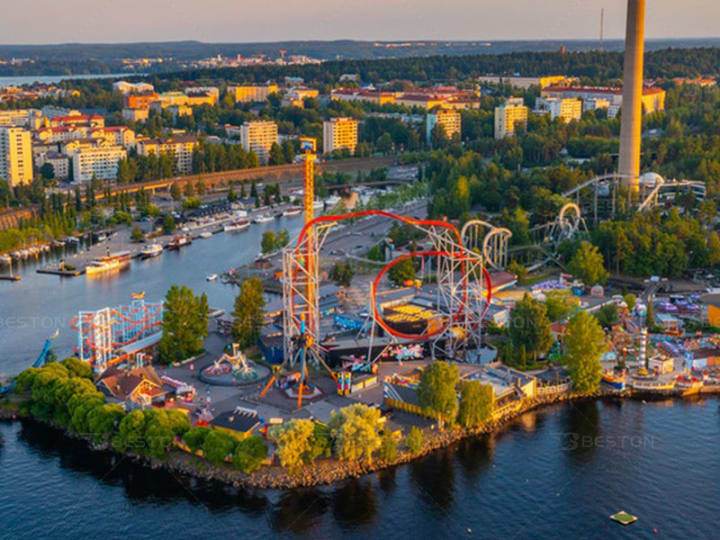
Utilizing natural or fabricated terrain enhances realism and immersion. Coasters that dive through canyons, weave around cliff-like structures, or disappear into caverns exploit the primal response to proximity and confinement. Terrain coasters, such as those hugging natural elevation changes, evoke a visceral connection with the physical world, enhancing the illusion of danger.
Architectural Interplay
Adventure theming benefits immensely from architectural interplay. Structures that mimic ancient ruins, derelict outposts, or futuristic corridors act as narrative checkpoints. As riders pass through these vignettes, they unconsciously piece together a story, each structure functioning like a chapter in an unfolding quest.
Kinetics and Emotional Trajectory
Thrill rides rely not solely on raw speed but on a calculated kinetic journey. The design of the ride path—its acceleration curves, inversion cadence, and directional shifts—must correspond to an emotional map.
Velocity Variability
Introducing bursts of speed followed by abrupt deceleration can mimic the rhythm of a chase or escape. The juxtaposition of motion types—e.g., freefall followed by lateral whipping—simulates real-world chaos and unpredictability.
Dynamic Inversions
Inversions can be more than physical stunts. When sequenced narratively, they represent pivotal moments in the ‘story arc’ of a ride. A slow corkscrew at the climax of an indoor coaster, for instance, may suggest a spatial anomaly or a narrative twist, rather than simply disorientation.
Sensory Augmentation
To invoke a true sense of adventure, the ride must overwhelm the conventional sensory experience. Advanced amusement ride designs incorporate technologies and techniques borrowed from cinema and virtual reality.
Audio-Visual Synchronization
Soundscapes and dynamic lighting systems are integrated into ride vehicles and trackside infrastructure to simulate environments such as storms, alien worlds, or collapsing caverns. Synchronizing audio cues with mechanical movements enhances the believability of the narrative.
Haptic and Thermal Feedback
The incorporation of mist, heat bursts, or vibrational panels adds tactile realism. These elements simulate real-world phenomena—steam vents from a subterranean vent or tremors from a nearby explosion—without requiring visual confirmation.
Thematic Consistency and Immersive Continuity
Adventure is most potent when the illusion is unbroken. Consistency across all ride elements—from queue design to exit corridors—maintains immersion and deepens emotional engagement.
Queue as Prelude
The waiting area sets the stage. Queue lines designed as exploratory tunnels, briefing rooms, or jungle paths contribute to pre-ride immersion. Integrating interactive displays or narrative audio establishes the context before the thrill ride even begins.
Exit as Epilogue
Post-ride areas should not abruptly return riders to reality. Instead, they can act as denouements—wreckage sites, souvenir chambers, or debrief zones—allowing the thematic experience to resolve organically.
Case Integration: Synthesis in Modern Ride Systems
Hybrid coaster systems, which combine dark ride segments with high-speed track elements, exemplify this design philosophy. These rides begin with slow-moving, story-driven sequences featuring animatronics or projection-mapped environments. At a narrative inflection point, they transition into high-speed thrill sequences, often without obvious mechanical segmentation.
This dual-modality fosters a cinematic rhythm, where storytelling precedes kinetic climax. Such integration underscores the evolving expectation for adventure in thrill rides—not merely exhilaration, but narrative participation.
Conclusion
Infusing adventure into amusement ride design is not a superficial aesthetic choice—it is an engineering philosophy. From track layout to thematic construction, every element must coalesce into a unified experience. Roller coaster innovation lies not in height or speed alone, but in the ride’s capacity to transport, challenge, and reward.
As the industry evolves, so too must the methodologies that shape it. By aligning mechanical complexity with narrative sophistication, designers can create rides that do more than excite—they captivate.
About the Creator
Beston Amusement Rides
As a leading amusement facility manufacturer, we provide safe and interesting amusement equipment to customers around the world, including roller coasters, Ferris wheels, pirate ships and so on.
Website:https://bestonamusementrides.com/
Keep reading
More stories from Beston Amusement Rides and writers in Journal and other communities.
The Physics of Thrill: Gravitational Mechanics in Amusement Ride Engineering
Amusement rides are engineered spectacles of motion, acceleration, and controlled chaos. Behind every moment of freefall or dizzying swing lies a disciplined framework of classical mechanics—specifically, the interplay between gravitational forces, inertia, and centripetal acceleration. From the towering descent of a drop tower to the sweeping arc of a pendulum amusement ride, gravity is not simply a background force—it is the principal architect of thrill.
By Beston Amusement Rides9 months ago in Journal
The goals I did not achieve
Every writing goal I made for the year is a wash. It has been this way for a while, but I think it's important to be open about my failures and the reality of how life can get in the way. This is especially true considering the several times I have posted on Vocal about my writing goals, how I was changing my approach, and where I was hoping to be for the upcoming year. I will probably do that again in a couple months, but for now, it is time to acknowledge where I am today.
By Kay Husnick19 days ago in Journal



Comments
There are no comments for this story
Be the first to respond and start the conversation.