
The Physics of Thrill: Gravitational Mechanics in Amusement Ride Engineering
Understanding the Role of Gravity, Motion, and Energy in Designing High-Impact Amusement Ride Experiences
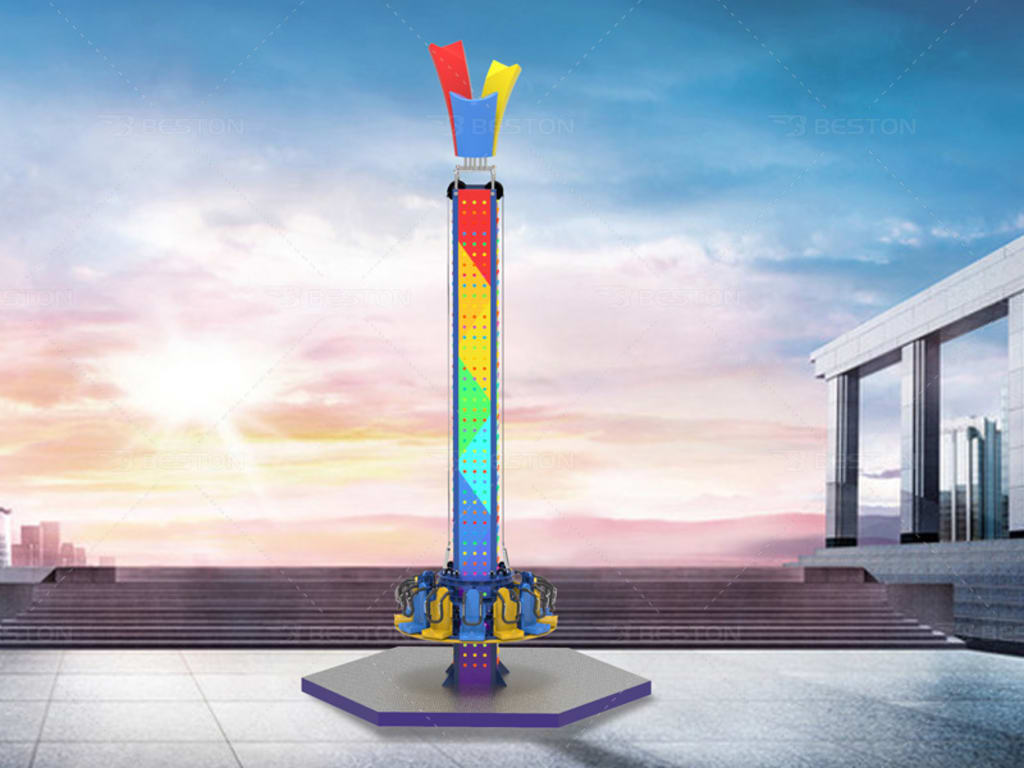
Amusement rides are engineered spectacles of motion, acceleration, and controlled chaos. Behind every moment of freefall or dizzying swing lies a disciplined framework of classical mechanics—specifically, the interplay between gravitational forces, inertia, and centripetal acceleration. From the towering descent of a drop tower to the sweeping arc of a pendulum amusement ride, gravity is not simply a background force—it is the principal architect of thrill.
Gravitational Acceleration as a Ride Engine
In the context of amusement rides, gravity is not merely an external constraint; it is harnessed as an active source of kinetic energy. The standard acceleration due to gravity—9.81 m/s²—becomes the baseline upon which ride dynamics are calculated.
Rides such as the drop tower rely almost entirely on gravitational pull to generate the principal motion. When passengers are lifted to the apex of the structure and released, their descent is driven by Earth's gravitational force alone. This produces a state of near-weightlessness, known as freefall, until mechanical brakes or magnetic systems safely decelerate the descent near ground level.
Key variables include:
Drop height (h)
Gravitational acceleration (g)
Time of descent (t = √(2h/g))
Impact velocity (v = √(2gh))
The predictable nature of gravitational acceleration allows precise calibration of descent time, impact velocity, and braking zones—ensuring safety alongside excitement.
Pendulum Dynamics in Ride Motion
The pendulum amusement ride exemplifies harmonic motion under the influence of gravitational torque. Structurally, this type of ride mimics a compound pendulum—an extended arm rotating about a pivot point with passengers seated at the extremity.
The oscillatory motion is governed by:
Angular displacement (θ)
Moment of inertia (I)
Restoring gravitational torque (τ = -mgL sinθ)
Period of oscillation (T ≈ 2π√(L/g)) for small angles
For large angular excursions, as in modern pendulum amusement ride designs, nonlinear dynamics dominate. Engineers must calculate beyond simple harmonic approximations to model angular velocity, maximum acceleration, and centripetal forces accurately.
At peak swing, riders momentarily experience reduced effective weight—a product of gravitational vector cancellation. At the nadir of the swing, gravitational and centripetal accelerations combine, producing high g-force loads that must remain within biomechanical tolerance levels, typically under 5 g for commercial applications.
Center of Mass and Ride Stability
In gravitational systems, the center of mass is a pivotal parameter for equilibrium and dynamic response. For a drop tower, structural stability is ensured by aligning the tower's center of mass along the vertical axis of support, reducing oscillations due to wind loading or uneven descent.
In pendulum systems, counterweights and distribution of mass influence:
Pivot torque resistance
Maximum attainable angle
Amplitude damping characteristics
Designers use computational fluid dynamics (CFD) and finite element analysis (FEA) to simulate how gravitational vectors act on asymmetrical loading or during emergency scenarios, such as sudden stop or misalignment during swing motion.
Potential and Kinetic Energy Transformations
Every amusement ride exploiting vertical displacement is a real-time demonstration of energy conservation. At their core, rides convert gravitational potential energy into kinetic energy and vice versa.
For example:
In a drop tower:
Potential Energy (PE) = mgh
Kinetic Energy (KE) = ½mv²
In a pendulum ride:
Energy transitions cyclically from potential (at peak height) to kinetic (at lowest point)
Friction, air resistance, and mechanical damping convert some of this mechanical energy into thermal or sound energy. To compensate, rides often require auxiliary propulsion systems (e.g., motors or pneumatic launchers) to initiate or sustain motion against dissipative losses.
Freefall and Perception of Weightlessness
A key thrill factor in gravitational rides is the engineered illusion of weightlessness. In freefall, riders experience a temporary nullification of normal force—the body’s usual response to gravitational pull.
This occurs because both the passenger and the ride structure are accelerating downward at the same rate (g), resulting in:
Apparent weight = 0 N
Normal force = 0 N
Net acceleration = g (relative to ground), 0 (relative to ride)
This biomechanical condition, while short-lived, produces intense sensory feedback due to the vestibular system's response to rapid elevation change and inertial variance. It is the physiological equivalent of being in orbit, albeit for seconds rather than hours.
Centripetal Force and Radial Acceleration
In rotational rides, especially those involving pendular or circular motion, centripetal force plays a dominant role. This inward-directed force ensures that the rider follows a curved trajectory rather than moving tangentially.
In a pendulum amusement ride, the centripetal force (Fc) at the bottom of the swing is calculated as:
Fc = mv²/r
Where:
m = rider mass
v = tangential velocity
r = radius from pivot to rider
At high speeds, this force can be several times the gravitational pull, contributing to the perceived “push” into the seat—a stark contrast to the weightlessness felt at the top of the swing arc. Accurate computation of this force is vital to structural integrity and passenger safety.
Inertial Frames and Safety Engineering
Amusement rides often transition between inertial and non-inertial frames. From a physics standpoint, non-inertial frames introduce fictitious forces—such as centrifugal force—that must be accounted for in engineering models.
In a drop tower, the moment of release shifts the system from a static to a dynamic inertial frame. Safety restraints and deceleration systems must engage within precise time windows to counteract the momentum acquired during the descent.
In pendulum systems, riders experience lateral and vertical forces that vary rapidly in direction and magnitude. As a result, restraint systems must provide multi-directional containment while maintaining rider comfort.
Safety engineering must consider:
Dynamic load analysis under extreme g-forces
Redundant braking systems in gravitational accelerators
Real-time ride monitoring to track motion profile and deviation
Biomechanical modeling to correlate force curves with human tolerances
Conclusion
The operation of amusement rides is not merely entertainment—it is applied physics in motion. Gravity serves as the foundational force, dictating the tempo, structure, and sensory impact of rides like the pendulum amusement ride and drop tower. Through rigorous application of mechanical principles, energy conservation laws, and inertial dynamics, ride engineers craft experiences that are as scientifically precise as they are thrilling. As ride technology evolves, the mastery of gravitational physics will remain the cornerstone of innovation, safety, and exhilaration.
About the Creator
Beston Amusement Rides
As a leading amusement facility manufacturer, we provide safe and interesting amusement equipment to customers around the world, including roller coasters, Ferris wheels, pirate ships and so on.
Website:https://bestonamusementrides.com/
Keep reading
More stories from Beston Amusement Rides and writers in Journal and other communities.
Precision in Play: Engineering Safety in Children's Amusement Rides
Children’s amusement equipment must meet rigorous safety criteria to ensure a secure environment without compromising the essence of play. Safety is not incidental—it is engineered. Whether designing a wacky worm roller coaster or a self-control plane, the process must reflect an uncompromising commitment to accident prevention, user appropriateness, and operational resilience.
By Beston Amusement Rides11 months ago in Journal
Author’s Advice
If you would’ve asked me 20 years ago did I know I’d become a writer and an author, I would’ve said “nope, ain’t happening”. As fate would have it I did become an author and I can honestly say I’m loving it so far. It really does feel good to be a writer. I’ve learned a lot on this journey and I feel like with even me being as new to this world as I am, there’s some wisdom I need to share with every other aspiring author.
By Joe Patterson2 days ago in Journal
Lycan Lore
As the students of my 10am mythology class take their seats, I decide to steer the day's curriculum away from Greek and dive into a Western European discourse on the misaligned beliefs of the Werewolf. A tale of truth or fiction. No one really knows.
By Lamar Wigginsabout 23 hours ago in Fiction



Comments
There are no comments for this story
Be the first to respond and start the conversation.