
Energy Transition Index: How the Brazil Renewable Energy Market Compares Globally
Brazil is a top-tier performer, ranking 12th globally on the World Economic Forum's Energy Transition Index (ETI) with a score of 65.7.

The global race to net-zero is intensifying, but one nation is already running a different race. The Brazil renewable energy market stands as a global anomaly, boasting a green grid that most developed nations can only dream of achieving by 2050. While other countries struggle to phase out coal, Brazil ranks impressively high on the Energy Transition Index. But what do the numbers actually say? According to the IMARC Group, the market size is set to reach USD 17.4 billion in 2025, proving that sustainability and profitability can go hand in hand.
This article explores how Brazil compares to the world's superpowers. We will analyze the latest data, forecast trends, and explain why this South American giant is winning the clean energy battle.
How Large is the Brazil Renewable Energy Market Today?
The market is a financial powerhouse, currently valued at USD 17.4 billion for 2025. Furthermore, analysts predict a robust upward trajectory over the next decade.
Specifically, the IMARC Group forecasts the sector will grow to USD 31.0 billion by 2034. This represents a steady Compound Annual Growth Rate (CAGR) of 6.60% between 2026 and 2034. Several factors fuel this expansion. First, Brazil possesses enviable natural resources, including high solar irradiance and consistent wind patterns. Second, government initiatives continue to attract foreign investment. Consequently, the market is not just stable; it is accelerating, with solar and wind segments leading the charge toward a cleaner future.
Where Does Brazil Rank on the Global Energy Transition Index?
Brazil is a top-tier performer, ranking 12th globally on the World Economic Forum's Energy Transition Index (ETI) with a score of 65.7.
This ranking places Brazil in an elite category, significantly ahead of the world's largest economies. For comparison, the United Kingdom ranks 13th, China ranks 17th, and the United States ranks 19th. Additionally, Brazil holds the #1 position in Latin America, serving as a regional beacon for decarbonization. This high score reflects Brazil's long-standing commitment to renewable infrastructure. While other nations are currently building their foundation, Brazil is optimizing an already mature green network.
How Does Brazil’s Energy Mix Compare to the Global Average?
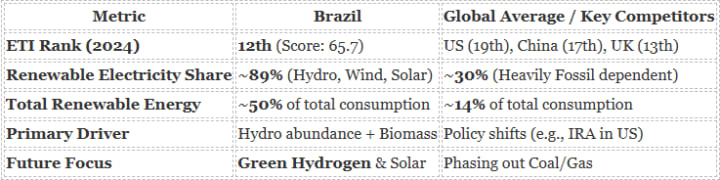
Brazil is a statistical outlier; its electricity matrix is roughly 89% renewable, whereas the global average sits near 30%.
Historically, Brazil has relied heavily on hydroelectric power. However, recent years have seen a massive diversification into wind, solar, and biomass. In contrast, the global energy mix still leans heavily on fossil fuels like coal and natural gas. When we look at the Total Energy Matrix (which includes transport fuels), renewables still account for nearly 50% of Brazil's consumption. This is almost four times higher than the global average of roughly 14%. Thus, Brazil effectively operates in a different league regarding carbon intensity.
Brazil vs. The World: Who Is Greener?
Brazil wins on current infrastructure and implementation, while major economies are scrambling to catch up through massive new investments.
To help you visualize this disparity, we have compiled a comparison of the Brazilian renewable energy market against global standards.
What Are the Key Drivers Behind This Market Growth?
Abundant natural resources combined with strategic government incentives, such as Proinfa, drive this exceptional growth.
Brazil does not need to import its energy potential; it grows it and harvests it. The country utilizes its massive agricultural sector to fuel a booming biomass energy trend. Simultaneously, the Northeast region acts as a "Saudi Arabia of Wind," offering some of the best capacity factors in the world. Moreover, the photovoltaic expansion is exploding as costs drop. Investors are also eyeing Green Hydrogen potential, seeing Brazil as a future export hub for clean fuel. Therefore, the drivers are structural, making the market resilient to external shocks.
What's Next?
Brazil is not just participating in the energy transition; it is leading it. With a market heading toward USD 31.0 billion and a ranking that beats the world's superpowers, the Brazilian renewable energy market is a blueprint for success. As the world strives to meet the Energy Transition Index goals, Brazil proves that a green economy is possible, profitable, and scalable.
About the Creator
Joey Moore
I'm Joey Moore, a seasoned Research Analyst with 5+ years of experience in market research. Expert in data analysis, strategic planning, and industry insights. Proven track record in delivering actionable reports.
Keep reading
More stories from Joey Moore and writers in Journal and other communities.
Traditional vs Smart Toys: Who Is Winning the Battle for the Europe Toys Market?
The battle between nostalgic wooden blocks and AI-powered robots is heating up. As the Europe toys market evolves, parents face a difficult choice: should they embrace the future with Traditional vs Smart Toys, or stick to the classics? This isn't just about fun; it is about child development, privacy, and economic value. According to recent data from the IMARC Group, the European market reached a massive USD 27.82 billion in 2024, proving that the appetite for play is stronger than ever.
By Joey Mooreabout 24 hours ago in Journal
~ Fired ~
— Ai Intrusion ~ Are you Next ~ Is Ai Evolution after your job? — Few workplaces haven't been affected. Ai is in supermarkets, at doctors' offices, and even monitoring farms. I just can't think of anything this machine is not getting into, can you? For instance: Education ~ Law and Tech jobs will one day have a major influence or be taken over by these inanimate machines, with accuracy and vigor. From mechanics' diagnoses to a wide variety of everyday jobs, including fast food workers, with this input having the ability to cut their unnecessary work hours. I'm certain all of us have been touched by this with our short stories and colorful headings, have you? Even comments are very questionable 'Non-Robot' insertions.
By Jay Kantor6 days ago in Journal
Air Independent Propulsion: Redefining Undersea Persistence in Conventional Submarines
Introduction: Beyond the Limits of Diesel-Electric Submarines For decades, conventional diesel-electric submarines have operated under a fundamental constraint: the need for atmospheric oxygen. While batteries allow submerged operations, periodic surfacing or snorkeling is unavoidable for recharging, creating predictable detection windows. Air Independent Propulsion (AIP) emerged as a response to this vulnerability, offering a method to sustain underwater operations without access to air and reshaping the operational relevance of non-nuclear submarines.
By Beckett Dowhan3 days ago in Journal
Choose Your Own Adventure: St Helena Station
*****Preface***** I have been obsessed with Choose Your Own Adventure stories since I was a kid. I credit them with my love of reading and writing. I've been struggling to get my own kids to embrace words the same way I have but they love video games and our occasional Dungeon's and Dragon's game... which gave me an idea. I'll write an interactive story. So far its working; my middle son loves it and can't wait for the next section to come out.
By Sandor Szabo2 days ago in Fiction


Comments
There are no comments for this story
Be the first to respond and start the conversation.