
Earthquake Jolts California's Bay Area; Residents Report Shaking
Earthquake Jolts California’s Bay Area: A Wake-Up Call from Beneath the Ground

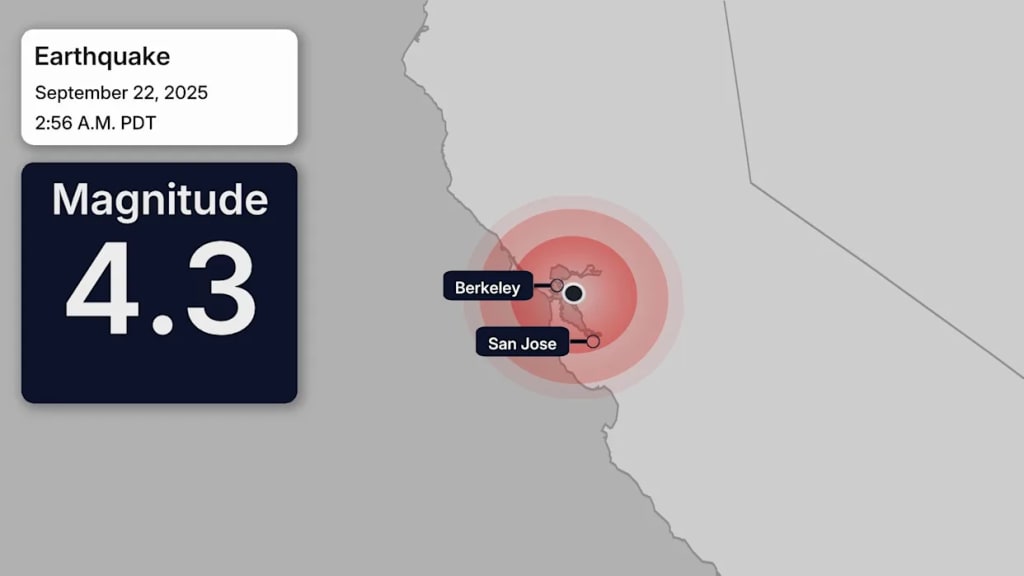
In the stillness of the early morning hours, when most of California’s Bay Area was wrapped in slumber, the earth had other plans. At precisely 2:56 a.m. local time on Monday, September 22, 2025, a magnitude 4.3 earthquake jolted residents awake, sending ripples of unease across one of America’s most populous and earthquake-prone regions.
The U.S. Geological Survey (USGS) confirmed that the quake’s epicenter was just over a mile east-southeast of Berkeley, at a relatively shallow depth of 5 miles. While no serious injuries or damages were reported, the shallow nature of the tremor magnified the shaking felt across neighborhoods, making even a moderate quake seem much stronger than it was.
From San Francisco to Oakland, Berkeley to Richmond, and even parts of San Jose, residents took to social media within minutes, sharing stories of rattling furniture, swaying light fixtures, barking dogs, and sleepless nights.
This wasn’t just another seismic event—it was a reminder of California’s fragile relationship with the ground beneath its feet.
The Anatomy of the Bay Area Quake
Earthquakes in the Bay Area are nothing new, but each one carries its own story. The September 22 quake was:
Magnitude: 4.3 (preliminary)
Epicenter: Near Berkeley, California
Depth: 5 miles (shallow quakes cause more intense surface shaking)
Time: 2:56 a.m. PT (5:56 a.m. ET)
The shallow depth is what made this quake feel particularly sharp for thousands of residents. According to seismologists, shallow earthquakes allow seismic waves to reach the surface more quickly, intensifying the shaking experience even if the magnitude is not catastrophic.
The quake lasted only seconds, but its impact lingered for hours as residents replayed the experience in their minds, wondering if this was just a foreshock of something bigger to come.
Social Media Reaction: California’s New Seismic Diary
In today’s digital age, earthquakes are not just geological events—they are social moments. Within minutes, platforms like X (formerly Twitter), TikTok, Instagram, and Facebook were buzzing with updates.
Some users described the quake as a “strong jolt that felt like someone slammed a door.” Others compared it to the unsettling feeling of a train passing under the house.
Memes appeared almost instantly:
One viral post showed a Bay Area resident holding a coffee mug with the caption: “Earthquake at 3 a.m.? Guess I’m up now.”
Another featured a dog hiding under a blanket with the words: “California security system activated.”
The earthquake once again showcased how Californians use humor to cope with the reality of living on shifting ground.
A History Written in Tremors: Why the Bay Area is So Seismically Active
California’s Bay Area sits precariously close to the San Andreas Fault System, one of the most studied—and feared—fault lines in the world.
Key historical quakes remind us of what lies beneath:
1906 San Francisco Earthquake (Magnitude ~7.9): One of the deadliest in U.S. history, it devastated the city and killed more than 3,000 people.
1989 Loma Prieta Earthquake (Magnitude 6.9): Struck during the World Series, collapsing highways and killing 63 people.
2014 Napa Earthquake (Magnitude 6.0): Caused nearly $1 billion in damages, injuring hundreds.
Compared to these, the 2025 Berkeley quake was minor—but it taps into a collective memory of destruction that runs deep in the region’s psyche.
Scientists Weigh In: What Does This Mean?
Seismologists from the USGS and UC Berkeley Seismology Lab were quick to assure the public that this was not the “Big One.”
Dr. Angela Morales, a seismologist at UC Berkeley, explained:
“A 4.3 earthquake is moderate in scale. While it’s felt widely, it’s not unusual for this region. The shallow depth amplified the shaking, but we do not currently see evidence that this is a precursor to a larger quake.”
However, she also noted that the Bay Area is overdue for a major quake on the Hayward Fault, which runs directly beneath cities like Oakland, Berkeley, and Fremont.
Residents React: Stories from the Ground
For many, the quake was a startling interruption to their night.
John, a student at UC Berkeley, said: “I thought my roommate was shaking my bed as a prank. Then I realized the whole building was moving.”
Maria, a nurse in Oakland, shared: “I jumped out of bed and checked on my kids. They were terrified, asking if the house was falling.”
Kevin, a tech worker in San Francisco, admitted: “I didn’t even get up. I just tweeted about it. That’s California life.”
These firsthand accounts reveal the blend of fear, nonchalance, and resilience that defines Californians in the face of earthquakes.
Earthquake Preparedness: A Wake-Up Call for Californians
Every quake is a reminder that preparedness is not optional in California—it’s essential. Experts recommend:
Create an Earthquake Kit: Include water, non-perishable food, flashlights, batteries, first-aid supplies, and cash.
Know the “Drop, Cover, and Hold On” Rule: Drop to the ground, cover your head and neck, and hold on until the shaking stops.
Secure Heavy Furniture: Anchor bookshelves, TVs, and appliances to walls.
Have a Family Plan: Decide on meeting points and communication strategies.
Download Earthquake Apps: The MyShake app sends early alerts seconds before shaking begins.
The Berkeley quake, though minor, underscores the unpredictability of seismic activity. Preparedness saves lives.
Economic Impact: Why Even Small Quakes Matter
While no immediate damages were reported, earthquakes—even small ones—carry economic consequences:
Disruptions in transit: BART trains were briefly slowed as officials conducted safety checks.
Insurance claims: Even small cracks or damages can lead to property claims.
Business interruptions: Early morning quakes often lead to work delays, particularly in the tech sector.
California’s economy is massive, and every tremor—even symbolic—reminds investors and residents of the risks tied to living in an earthquake zone.
Looking Ahead: Is the “Big One” Coming?
The question on everyone’s mind: Does this mean the Big One is near?
Scientists caution against making direct connections. Earthquakes of magnitude 4 to 5 are common in California and often relieve pressure rather than build toward catastrophe.
Still, the Hayward Fault is considered “one of the most dangerous in America,” and experts believe a magnitude 6.7 or greater quake has a 72% chance of hitting the Bay Area within the next 30 years.
In other words: this quake wasn’t the Big One, but it was a reminder that it’s not a matter of if—it’s a matter of when.
Conclusion: A Shake, A Reminder, A Warning
The September 22, 2025 Bay Area earthquake may not go down in history as a destructive event, but it will be remembered as another wake-up call.
For residents, it was a reminder to check their emergency kits, talk to their families about safety plans, and remember the region’s seismic reality. For scientists, it was another data point in the endless quest to understand the earth’s movements. For the nation, it was a headline that once again highlighted California’s unique vulnerability.
The quake may be over, but the lessons are ongoing: in California, the ground may rest for a while, but it never truly sleeps.
About the Creator
Omasanjuwa Ogharandukun
I'm a passionate writer & blogger crafting inspiring stories from everyday life. Through vivid words and thoughtful insights, I spark conversations and ignite change—one post at a time.
Keep reading
More stories from Omasanjuwa Ogharandukun and writers in Journal and other communities.
Charlie Kirk Memorial 2025
Introduction: A Nation Pauses for Charlie Kirk On September 21, 2025, the American conservative movement gathered in Glendale, Arizona, for one of the largest political memorials in recent history. More than 100,000 people filled the State Farm Stadium, home of the Arizona Cardinals, to mourn the death and celebrate the life of Charlie Kirk—the 31-year-old conservative activist, commentator, and founder of Turning Point USA, who was tragically shot dead just days earlier.
By Omasanjuwa Ogharandukun4 months ago in Journal
Discover the Hidden Wonders of the Everest High Pass Trek
There is a trail in the Himalayas that promises adventure, awe, and memories that last a lifetime. The Everest Three High Passes Trek is one of the most thrilling journeys you can take in Nepal. It goes beyond the classic Everest Base Camp trek, taking you over three high passes, each offering incredible views, serene villages, and a chance to experience the heart of the Himalayas. If you are ready to discover hidden wonders, this trek is calling your name.
By Olivia Flores2 days ago in Journal
How to Succeed at the Benson Directory®
Congratulations and welcome to the Benson Directory® employee #22391! As our newest call handler, you will have the privilege of speaking with dozens of unique and interesting people on a daily basis as well as the opportunity to earn bonuses for high performance. Contained within this handbook you will find a set of ease to follow instructions designed to help you settle in to your new role and begin paving the way to success.
By S. A. Crawford4 days ago in Fiction


Comments
There are no comments for this story
Be the first to respond and start the conversation.