
Earth's Second Moon
All You Need To Know

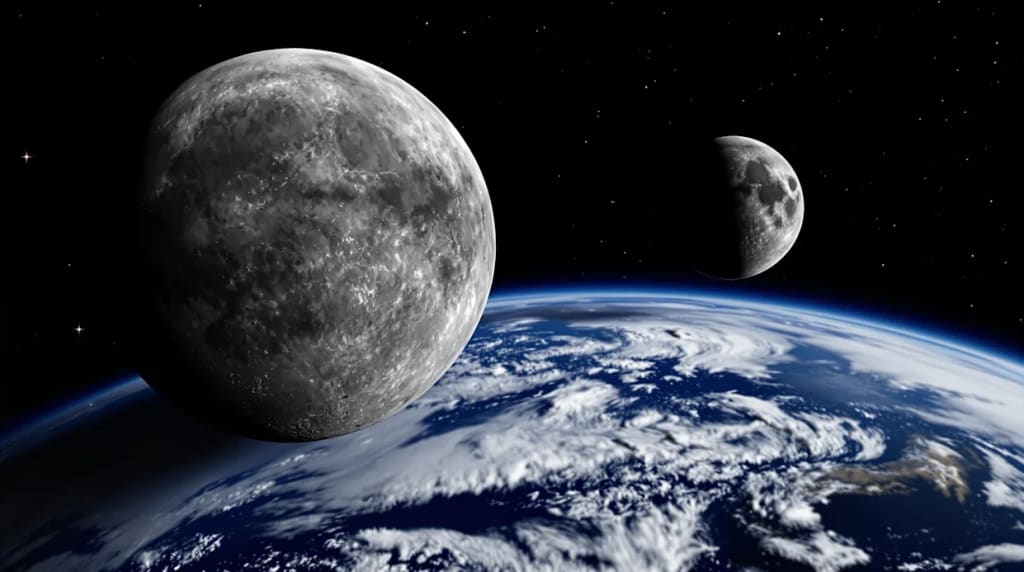
For billions of years, Earth has danced alone under the gentle gaze of a single, loyal companion — the Moon. But 2025 changed the rhythm of that cosmic waltz. NASA has just confirmed that Earth, for the first time in living memory, has picked up a second partner in its celestial choreography: a quasi-moon named **2025 PN7**.
This discovery feels like finding out your planet has a secret admirer — one who’s been quietly pacing your every move for 60 years. The new cosmic companion isn’t a massive marble like our Moon; it’s more like a pebble skipping beside a giant, modest in size but rich in mystery. And if predictions hold true, it’ll stay in Earth’s shadowy company until **2083**, before quietly drifting back into the cosmic sea.
🌙 The Little Moon That Could
Imagine jogging on a track and suddenly noticing someone running beside you — same pace, same stride, just far enough away to never touch. That’s 2025 PN7. Discovered by astronomers at the **University of Hawaii’s Pan-STARRS telescope**, this asteroid orbits the Sun in almost perfect sync with Earth. It’s not our satellite in the traditional sense — it doesn’t orbit our planet directly — but its orbit mirrors ours so closely that it looks like it’s circling us.
The cosmic hitchhiker is tiny — just **18 to 36 meters wide**, about as tall as a three-story building. By astronomical standards, that’s minuscule, yet its presence is monumental. Because what it represents isn’t just another rock in the void — it’s a rare class of celestial companion called a **“quasi-moon.”**
These are the cosmic wallflowers of the solar system — shy, faint, and often unnoticed, yet moving in harmony with our planet as if drawn to its rhythm.
🌀 How Earth Found Its Shadow Dancer
It wasn’t easy spotting this hidden partner. Earlier this year, during a routine telescope survey, astronomers noticed a faint speck moving against the backdrop of stars. At first glance, it seemed unremarkable — another small asteroid, one of millions. But when they tracked its motion night after night, something strange emerged.
It wasn’t drifting away like most space rocks. It was **moving in perfect sync** with Earth’s orbit — as if it had been following us for decades. When NASA analyzed the data, the results were stunning: **2025 PN7 had been traveling with us since the 1960s.**
Think about that — for over half a century, through moon landings, the birth of the internet, and the rise of AI, this quiet rock has been gliding beside us, unseen.
At its closest, it comes within **4 million kilometers** of Earth — about ten times farther than our Moon. At its farthest, it swings out to 17 million kilometers, tugged by the competing gravities of the Sun, Earth, and neighboring planets.
It’s a celestial tango — gravity and inertia locked in an elegant push and pull that keeps 2025 PN7 forever near, yet never bound.
🌍 Why “Quasi-Moon” Matters
If the Moon is Earth’s lifelong partner, 2025 PN7 is the friendly stranger who joins the dance for a few rounds. Astronomers have confirmed **only eight quasi-moons** in total, making them one of the rarest orbital phenomena in our solar system.
Each one offers scientists a glimpse into the dynamic ballet of gravity — how small bodies move through space, how Earth’s mass influences nearby objects, and how certain asteroids can temporarily lock into step with our orbit.
They also hold practical promise. Because quasi-moons are relatively close and stable, they make ideal **testbeds for future space missions**. Instead of spending billions to chase distant asteroids, researchers could study these nearby companions — practicing landing maneuvers, mining techniques, or spacecraft navigation.
In essence, 2025 PN7 might be **the perfect cosmic lab**, orbiting right next door.
️ A Cosmic Relay of Companions
2025 PN7 isn’t alone in Earth’s extended neighborhood. It joins an exclusive club of celestial hitchhikers like **Kamoʻoalewa**, **Cardea**, and **2023 FW13**, each of which shared time near Earth before eventually slipping away.
What makes PN7 unique is its stability and longevity. According to NASA’s orbital models, it has been **in a 1:1 resonance with Earth** — meaning it takes exactly the same time to orbit the Sun as we do — for around **60 years**, and will likely stay that way for another **half-century**.
Its orbit shifts over time, sometimes resembling a **horseshoe** around Earth, and other times forming a looping **quasi-satellite** path. These transitions are caused by the gravitational ballet between the Earth, Sun, and even Jupiter, which subtly nudge the asteroid’s position.
It’s like watching a dancer change partners mid-performance but still stay perfectly on beat.
🔭 The Hidden Beauty of the Unseen
One reason 2025 PN7 stayed undetected for so long is its **dimness**. Unlike the Moon, which shines in borrowed sunlight, this small asteroid reflects barely any light at all. Detecting it is like spotting a grain of dust drifting through a darkened room — visible only when the angle is perfect.
Yet therein lies the poetry of discovery. In the vast emptiness of space, something so small and faint has managed to **move in lockstep with our world** for generations.
Scientists describe these quasi-moons as “temporary travelers,” but there’s something deeply human about that phrase. After all, aren’t we all temporary travelers — spinning around the Sun for a brief moment in cosmic time, leaving traces for those who’ll follow?
🧭 What This Means for Science
Beyond its beauty, the discovery of 2025 PN7 could help **refine our understanding of orbital mechanics**. By studying how quasi-moons move, scientists can improve models that predict asteroid paths — a critical step for protecting Earth from potential impacts.
Moreover, quasi-moons could play a key role in **future exploration**. Their proximity makes them excellent candidates for robotic missions. Unlike Mars or the outer planets, these asteroids are **close, accessible, and constantly moving with us**, reducing fuel costs and travel time.
Imagine launching a spacecraft to study an object that’s been our silent companion for decades. Imagine mining resources from it, or testing propulsion systems for deeper space journeys. 2025 PN7 may be tiny, but its potential impact on science and technology could be **planet-sized**.
🌌 Philosophical Reflections: A Mirror in the Void
There’s something profoundly symbolic about this discovery. While humanity grapples with conflict, climate change, and technological revolution, a silent rock has been following us — steady, patient, and indifferent.
It’s a reminder that in the grand clockwork of the cosmos, **Earth is not alone**, nor is it the center of the story. We’re part of a vast, interconnected system, full of unseen harmonies and unexpected companions.
The existence of 2025 PN7 suggests that even in the dark reaches of space, there are echoes of connection — cosmic proof that even planets can find fleeting friendship.
🕰️ The Countdown to Goodbye
Like all good stories, this one comes with an ending. Sometime around **2083**, the gravitational balance that holds 2025 PN7 near Earth will finally shift. Slowly, gracefully, it will begin to drift away — back into the infinite theater of space, its brief partnership with our planet complete.
It won’t make headlines then. There won’t be fireworks or farewells. But somewhere, an astronomer will watch its fading signal and remember that, for a few decades, **Earth had two moons** — and that even the smallest visitor can remind us of the vastness we inhabit.
🚀 Final Thoughts: Our Cosmic Waltz
2025 PN7 isn’t just a scientific discovery. It’s a **cosmic metaphor** — for connection, impermanence, and the quiet beauty of things that move with us unseen.
In a world obsessed with the loud, the bright, and the immediate, this faint asteroid teaches us patience. It teaches us that even the smallest traveler can share our journey around the Sun, that not all companions must be grand to be meaningful.
For now, as the Earth spins and humanity gazes upward, we are not alone in our orbit. Somewhere out there, **a tiny rock keeps pace with our dreams**, circling the same star, tracing the same path, whispering across the silence of space:
*“You’re not alone, even among the stars.”*
About the Creator
Omasanjuwa Ogharandukun
I'm a passionate writer & blogger crafting inspiring stories from everyday life. Through vivid words and thoughtful insights, I spark conversations and ignite change—one post at a time.
Keep reading
More stories from Omasanjuwa Ogharandukun and writers in Journal and other communities.
Was Trump Response To "No King" Marches AI Generated?
Imagine hundreds of threads woven into a grand design, each representing a person, a voice, a belief. Now picture one thread pulling so hard it distorts the weave. That’s the metaphor at the heart of the “No Kings” protests and Donald Trump’s response: one leader straining to dominate, while millions push back, tugging the tapestry toward balance.
By Omasanjuwa Ogharandukun3 months ago in Journal
How People Are Building Passive Income With Simple Websites and AI
Let’s be honest: if you’ve spent any time online lately, you’ve probably seen all the loud promises about making passive income with AI. “Set it and forget it!” “Earn six figures in your sleep!” “AI will do all the work for you!”
By ELIA MWAPINGA2 days ago in Journal
Violence Begets
"Any last words, cowboy?" "None you'd understand, sodbuster." "Funny. That's Marshall Sodbuster to you. But I meant some last nugget that would help us in the adjudication of the myriad offenses counted against you and your gang. I wasn't asking for penitence."
By Adam Diehl4 days ago in Fiction


Comments
There are no comments for this story
Be the first to respond and start the conversation.