
eBook Conversion Challenges and Expert Solutions
Tackle eBook conversion challenges with expert strategies to ensure your book is formatted correctly and accessible across various platforms.

Introduction:
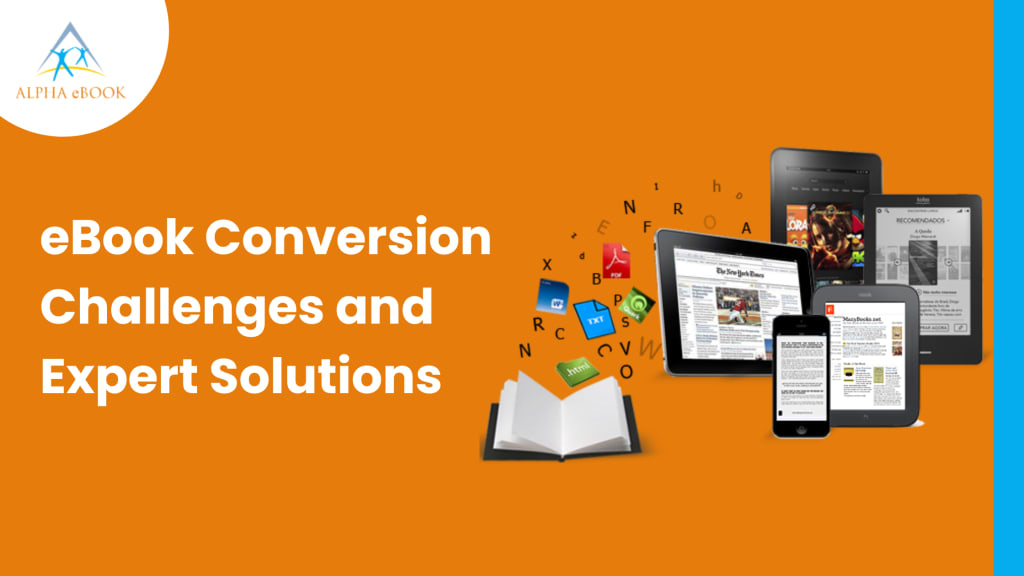
eBooks have quickly become one of the most popular formats for sharing information and stories, thanks to the rise of self-publishing platforms and the growing use of eBook readers.
Many publishers and authors are using eBook conversion services to transform their works into digital formats. However, this process comes with its own set of challenges, including issues related to formatting, accessibility, and device compatibility. If these challenges are not addressed, they can compromise the reader's experience.
This article will cover the most common eBook conversion challenges and offer expert solutions for effectively overcoming them.
7 Conversion Issues and How to Fix Them
Source Content Quality Matters
One key challenge in eBook conversion is ensuring the source content is of high quality. Low-resolution images, inconsistent typography, and faded text can hinder the conversion process and degrade the final product.
Intricate layouts, such as handwritten notes, fragile pages, or complex illustrations, require extra care to preserve their integrity during conversion.
Solution: eBook conversion services specialists must collaborate closely with publishers, librarians, and conservators when working with historical manuscripts or fragile materials. For instance, books that cannot lie flat may require specialized scanning equipment.
Careful planning and detailed evaluation of the source materials help ensure that content is properly preserved during the digital transformation.
Format Selection Isn't One-Size-Fits-All
Deciding on the correct format for your eBook is critical. ePUB has become the standard format for most platforms, including Kindle.
While Amazon still converts ePUB files to its own proprietary formats, such as AZW3 or KPF, using ePUB ensures compatibility across a wide range of devices.
PDFs may still be preferred for image-heavy content or documents meant for print, but they can present formatting challenges on smaller screens.
Selecting a single format without considering distribution platforms can lead to compatibility issues, limiting the eBook's accessibility.
Solution: To avoid compatibility issues, ensure your eBook is available in multiple formats, with ePUB as the default for most platforms. This guarantees that your eBook can be read seamlessly across different devices, providing a smooth experience for a broad audience.
Accessibility Standards Should Not Be Overlooked
Ensuring accessibility is another important aspect of eBook conversion. Making an eBook accessible means complying with global standards like WCAG, which guarantees that all readers, including those with disabilities, can access the content.
Failing to meet these standards can limit the eBook's reach and may even lead to legal implications in certain regions.
Solution: Implement accessibility features like alt text for images, proper navigation, and compatibility with screen readers. Collaborating with professionals experienced in accessibility coding ensures your eBook fully complies with these standards, allowing you to reach a diverse and inclusive audience.
Handwritten Content Poses Special Challenges
Converting handwritten manuscripts is often more complex than dealing with printed text. OCR (Optical Character Recognition) technology, while powerful, can struggle to accurately interpret handwriting, particularly if the content is faded or written in a non-standard style. This can lead to errors in the final eBook.
Solution: Combining OCR technology with manual proofreading is the best approach for handwritten content. Manual transcription may be necessary to ensure accuracy for older or more fragile documents.
This careful blend of technology and human oversight guarantees that the eBook remains faithful to the original manuscript.
Handling Complex MathML Content
Tables, charts, and mathematical equations can present unique hurdles during eBook conversion. While MathML is the preferred format for handling mathematical content, it's not universally supported by all platforms.
This can result in discrepancies when displaying complex content like equations. Similarly, charts and tables may lose their structure or become difficult to read on smaller devices.
Solution: Thoroughly test complex content across different devices and platforms, such as mathematical equations and tables. Where MathML support is lacking, high-resolution images can be used as an alternative.
Additionally, optimizing charts and tables for responsive design ensures they remain readable on smaller screens, improving the user experience across devices.
Testing Across Multiple Devices Is Essential
A common issue in eBook conversion is the assumption that it will display correctly on all devices once an eBook is converted.
However, different eBook readers can render content differently, and what works on a Kindle might not display well on a smartphone or tablet. Overlooking this step can lead to inconsistencies in the reader's experience.
Solution: Testing your eBook on a wide range of devices is critical to ensuring that it looks and functions as expected, regardless of the platform.
By thoroughly testing the formatting, readability, and functionality across various devices and operating systems, you can guarantee a consistent and high-quality reading experience for all users.
Managing Large-Scale Conversions Effectively
Converting large volumes of content can bring additional layers of complexity. Handling hundreds or thousands of pages with unique layouts and content variations requires meticulous project management.
Without a clear workflow, inconsistencies, such as misplaced images, formatting errors, or missing sections, are risky.
Solution: Break the project into manageable sections and prioritize content that requires special attention. Effective collaboration between the project team and eBook conversion professionals ensures that even large-scale projects are executed smoothly.
Planning and staying organized throughout the process will help maintain consistent quality across the entire conversion.
Overcoming Conversion Obstacles with Professional eBook Conversion Service
eBook conversion is a process filled with technical and creative challenges, from handling delicate source materials to ensuring compatibility across multiple platforms. Understanding and taking a structured approach to address these challenges is key to delivering a high-quality, accessible eBook.
Partnering with an experienced eBook conversion company offers the expertise needed to navigate these complexities, ensuring that your eBook—a current release or a backlist classic—is appropriately formatted, accessible, and ready to reach a global audience.
About the Creator
Darren Meeks
Alpha eBook we provide high-quality, high eBook conversion services to publishers and authors worldwide. We specialize in flowable and fixed layout (ePub and Mobi) compatible with all major devices. Visit our website for more information.
Keep reading
More stories from Darren Meeks and writers in Journal and other communities.
Why Convert Your Book into Multiple eBook Formats
As the demand for digital content grows, offering your book in just one ebook format limits its potential. With readers accessing content on a variety of devices, ebook conversion services are crucial for ensuring that your book is available in formats that suit different reading preferences and technologies.
By Darren Meeksabout a year ago in Journal
The Rise of Electric Aircraft in Business Aviation: A Sustainable Future
The aviation industry has long been known for its significant environmental impact, with business aviation contributing to a large share of emissions from private aircraft. However, as sustainability becomes a more pressing issue, the business aviation sector is looking to electric aircraft as a potential solution. With advancements in electric propulsion systems, blockchain and battery technology, electric aircraft are poised to revolutionize business aviation, offering a cleaner, more efficient alternative to traditional jet fuel-powered aircraft. In this blog, we will explore the rise of electric aircraft in business aviation and how they promise to shape a more sustainable future.
By Beckett Dowhan4 days ago in Journal



Comments
There are no comments for this story
Be the first to respond and start the conversation.