
Digital Marketing Agency vs. Official Yelp Advertising Partner
Chimera Marketing


In today's highly competitive digital landscape, local businesses face a pivotal strategic choice: how to effectively manage their online presence and attract customers. This often involves deciding between a comprehensive Digital Marketing Agency (DMA) or a specialized Official Yelp Advertising Partner (YAP). Making the right choice is paramount for optimizing online visibility, managing reputation, and driving genuine growth. This discussion will dissect the roles, benefits, and critical considerations of each, guiding businesses toward an informed strategic decision.
The increasing complexity of digital platforms and their advertising models naturally leads to a demand for specialized expertise. This suggests that while general DMAs offer breadth, the depth required for specific platforms might necessitate a dedicated partner. This evolution underscores the maturity of the digital marketing industry, where niche expertise can become a significant competitive advantage.
The Broad Spectrum: Digital Marketing Agencies (DMAs)
A Digital Marketing Agency functions as a comprehensive solution for a business's online needs, often described as a "one-stop shop" for improving online presence and expanding brand reach. Their core offerings typically span a wide array of services, including Search Engine Optimization (SEO) for organic visibility, Pay-Per-Click (PPC) advertising (such as Google Ads), social media marketing, content marketing (e.g., blogs and videos), email marketing, web design and development, and online reputation management.
DMAs adopt a holistic strategic approach, understanding how various marketing channels interact and contribute to overarching business objectives. Their aim is to generate organic traffic, cultivate leads, and increase revenue across multiple digital platforms. The benefits of partnering with a DMA include an integrated strategy that ensures brand consistency and synergy across all digital touchpoints.
Businesses gain access to a multidisciplinary team of specialists in SEO, content, web development, and social media, all under one roof. Such a partnership can also be more cost-effective than engaging multiple specialized agencies or building extensive in-house teams for each channel. Furthermore, DMAs offer a big-picture view, analyzing a business's goals, sales funnel, and target audiences to craft a cohesive and impactful strategy.
It is important to understand that "advertising" is a subset of "marketing." While advertising focuses on creative execution and paid or organic outbound initiatives, with performance metrics like impressions and clicks, marketing encompasses the grand strategy, including positioning, pricing, and broader business key performance indicators (KPIs) such as customer acquisition cost and new sales.
A DMA, by covering the broader scope of marketing, aims for a deeper business impact beyond mere ad performance. This distinction implies that businesses must determine if their immediate need is purely ad execution or a foundational, long-term strategic overhaul of their digital presence. A DMA is generally better suited for the latter, providing strategic guidance that aligns with overall business growth.
The Specialized Edge: Official Yelp Advertising Partners (YAPs)
An Official Yelp Advertising Partner (YAP) is a third-party advertising agency formally certified by Yelp to manage Yelp Ads campaigns and business profiles. These partners are not Yelp employees; rather, they serve as intermediaries, working on behalf of businesses. To achieve certification, YAPs must pass specific exams and meet certain requirements for product expertise and ad spend.
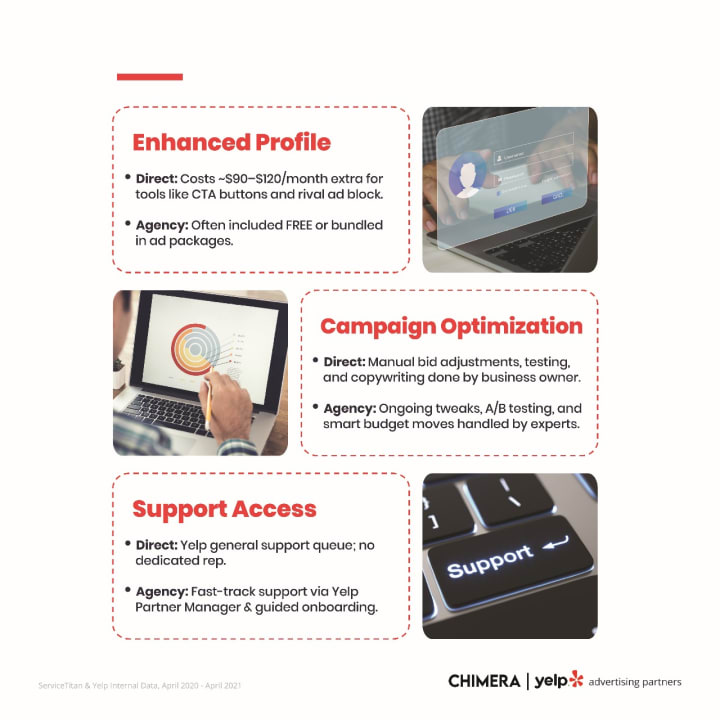
YAPs offer a highly focused approach to maximizing a business's presence on Yelp, providing distinct advantages often unavailable to direct advertisers. These include access to exclusive tools and data through a special agency dashboard, enabling superior optimization, tracking, and support, including the ability to differentiate between paid and organic clicks for deeper performance insights.
YAPs serve as a dedicated single point of contact, effectively eliminating direct sales calls from Yelp. They operate in the client's best interest and benefit from priority access to Yelp support, leading to quicker issue resolution.
Furthermore, YAPs can offer cost efficiencies by receiving discounted pricing and special promotions from Yelp, which they can then pass on to their clients, potentially making ad spend more economical. They are also instrumental in securing "Enhanced Profiles," which include crucial features like Call-to-Action (CTA) buttons, photo slideshows, video hosting, and the removal of competitor ads from a business's Yelp page. YAPs can also assist with Verified License badges and Portfolios.
Their expertise extends to optimizing profiles and ad campaigns for maximum visibility and conversions, employing strategies such as keyword targeting, compelling ad copy, and A/B testing. They provide comprehensive, detailed reports on ad performance, including views, clicks, leads, and cost data, often offering deeper insights than Yelp's standard dashboard. They can also unlock call tracking data for full-funnel visibility. Additionally, YAPs offer valuable reputation management support, including guidance on flagging negative reviews that violate Yelp policies, and some even provide automated message responses or review reply services.
The benefits offered by YAPs directly address many common criticisms of Yelp, such as a perceived lack of data, aggressive sales tactics, and limited features for non-advertisers.
The availability of exclusive tools, a single point of contact, and enhanced profiles through YAPs suggests that Yelp has developed this partner ecosystem to provide a superior advertising experience. For businesses serious about leveraging Yelp, a YAP becomes almost essential to overcome inherent platform limitations and navigate potential frustrations with Yelp's direct sales team. This effectively positions YAPs as the premium pathway to advertising on Yelp.
The Chimera Marketing exemplifies a certified Yelp Advertising Partner, offering a structured approach to Yelp ad management. Their services are organized into tiered plans—Starter Boost, Growth, Pro Accelerator, and Dominance Elite—each tailored to different ad spend levels and lead generation goals, with transparent flat fees.
These plans encompass advanced funnel strategies, all Yelp add-ons (paid via client ad spend), A/B ad copy testing, keyword and location optimization, competitor insights, and even bonus services like retargeting campaign management (Meta or Google) and chatbot setup for higher tiers. The Chimera Marketing emphasizes several unique selling propositions, including access to superior tools, data, and support; no additional costs beyond their flat fee (passing on Yelp discounts); a single point of contact to avoid Yelp sales calls; customized campaign strategies based on industry insights; faster issue resolution; and advanced reporting. Their approach integrates
Yelp into a broader unified marketing strategy, leveraging their full-service agency capabilities. Yelp's strategic push to attract larger national and multi-location businesses, evidenced by new features like "Request a Quote for Brands," "Yelp Guaranteed," "Leads API," and "Yelp Audiences for audio/CTV" , indicates a potential future where more sophisticated tools and data become available through partners, benefiting smaller businesses indirectly. YAPs will need to adapt and leverage these new features to continue providing cutting-edge services, potentially broadening their appeal to multi-location SMBs.
Yelp Advertising: Unpacking the FAQs and Realities
Yelp is a platform characterized by high user intent; a significant 83% of users reportedly make a purchase from a business they discover there. Yelp users are typically further along in their buying cycle, which translates into increased mobile calls, requests for directions, and website visits for advertisers.
In the first quarter of 2024, Yelp generated over $203 million in advertising revenue from service businesses, and advertisers reportedly achieve 2.5 to 4 times more leads compared to businesses not running ads. Yelp advertising is most effective for high-ticket service providers such as HVAC companies, attorneys, and med spas, as well as for established restaurants with strong reviews, where a single conversion can justify substantial ad spend. It tends to be less effective for low-ticket, high-volume businesses or those relying on impulse buys.
Yelp operates on a Cost-Per-Click (CPC) model, meaning businesses only pay when someone clicks on their ad, with impressions being free. The average CPC ranges from $3 to $6, though this can vary significantly based on industry, location, and competition. Highly competitive industries, such as law, dentistry, and home services, generally incur higher CPCs. Typical monthly ad budgets vary, ranging from $300-$500 for small businesses, $1,000-$2,500 for mid-range advertisers, and upwards of $5,000 for high-budget campaigns. Yelp often suggests increasing ad spend to maximize reach.
Despite its reported effectiveness, Yelp advertising faces several common concerns and criticisms, frequently appearing in trending USA FAQs. One prevalent accusation is that Yelp operates as a "pay-to-rank" platform, where businesses are compelled to pay to be visible, and Yelp allegedly hides positive reviews or highlights negative ones if businesses do not advertise.
Yelp's proprietary algorithm for filtering reviews also lacks transparency, leading to accusations of manipulation, with businesses reporting legitimate positive reviews disappearing without explanation. Numerous complaints highlight Yelp's aggressive sales tactics, often described as "borderline harassment," with persistent calls from various numbers even after businesses decline services.
Concerns also extend to ROI transparency and what critics term "fuzzy math." While Yelp provides performance dashboards, critics, including former employees, question the accuracy of ROI calculations, citing methods that count leads rather than actual transactions and include non-mutually exclusive events, potentially overstating generated revenue. Some studies even suggest a negative or limited ROI for certain business categories.
Another significant issue is the lack of control over listing removal; once a business listing exists on Yelp, it is permanent and cannot be removed, even if the business ceases to claim or verify the page. Furthermore, ads often direct users to the Yelp business profile rather than the business's website, necessitating an optimized Yelp profile for conversion. Ads may appear on competitor profiles, but only if those competitors are not also advertisers.
The value proposition of Yelp presents a clear dichotomy. On one hand, Yelp boasts high user intent and significant advertising revenue, suggesting its effectiveness. On the other hand, it faces widespread complaints regarding "pay-to-rank" tactics, review manipulation, and aggressive sales. This indicates that Yelp's value is highly conditional; it can be effective for businesses that fit specific criteria (e.g., high-ticket services, strong existing reviews, active management) and are willing to navigate its controversial practices, often by leveraging a YAP.
Businesses must therefore conduct a rigorous cost-benefit analysis, considering their industry fit and tolerance for potential platform frustrations, rather than investing blindly. The "worth" of Yelp ads is not universal.
A critical factor for success on Yelp is reputation management. It is repeatedly emphasized that "ads drive traffic, but your reviews do the selling". A business with a low star rating or outdated reviews will struggle to convert traffic into customers, regardless of ad spend. This highlights a causal relationship: advertising on Yelp amplifies what is already present. If the underlying reputation is poor, ads will only draw more attention to a negative impression.
Therefore, investing in reputation management—actively soliciting positive reviews and responding to all feedback—must precede or run concurrently with Yelp ad campaigns to ensure a positive return on investment. A YAP's ability to assist with review management becomes a crucial component of their value, not merely an additional service.
Making Your Strategic Decision: DMA or YAP?
The choice between a Digital Marketing Agency and an Official Yelp Advertising Partner hinges on a business's unique needs, budget, and strategic priorities.
A Digital Marketing Agency (DMA) is ideal when a business requires a broad, integrated online strategy encompassing multiple channels, such as SEO, social media, PPC beyond Yelp, content marketing, and web design. It is also the preferred choice if the goal is to build a comprehensive brand presence and generate leads from diverse sources, not solely Yelp. DMAs are well-suited for businesses seeking long-term brand recognition and a cohesive digital footprint , or those preferring a single partner to manage all aspects of their digital marketing for consistency and holistic oversight.
Conversely, an Official Yelp Advertising Partner (YAP) is ideal if Yelp is a primary or critical lead generation channel for a specific industry, such as high-ticket local services or restaurants. YAPs are also beneficial for businesses aiming to maximize their Yelp ad spend and profile performance by leveraging exclusive tools and insights unavailable directly from Yelp.
They are the preferred option for those who wish to avoid aggressive Yelp sales calls and prefer a dedicated, expert point of contact. YAPs can significantly enhance a Yelp profile with premium features like competitor ad removal, video hosting, and Call-to-Action buttons. Furthermore, they provide specialized assistance with Yelp-specific reputation management, such as flagging inappropriate reviews or implementing automated responses. Crucially, a YAP is most effective when a business already possesses a strong existing Yelp reputation (e.g., a high star rating and recent positive reviews) that advertising can then amplify.
Here are the key differences to consider:
Digital Marketing Agency (DMA)
Scope: Broad, holistic digital presence, covering SEO, PPC, Social Media, Content Marketing, Web Design, Email Marketing, and Reputation Management.
Expertise: Offers a wide range of digital marketing disciplines and focuses on a big-picture strategy.
Primary Goal: Aims for overall online visibility, brand growth, diverse lead generation, and increased revenue.
Platform Focus: Multi-channel, including Google, Facebook, Instagram, Website, Email, etc..
Cost Model: Typically involves monthly retainers or project-based fees, ranging from $2,500-$12,000+ per month.
Yelp Interaction: May manage Yelp as one of many channels; generally has less direct access to Yelp support and exclusive tools (Implied).
Best For: Businesses requiring a comprehensive digital strategy and integrated campaigns across various platforms.
Official Yelp Advertising Partner (YAP)
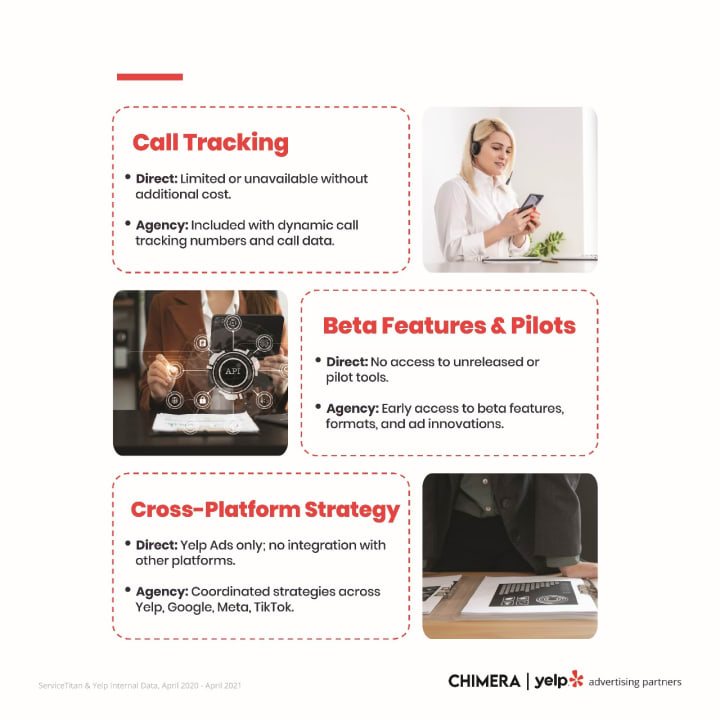
Scope: Niche and specialized focus specifically on Yelp advertising and profile optimization.
Expertise: Possesses deep, certified expertise in Yelp's platform, tools, and algorithms.
Primary Goal: Focused on maximizing Yelp ad performance, generating high-intent local leads, and managing Yelp reputation.
Platform Focus: Primarily Yelp; may offer limited external services like retargeting campaigns.
Cost Model: Involves Yelp ad spend (Cost-Per-Click) plus a flat management fee (e.g., The Chimera Marketing's plans range from $1,000-$4,500+ ad spend + $200-$1,000 flat fee).
Yelp Interaction: Acts as a direct liaison with Yelp, providing access to exclusive tools, data, and priority support.
Best For: Businesses heavily reliant on Yelp for local leads, or those with strong Yelp reviews seeking to amplify their presence on the platform.
Key considerations for this decision include budget: DMAs can range from $2,500-$12,000 per month for full service , while YAPs involve Yelp ad spend (e.g., $1,000-$4,500+ for The Chimera Marketing) plus a flat management fee (e.g., $200-$1,000 for The Chimera Marketing).
Specific marketing goals must be defined: is the aim broad brand awareness, diverse lead generation, or hyper-local, high-intent conversions specifically from Yelp?. The
current online reputation is also crucial, as a strong existing reputation is vital for Yelp ad success. Finally, businesses should assess their
internal resources: do they have the time and expertise to manage Yelp directly, or is an agency needed to offload this responsibility?.
It is worth noting that a "hybrid" approach is an unstated, yet viable, option. The detailed services of The Chimera Marketing, for instance, show that while they are a YAP, they also offer a "Unified Marketing Strategy" and "BONUS: Retargeting Campaign Management (Meta or Google)". This suggests that some YAPs are evolving into more comprehensive DMAs, or that a business might engage a YAP for Yelp and a separate DMA for other channels. This blurs traditional distinctions and offers a more nuanced solution.
Businesses are not necessarily limited to an "either/or" choice; they can seek a YAP that provides broader services or strategically combine a specialized YAP with a general DMA, depending on their budget and specific needs for integration versus deep platform expertise.
The interdependence of platform-specific expertise and overall digital strategy is also critical. The success of Yelp ads, even with a YAP, is intrinsically linked to factors like strong reviews and a well-optimized profile, which are components of broader digital marketing. Conversely, a DMA might struggle to achieve optimal Yelp results without deep, platform-specific knowledge. This implies that even if a DMA is chosen, they must either possess or acquire strong Yelp expertise, or a YAP might be necessary to complement their services.
The most effective strategy often involves ensuring that specialized platform knowledge, such as Yelp's intricacies, is either a core competency of the chosen DMA or is handled by a dedicated YAP, integrated into the overall digital marketing plan.
Conclusion: Aligning Your Choice with Business Objectives
The decision between a Digital Marketing Agency and an Official Yelp Advertising Partner ultimately hinges on a business's unique needs, budget, and strategic priorities. DMAs offer a holistic approach to managing an entire digital footprint across various channels, providing comprehensive online growth. In contrast, YAPs deliver specialized, in-depth expertise specifically focused on maximizing a business's presence on Yelp.
For businesses aiming for comprehensive online growth across multiple digital channels, a full-service Digital Marketing Agency is often the most suitable choice. However, if Yelp represents a critical, high-intent lead source for a specific industry, and there is a desire to navigate its complexities with expert guidance, a certified Yelp Advertising Partner, such as The Chimera Marketing, can provide the specialized advantage needed to unlock Yelp's full potential. Businesses are encouraged to evaluate their current online standing, define clear marketing goals, and then select the partner that best aligns with their specific path to growth.
About the Creator
Keep reading
More stories from Alyssa Mammano and writers in Journal and other communities.
Local Business Potential Vs a Yelp Advertising Partner
Introduction In today’s digital age, local businesses face the challenge of standing out in a crowded online marketplace. Yelp, a platform with millions of monthly users searching for local services, offers a powerful solution for connecting with high-intent customers. However, managing Yelp Ads can be complex and time-consuming, especially for small businesses with limited resources.
By Alyssa Mammano6 months ago in Journal
Discover the Hidden Wonders of the Everest High Pass Trek
There is a trail in the Himalayas that promises adventure, awe, and memories that last a lifetime. The Everest Three High Passes Trek is one of the most thrilling journeys you can take in Nepal. It goes beyond the classic Everest Base Camp trek, taking you over three high passes, each offering incredible views, serene villages, and a chance to experience the heart of the Himalayas. If you are ready to discover hidden wonders, this trek is calling your name.
By Olivia Floresa day ago in Journal




Comments
There are no comments for this story
Be the first to respond and start the conversation.