

As a five year old, I came to the conclusion that I wanted to be a fashion designer when I grew up. I have no idea where this far-fetched idea came from, as both my parents worked in Law and had no real interest in clothes, outside of ensuring Dad's work shirts were ironed properly for the day. If I think back, really hard, this probably stemmed from my obsession with Barbie dolls, despite being a quite short and tubby brown-haired, pale-skinned English girl. Who taught me the word "designer", we'll never know. All I know is that it became an obsession, from drawing outfits on every scrap of paper I could get my hands on, to endlessly observing every seam on every garment I came near and working out, in my mind, the shapes I thought made these clothes. In one memory, I distinctly remember creating a small, red velvet two piece from a pair of old burgundy velvet curtains, with a hexagonal pearl and metal button sewn on the front. As I pulled it on to one of my favourite dolls, I felt that this pathway of creation was just meant for me.
At school, I was smart, in the top classes across all subjects and consistently high-achieving at exams, but it was only Art and later, Design Technology, that really had my interest. I spent my Art classes entranced by paintings depicting the female form and oil painted fabrics, and later became absorbed by the vibrancy of Pop Art and the 60s. As often as I could, I'd gather bits of fabric and experiment with cutting and tearing, painting and dying, twisting and manipulating and hand tacking forms together, much to the dismay of my teachers, who wished for far more Fine Art projects. My academic teachers berated me for focusing too much of my attention on creativity, rather than Spanish or Maths, despite continually succeeding in examinations. However, the criticism that cut the most was from the other girls learnt of my life goal and I was relentlessly bullied for not being skinny enough, or cool enough to be a fashion designer.
When the time came to study my final years of Sixth Form, I focused my attention on textiles as much as possible, informing my teachers I wished to apply to study Fashion. I remember being called in to see the Headmaster, who lamented that I should use my knowledge of Maths and infatuation with drawing to become an Architect, as Fashion was far too frivolous a topic to study amongst my peers, who were applying to be teachers, economics students or medical researchers. Despite their best efforts to persuade me to take up a different route, I was accepted to a presitgious Art College, and then to study Fashion at University. I remember the feeling of finally learning to use a sewing machine for the first time, feeling free of the restrictions I had to adhere to at school, and being allowed to create what I wanted. It felt so exciting and full of endless possibilities.
I never expected University to be glamorous, studying Fashion, and I threw myself in to working late nights at my sewing machine to perfect my skills. My favourite lessons were always pattern cutting classes, learning new tricks to create the best shaped collar or draw the best garment facing. I became so passionate about learning to work with paper patterns that I became the go-to student in my year for my peers' pattern cutting problems. In my third year of studies, I drew inspiration from my great-grandmother, who was a teacher but also stitched leather gloves to make ends meet, for my final collection. I was chosen as one of 18 students in my year of 100 to show at Graduate Fashion Week and featured in Vogue for the first time. My first job upon graduating was temporary, but incredibly apt, as I worked on a short-lived PR project to create tiny garments for a range of dolls, cutting out 1:6 ratio pattern pieces and stitching them together to create a catwalk of miniature mannequins. At 21, I felt I was living my 5 year old self's dream.
However, the following year was more difficult than I had ever imagined, where I desperately struggled to undertake unpaid internships in London to further my chances at employment within my chosen industry. Nobody warned me how important it was to learn CAD skills, and how fast I would have to learn them without assistance, between carrying out clothing returns for my seniors to competitor stores and tidying closets. At home at night, I was exhausted from commuting and running out of patience. Nearly a full year of unpaid work in, I finally found a real-life, paying job, which promised to pay me in return for creating garments.
I quickly picked up skills in computer aided design, assisting predominantly on scaling prints for the graphic designers. The idea was to measure a t-shirt, blow the image they had created up on screen, print it on paper and cut and stick until the garment could be wrapped around the body and held for examination by a manager, who would decide if it would be sent for creation in fabric. Often, I would print, cut and stick until 10 o' clock at night, as the most junior and the last one in the office, increasing slogans by millimetre increments until it looked perfect. What began as an exciting task soon became tiresome, and the novelty of seeing another slogan t-shirt I had sized wore off.
Very suddenly, several months in, things changed. There was a call for more garment-led pieces and the print became less important. I was asked to create a small collection of smart, going out tops, which opened doorways to change the entire womenswear pathway. The factories we worked with weren't used to this type of garment, so for the first time in a couple of years, I got out my French curves, paper, pencil and scissors and got to work creating paper patterns to send to our Turkish counterparts. The manufactured garment samples arrived looking incredible and we quickly showed them to several customers who opened up new business with the company.
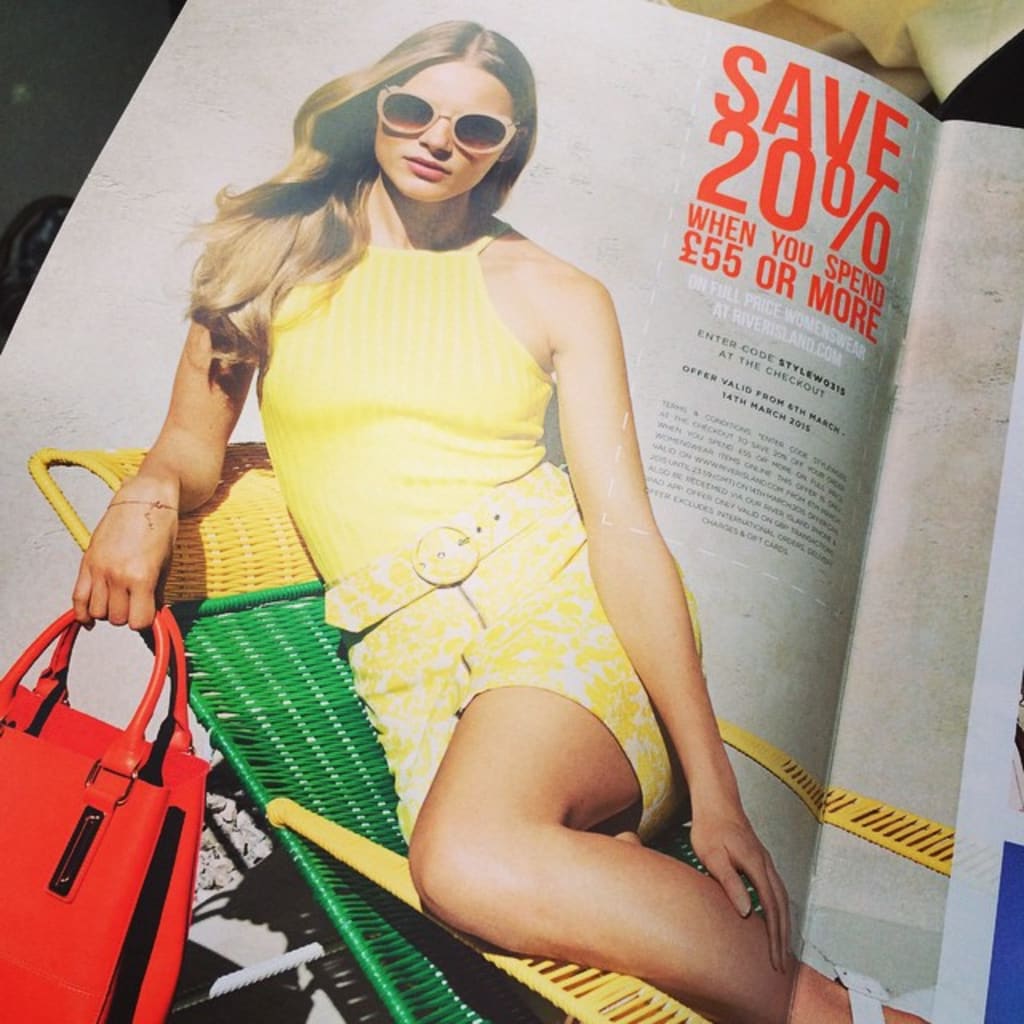
It also meant my job changed dramatically to become something I enjoyed immensely, getting to work early every day and leaving late at night and eventually I was put in charge of my first account, followed soon by my second, and then my third, reaching multi-million pound targets and leading a team. However, the long hours and high pressure affected my health and I regularly suffered from severe, blinding headaches at my desk. I convinced myself it was just too many late nights, too much looking at a screen, too much anxiety over deadlines. A small blip saw me collapse over the Christmas holidays, with an ambulance called, and the crew confirmed that I was suffering from stress and should spend the remaining few days relaxing before returning to work. On return to the office, I smashed targets and obtained the largest ever order that the company had had in its 6 years of trading, and that kept me going. This particularly large order saw 55,000 units of my top design reaching stores all over the UK and was the campaign image for the retailer for the season, appearing in every fashion magazine. I even visited my childhood town with my parents and showed them the garment in the store I'd visited as a teenager, with three different colourways all neatly hanging in a row.
My successes had made me feel on top of the world, but bad news was just around the corner, as the company I worked for announced mass redundancies were to be made across the design team and I unfortunately was one of the unlucky designers who was axed, so that they could channel their energy back in to printed t-shirts. I assured myself that after two years, it was appropriate for me to move on, and within a week I had secured a new job in central London. I was thrilled to be working just off Oxford Street and living the fashion dream, spending most of my time designing the edgiest fashion for one of the biggest names on the British High Street.
Following my dramatic collapse over Christmas, I had been called in to see my doctor and I explained how work had affected me recently, and the headaches I had suffered with. She forwarded my details to a specialist at a hospital near my workplace, for what I thought were precautionary checks. I met with a Neurologist, explaining my problems to him and room full of three student doctors, and he decided to send me for an MRI scan “just in case”.
The days flew by at work, where I felt part of a successful team and enjoyed my days working on the most innovative CADs and snipping fabric swatches to bring the garments to life for new buying teams. My headaches cleared, my days were more practical hours and I even began to enjoy my commute, imagining I was the main character riding the tube to work and strutting past big Topshop on my way to the office. It had almost slipped my mind about my health by the time I was called back to the Neurology department to discuss my scans several months in to my new role. This time, the Neurologist was alone. His welcome was abrupt and he immediately brought images of my brain up on his screen, pointing out small, white blurs across the cloud-shaped mass in front of me. My heart sank and I knew something was seriously wrong. He announced I had Multiple Sclerosis at 25.
I couldn't believe what was happening. I was young and I was working in a super-cool industry and living my dream, visiting head offices of enormous brands by day to predict trends that girls would wear in 6 months time. On the weekends, I would be on the guest list for private views at London art galleries and opening nights of the coolest new bars. And here I was, with my only reference point for MS being a wheelchair-bound family friend in her 50s. Looking back, I knew I should have taken the rest of the day off, but my enthusiasm for my job drew me back in to the office and I returned to carry on the afternoon of working, explaining to my colleagues that I was sick, but I didn't really know how to explain it. Fortunately, the support from my fellow female designers was incredible, and over the following months they rallied around me whilst I changed my whole approach to life, diet, meditation and health. I kept well for a year, my body running on an abundance of kale whilst my designs appeared in shops across the country.
It was February 2016 when my MS took over my whole form, paralysing three of my limbs and taking the eyesight in one of my eyes. I begged to be allowed to work from home, repeatedly insisting that the majority of my work had become computer-based, my fabric shears having switched to the Adobe Scissor Tool many months before my relapse even happened. The continued refusal from my employer led to a slower and far more stressful recovery than anticipated, leaving me struggling to walk well in to the Autumn months. When I was finally allowed to phase back in to work, there was a painful sense of hostility, the goalposts had been moved for my role, and a messy contractual termination followed. The exhaustion of the illness, the reaction of my employer and the sudden severing of my dream career hit me hard and I ached both physically and mentally from the changes in my life.
It has taken the past three years to learn to re-manage my health and come to terms with the differences in my life without my dream career. I have pivoted my skills and now apply myself within the family business I grew up with, across everything from print to web design, working around my own needs. There have been many times where I have wished I could cut the difficult bits out of my life, but I have learnt a lot about my resilience and my determination through this time. I have been saving up to achieve my new goal: to undertake a Masters degree in Graphic Design and set up my own business. My old career has become my new hobby and I no longer need to design vast numbers of garments each week, because now I can choose when I pull out my pins, needles and scissors and stitch my own pieces together.
About the Creator
Christina Walton
Designer.
Keep reading
More stories from writers in Journal and other communities.
Autonomy Is The Real Privilege
Good morning, freedom-seekers! Today we’re gonna be looking at autonomy. A strange word, I know; one many would probably look at blankly and run away from on sight. We’re gonna figure out what it actually means, consider how it’s achieved, and decipher just how deeply most of us are tangled up in dependence without realising it.
By That ‘Freedom’ Guy6 days ago in Humans
Book Review: "The Queen" by Andrew Morton
You're probably wondering why on earth I would read this book. It was free and it was a fair length. That was basically it at first. But another reason is because I enjoyed the show The Crown and so, it only makes sense to read a book that goes through separating facts from fictions - and to be fair, there aren't a lot of fictions about the show it seems. From the birth of the little princess and the way in which her father was reluctantly to become the king, all the way to meeting and marrying the veteran prince, Duke of Edinburgh and even down to the death of her father, queendom and beyond, this book actually gives us a lot about a woman who basically embodied the greatness and modernisation of the British 20th Century.
By Annie Kapur7 days ago in Geeks




Comments
There are no comments for this story
Be the first to respond and start the conversation.