
China’s Military Corruption Crackdown
The Fall of Nine Generals Including He Weidong and Miao Hua

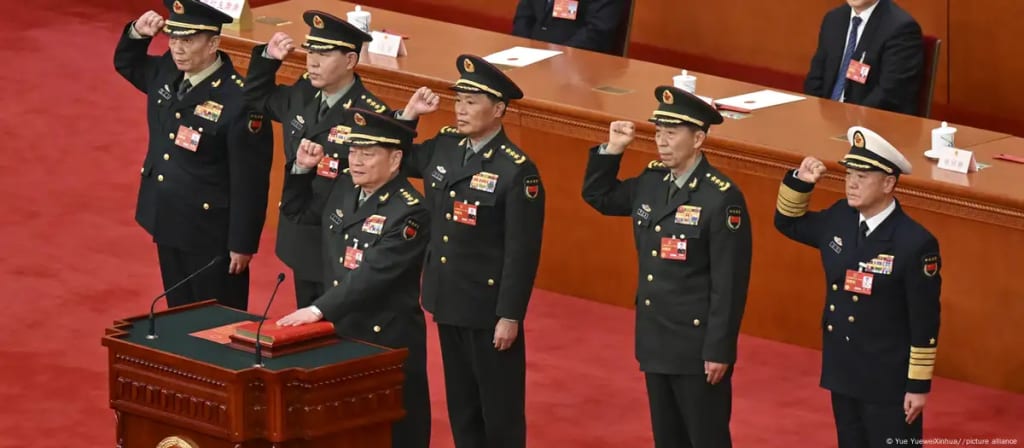
When the dragon turns inward, even the generals tremble.
In a dramatic purge that has sent shockwaves through China’s corridors of power, nine senior military officials — including two of the country’s most powerful generals — have been stripped of their Communist Party memberships and military ranks. Among them: He Weidong, former Vice Chairman of the Central Military Commission (CMC), and Miao Hua, former head of the CMC’s Political Work Department.
The news, confirmed by China’s Ministry of National Defense and reported widely by state media on Friday, underscores President Xi Jinping’s tightening grip on the People’s Liberation Army (PLA) and his relentless campaign to root out corruption at the highest levels of China’s defense establishment.
A Sweep at the Top of the Ranks
According to Defense Ministry spokesperson Zhang Xiaogang, months of internal investigation culminated in the disciplinary action against the nine men. They have been expelled from the Communist Party of China (CPC) and referred to military prosecutors for criminal investigation.
The list reads like a who’s who of China’s military elite:
He Weidong – Vice Chairman of the CMC, Politburo member, and second-highest-ranking officer in the PLA.
Miao Hua – Former CMC member and Director of the Political Work Department.
He Hongjun – Former Executive Deputy Director of the CMC Political Work Department.
Wang Xiubin – Former Deputy Director of the Joint Operations Command Center.
Lin Xiangyang – Former Commander of the Eastern Theater Command.
Qin Shutong – Former Political Commissar of the PLA Army.
Yuan Huazhi – Former Political Commissar of the Navy.
Wang Houbin – Former Commander of the Rocket Force.
Wang Chunning – Former Commander of the People’s Armed Police.
Each had already been removed from their positions and stripped of military credentials earlier this year. Friday’s announcement makes their political downfall official — and their legal troubles inevitable.
The Official Line: “Corruption Without Limits”
The Defense Ministry’s statement accused the men of “serious violations of party discipline and the law,” describing the scale of corruption as “extraordinarily massive” and the impact on the military’s reputation as “extremely harmful.”
In Chinese political vocabulary, such wording is not chosen lightly. It signals that investigators uncovered large-scale bribery, embezzlement, or abuse of military contracts — practices that have haunted the PLA for decades.
Zhang Xiaogang’s remarks were blunt:
“The severe punishment of He Weidong, Miao Hua, and others demonstrates the firm resolve of the Party Central Committee and the Central Military Commission to push the anti-corruption struggle to the end. The PLA will not allow any corrupt elements to hide within its ranks.”
In Beijing’s coded political theater, that’s as close as one gets to saying: No one is safe.
He Weidong: The Second Most Powerful Soldier in China
He Weidong’s fall is especially stunning. Until his dismissal, He was China’s No. 2 military figure, serving directly under Xi Jinping, who chairs the CMC. He was a Politburo member — a position held by only one other general in modern Chinese history before him.
Born in Jiangsu Province, He rose through the ranks of the 31st Group Army under the former Nanjing Military Region, which covers the eastern coastal provinces — including Fujian, directly across from Taiwan. That geographical detail is crucial: the 31st Army has long been considered China’s frontline force for a potential Taiwan operation, and it’s where many of Xi’s loyal officers, the so-called “Taiwan Strait faction,” built their careers.
He’s close ties to Xi made his disappearance from public view after March’s National People’s Congress particularly conspicuous. For months, rumors swirled in Beijing’s elite circles that the general was under investigation. Friday’s announcement confirmed it.
Miao Hua: The Political Gatekeeper
If He Weidong was the sword, Miao Hua was the shield — the man who managed the PLA’s political loyalty to the Party. As the head of the Political Work Department, Miao controlled propaganda, ideological training, and internal discipline across the armed forces.
Like He, Miao’s career traces back to Fujian Province, where Xi Jinping served as governor and Party Secretary in the 1990s. U.S. Department of Defense reports have long noted Miao as one of Xi’s “trusted allies” — part of a network of officers who built personal loyalty to the president long before his rise to national power.
That makes his downfall symbolically significant. If Xi is purging even those once considered loyalists, it suggests a deep crisis of trust within China’s military hierarchy.
The Broader Purge: Rocket Force and Beyond
This wave of dismissals is not an isolated event. It follows an earlier purge within the Rocket Force, China’s elite missile command, which saw multiple top officers — including Wang Houbin and Xu Xisheng — investigated or replaced in 2023.
The Rocket Force oversees China’s nuclear and conventional missile arsenal, a cornerstone of Beijing’s deterrence strategy. Allegations of procurement fraud and unauthorized project spending have dogged the branch for years.
By targeting both the Rocket Force and senior commanders in the Eastern Theater Command — the units closest to Taiwan — Xi is effectively reasserting political control over China’s most strategically sensitive military operations.
A Pattern of Power and Paranoia
Xi Jinping’s anti-corruption campaign began shortly after he took power in 2012, and it has touched every corner of Chinese governance — from provincial governors to billionaires, from tech moguls to generals.
But while the campaign is framed as a moral cleansing, analysts say it also serves another purpose: political consolidation.
“Xi’s campaign has two faces,” said Dr. Lin Zhao, a political analyst at SOAS University of London. “It’s both a genuine effort to clean up systemic corruption and a mechanism to eliminate potential rivals and ensure loyalty.”
Indeed, the PLA’s modernization drive has been shadowed by corruption scandals involving weapons procurement, land deals, and promotions-for-sale schemes. In a system where loyalty to the Party outweighs merit, corruption becomes both symptom and tool of political survival.
Why This Matters Now
The timing of the purge is notable. China faces mounting geopolitical pressure — from tensions over Taiwan and the South China Sea to economic challenges at home. For Xi, maintaining a disciplined and loyal military is essential as the country projects strength abroad.
Removing compromised generals sends multiple messages:
To the West — that China’s leadership is serious about reform and control.
To the Party — that no rank is immune from scrutiny.
To the Military — that absolute loyalty to Xi outweighs any factional ties.
But it also reveals something darker: the deep-rooted anxiety within China’s power structure. If even the generals closest to Xi can fall, the system’s internal cohesion may be far more fragile than it appears.
A Campaign Without End
This is not the first time a sweeping military purge has rocked Beijing — nor will it be the last. Under Xi, at least 160 senior officers have been disciplined or prosecuted since 2012, including former CMC vice chairmen Xu Caihou and Guo Boxiong, both of whom died under investigation.
What distinguishes the 2025 purge is its scale and symbolism. It strikes at the very heart of the chain of command that Xi himself built — a reminder that loyalty in authoritarian systems is never permanent; it’s transactional.
In the Chinese political lexicon, corruption is often described as a “cancer.” If so, Xi’s latest move is both surgery and showmanship — cutting out diseased tissue while displaying the incision to the world.
Conclusion: The Iron Discipline of a Paranoid State
The fall of He Weidong, Miao Hua, and their peers marks one of the most consequential purges in modern PLA history. It is a story of power, loyalty, and the uneasy marriage between politics and the military in a one-party state.
Xi Jinping’s message is unmistakable: the gun must always obey the Party. But beneath the veneer of control lies a paradox — the more he purges, the more instability he reveals.
As Beijing tightens its grip, one question lingers like a drumbeat in the barracks:
If even the generals are not safe, who is?
About the Creator
Omasanjuwa Ogharandukun
I'm a passionate writer & blogger crafting inspiring stories from everyday life. Through vivid words and thoughtful insights, I spark conversations and ignite change—one post at a time.
Keep reading
More stories from Omasanjuwa Ogharandukun and writers in Journal and other communities.
The 'Nostalgia Industrial Complex' Is Robbing Us of Our Actual Memories.
Every decade, it seems like something old becomes suddenly “new again.” Movies, TV shows, toys, and fashion trends from our childhoods are repackaged and sold back to us. The term “nostalgia industrial complex” describes this phenomenon: a system where corporations, media companies, and marketers capitalize on longing for the past. But the problem isn’t just commercialization—it’s how this cycle distorts our actual memories.
By Wilson Igbasi6 days ago in Journal


Comments
There are no comments for this story
Be the first to respond and start the conversation.