
Caligula: Rome's Cruelest Emperor?
A Review and Recap On The Documentary from Timeline

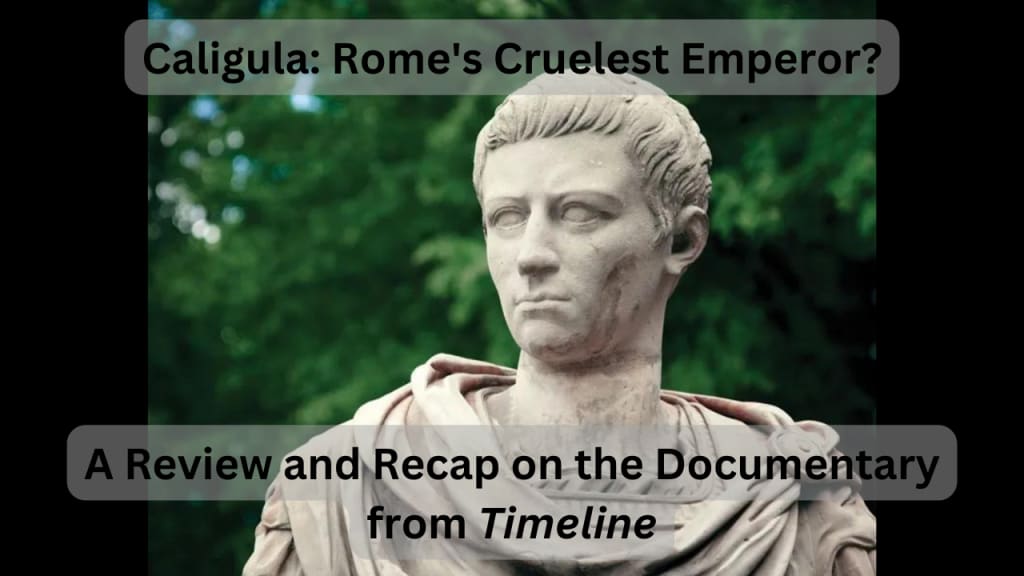
In the documentary titled Caligula: Rome’s Cruelest Emperor? published to YouTube on July 14, 2018, there are illuminating, thorough details on the life of Gaius Julius Caesar Augustus Germanicus, who is better known as Caligula. The viewer of this motion picture from Timeline would be transported back to the time Caligula lived, through images of historical artifacts and the words of a narrator. They would learn where Caligula went and what he did, as well as his significant contributions to Roman history, and, at the time, the culture of Rome.
The film expressed the point of view that Caligula made some of the biggest changes to Rome and its culture, despite being in power for only four years and his death when he was in his twenties. It shows how Caligula really was – brutal and psychologically unstable, power-hungry, paranoid. Caligula is seen as a symbol of Imperial Rome’s ugly, scary side. The disgusting luxury, the outrageous indulgence, the brutal happenings of the Imperial family were all indications of that. Caligula is a kind of mascot, almost, for the bad parts of being royalty in the city of Rome.
The film also gave some interesting facts on Caligula, and on his life. As for his life, Caligula was born into a military family and spent his early years traveling between army camps with his mother and father, who was a high-ranking officer. Later on, as a teenager, he received some training on brutal leadership from his father. This took place on the island of Capri, and it was no doubt effective. Finally, he became the emperor. As for an interesting fact, it has been noted through ancient Roman art that Caligula was a HUGE pervert. Apparently, he loved sex so much that his palace pretty much turned into a kink club whenever he got horny. He seems to have especially loved cross-dressing, and he clearly wore out his male sex partners very quickly. In addition to being Rome’s symbol for disgusting indulgence and brutal leadership, he is also seen as a symbol of sexual excess.
The details on how Caligula and other emperors ruled are fascinating. As the emperor, Caligula’s control over everyone and everything – including propaganda, which was often on coins – was absolute. To solidify their power, Roman emperors would build many buildings and structures, and some of Rome’s most prominent architecture was built when Caligula came into power. For the royalty in Imperial Rome, it was vital to know how to conduct yourself appropriately since you could quickly and easily end up dead if you did the wrong thing or even if someone just didn’t like you. If someone dropped dead after being poisoned at the dinner table, you just kept on eating like nothing happened if you didn’t want to be killed too. But it’s not only the out-of-power royals that needed to watch out. Since there were naturally many people out to kill them, of course the emperors – especially Caligula – documented all of their staff. These documents included everyone from the most trusted advisors – who, in reality, were slaves with lots of power – to the personal trainers, to the architects that designed the structures built by them. Some of Caligula’s staff records, put on tablets, can be seen displayed in museums.
But constantly looking over his shoulder, documenting his staff, and poisoning potential threats at dinner wasn’t enough to keep Caligula alive. He was killed by a group of soldiers that struck him around thirty times, starting with the neck or the chin, depending on the version of the story. It is also rumored that this group of guards also included some of Caligula’s staff.
Different sources are used to show proof of things that happened and explain theories of what might have been. The narrator traveled all over Rome and the surrounding areas to explain Caligula’s significance to a particular place or object. She also spoke with another historian that gave a second perspective – and more information – on life in Imperial Rome and on Caligula. By showing historical artifacts, explaining what they are, and connecting that to a place, or a person, or a situation, or another object, or even just making an inference based on what is known, she was able to show what life was like back in that place and time. She also used her voice to add to the mood by using a certain tone or having the occasional dramatic pause. The sound effects and music in the film was also used very effectively – the timing was perfect. The mood and tone of the discussion or event was brought into greater focus with the addition of sound. Overall, the sources were convincing, especially the artifacts and perspectives of historians.
Caligula has a part in the book series The Trials of Apollo by the author Rick Riordan. He is one of the main antagonists of the series, along with the other Roman emperors Commodus and Nero. In the books, indications of Caligula’s brutality are definitely given. However, I read about Apollo blinding Caligula a long time ago (like, years ago), so I don’t remember a whole lot about what happened leading up to that. I just remember that he was BAD.
There were many important points made in the documentary. It is stressed that Caligula was a psychopath, an extreme one to be sure. He was violent and brutal, known today as one of Roman history’s most prominent villains. Second, life was unpredictable as a Roman noble. Imperial power made it certain that there were many people out to kill you. For that reason, it’s no wonder that Caligula was paranoid, and that anyone could and would be killed off if they were any threat to the throne. Third and finally, Roman culture was terrifying. It was never clear what was real, and what was not. For example, if you were at a dinner with Caligula, the food on the table may look real, but you could find that it was actually made of solid gold. In a mock sword fight with him, both swords would appear to be wooden, but Caligula’s would end up being real – and deadly. The narrator showed a Roman painting displayed in a museum, and when the light was dimmed, it was painted in a way where you could not be sure whether you were in a museum gallery, or in the middle of a utopian forest. It felt really creepy. Those were some of the points that were stressed the most in the documentary, and they are things that are important to note.
When watching the film, my response was mainly disgusted fascination. It was disgusting to hear and see the kind of things that Caligula did and what he was a part of, but the way he and other emperors ruled was interesting, in a way. Overall, I thought it was an interesting thing to watch. I’d probably watch it again, to be honest.
In conclusion, this documentary showed the life of Caligula through many different sources. It was an interesting thing for me to watch, although it disgusted and disturbed me quite a bit. It is clear that Caligula ruled in a brutal, cruel way, the psychopath that he was. Being an emperor, he was naturally paranoid, so everyone – especially his staff and the other royals – needed to watch their behavior if they wanted to stay alive. The film stresses the ugly, scary parts of Roman culture, as well as the significant contributions made to it by Caligula. It is also stressed how Caligula is perceived today, and how symbolic his life and activities were to the way Imperial Rome is perceived by historians and the general public in present times. It is clear that he is seen as a symbol of Rome’s sexual excess, disgusting luxury, and outrageous indulgence. His actions and fate are clear indications that life was brutal for the Imperial family. For anyone interested in the life of Caligula, I highly recommend this illuminating piece of work from Timeline.
About the Creator
Jade
Jade is an 18-year-old high school student located in Seattle, Washington. Her young age and diverse life experiences have given her a unique perspective on the world. She has a lifetime of writing experience and loves sharing her work!


Comments
There are no comments for this story
Be the first to respond and start the conversation.