
BYD’s $60 Billion Wipeout Points to Deeper Turmoil for China EVs
A sharp market sell-off exposes mounting pressures in China’s electric-vehicle sector, raising questions about sustainability, competition, and global expansion
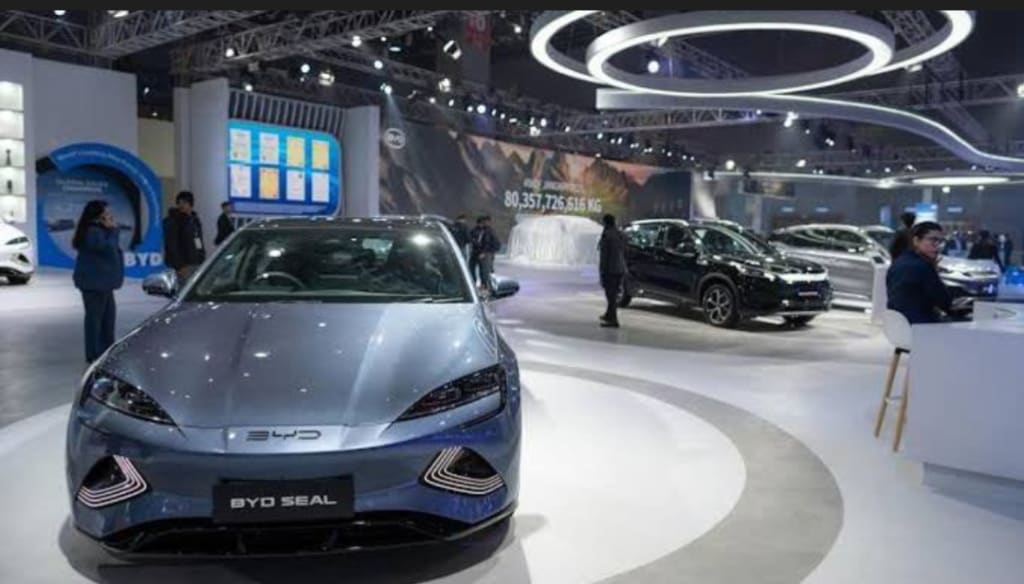
China’s electric-vehicle (EV) industry, long seen as the global leader in the transition away from fossil fuels, is facing a moment of reckoning. The recent $60 billion wipeout in BYD’s market value has sent shockwaves through global financial markets and sparked renewed scrutiny of the foundations underpinning China’s EV boom. Once celebrated as a symbol of China’s technological rise and green ambition, BYD’s sudden stumble suggests that deeper structural challenges may be brewing across the country’s electric-vehicle ecosystem.
BYD is not just another automaker. It is the world’s largest EV producer by volume, a national champion backed by years of government support, and a flagship name for China’s clean-energy aspirations. When a company of this stature suffers such a dramatic loss in valuation, it raises a critical question: is this merely a temporary correction, or a sign of broader turmoil for China’s EV industry?
---
What Triggered BYD’s Market Rout?
The sell-off that erased roughly $60 billion from BYD’s valuation did not stem from a single event, but rather from a convergence of pressures that have been building for months. Slowing sales growth, intensifying price wars, and rising investor concerns about margins all played a role.
China’s EV market has become brutally competitive. Dozens of manufacturers are fighting for market share, often slashing prices to unsustainable levels. BYD itself has been forced to cut prices on several models to defend its dominance, a move that helped maintain sales volumes but alarmed investors worried about profitability.
At the same time, global markets have grown cautious about Chinese equities overall. Concerns over China’s slowing economy, regulatory uncertainty, and geopolitical tensions have made investors more risk-averse. BYD’s valuation, once buoyed by optimism and rapid growth, suddenly looked vulnerable in this shifting environment.
---
The Price War Problem
At the heart of the turmoil lies China’s EV price war. What began as a strategy to boost adoption has evolved into a race to the bottom that threatens even the strongest players.
While lower prices benefit consumers in the short term, they compress margins across the industry. Smaller EV makers are particularly exposed, but even giants like BYD are feeling the strain. Analysts warn that prolonged price competition could weaken balance sheets, reduce spending on research and development, and ultimately slow innovation.
For BYD, the challenge is acute. The company has invested heavily in vertical integration — producing its own batteries, chips, and components — which once gave it a cost advantage. But as rivals catch up technologically and compete aggressively on price, that edge is narrowing.
---
Signs of Overcapacity
Another issue highlighted by BYD’s valuation drop is overcapacity. China’s EV production capacity now far exceeds domestic demand growth. Factories are capable of producing millions more vehicles than consumers are currently buying.
This imbalance has forced automakers to look abroad for growth. Exports have surged, particularly to Europe, Southeast Asia, and Latin America. However, this strategy brings its own risks. Trade tensions are rising, with several countries investigating or imposing tariffs on Chinese EVs over concerns about subsidies and unfair competition.
If export routes become restricted, China’s EV industry could find itself with too many cars and too few buyers — a scenario that would deepen financial stress across the sector.
---
Government Support Under Scrutiny
For years, China’s EV rise was fueled by generous government incentives, including subsidies, tax breaks, and preferential policies. While many of these measures have been scaled back, the industry remains closely tied to state support.
BYD’s market wipeout has reignited debate over whether the sector has become overly dependent on policy backing. Investors are increasingly questioning whether Chinese EV makers can thrive in a more market-driven environment without constant intervention.
If authorities decide to reduce support further — especially as economic priorities shift — weaker players could collapse, and even strong companies may face painful adjustments.
---
Global Implications Beyond BYD
The consequences of BYD’s valuation plunge extend far beyond one company. Global automakers, battery suppliers, and raw-material producers are watching closely. China sits at the center of the global EV supply chain, and any slowdown or instability could ripple across markets.
International competitors may see opportunity in China’s struggles, but they also face the risk of oversupply pushing prices down worldwide. Meanwhile, investors are reassessing how they value EV companies, moving away from growth-at-any-cost narratives toward a sharper focus on profits and resilience.
---
Is This a Turning Point?
Despite the turmoil, it would be premature to declare the end of China’s EV dominance. BYD remains profitable, technologically advanced, and well-positioned compared to many rivals. Consolidation could ultimately strengthen the industry by weeding out weaker players.
However, the $60 billion wipeout serves as a warning. It signals that the era of effortless growth is over. China’s EV sector is entering a more mature, more challenging phase — one where efficiency, innovation, and sustainable business models matter more than sheer scale.
---
Conclusion
BYD’s dramatic loss in market value is more than a stock-market story. It reflects mounting pressures within China’s electric-vehicle industry, from price wars and overcapacity to global trade tensions and shifting investor expectations. While the long-term future of EVs remains bright, the path forward for China’s EV champions looks increasingly complex.
The coming years will reveal whether companies like BYD can adapt and emerge stronger — or whether this moment marks the beginning of a deeper reckoning for the world’s largest EV market.
About the Creator
Keep reading
More stories from Sadaqat Ali and writers in Journal and other communities.
Trump Threatens Tariffs on Countries Trading with Iran — What It Means for Global Trade
U.S. President Donald Trump has taken a strikingly assertive turn in U.S. foreign and trade policy by threatening to impose tariffs on countries that maintain economic ties with Iran, signaling a broader strategy to isolate Tehran while escalating economic pressure on nations that engage in commerce with the Islamic Republic.
By Sadaqat Aliabout 13 hours ago in Journal
~ Fired ~
— Ai Intrusion ~ Are you Next ~ Is Ai Evolution after your job? — Few workplaces haven't been affected. Ai is in supermarkets, at doctors' offices, and even monitoring farms. I just can't think of anything this machine is not getting into, can you? For instance: Education ~ Law and Tech jobs will one day have a major influence or be taken over by these inanimate machines, with accuracy and vigor. From mechanics' diagnoses to a wide variety of everyday jobs, including fast food workers, with this input having the ability to cut their unnecessary work hours. I'm certain all of us have been touched by this with our short stories and colorful headings, have you? Even comments are very questionable 'Non-Robot' insertions.
By Jay Kantor7 days ago in Journal



Comments
There are no comments for this story
Be the first to respond and start the conversation.