
Business results through Microsoft Power Platform Implementation
Know how you get effective results through Microsoft Power Platform Implementation
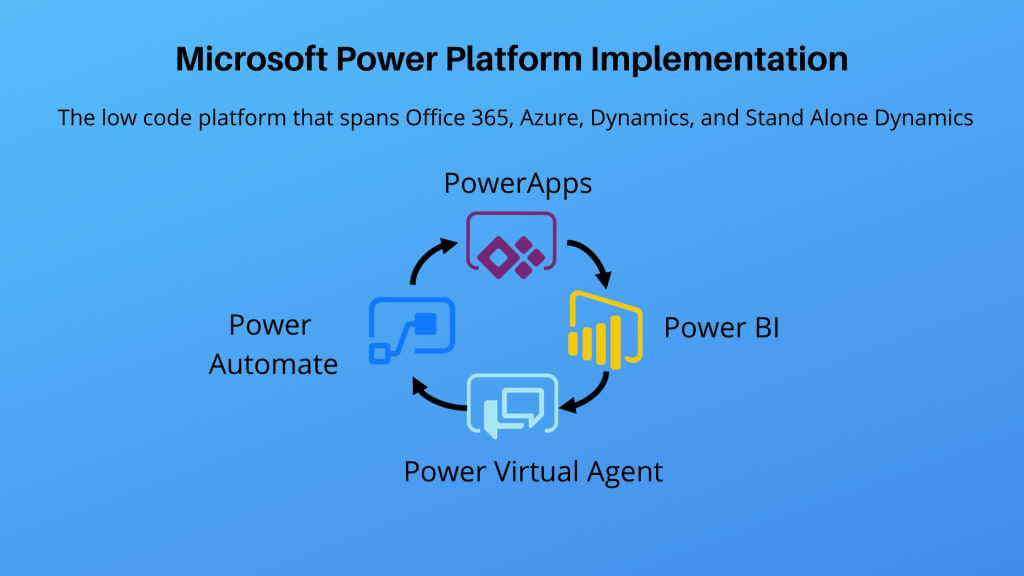
The power of Microsoft Power Platform
When Power Platform was launched, it was composed with three main components – Power BI, PowerApps, and Microsoft Flow. Over time, advanced tools such as Power Automate, AI builder, and Power Virtual Agents have also entered the picture. Furthermore, added layers of Power Portal and RPA capabilities joined the Power family.
Microsoft Power Platform Implementation allows for a strategic fusion of business intelligence to let users perform three key actions on enterprise data – analyze it, act on it, and automate, i.e., the ‘Triple-A loop.’ Satya Nadella has repeatedly touched upon how the triad of Microsoft 365, Dynamics 365, and the Power Platform on top of Azure cloud is core to showing impact for business enterprises – regardless of the business size or the market it is in.
The business impact of Power Platform
- The following are the key findings from Forrester as per their latest report ‘The Total Economic Impact of Power Apps and Power Automate:
- Cost effective. Reduced cost of application development by ~70% lower
- Tailored, in-house applications eliminating any external software licensing fees
- Efficiencies gains of ~15% through automated processes for mobile workforces
- Reduced application maintenance and management effort by a whopping ~38%
- High productivity from streamlining and automation of business processes
The strength and ability to give amazing results by the Platform:
- Easily and rapidly built data-driven apps with full-featured low-code & no-code platform (PowerApps)
- Connected enterprise data through pre-built connectors or using custom connectors (Connector Library and Office 365)
- Putting your data to work with Common Data Service (CDS)
- Strong and Secure integration with Office 365, Azure Services, Dynamics 365, etc.
- Strong enterprise governance and security
- Pro-code extensibility for future growth and scalability.
Together, the power components of Microsoft Power Platform Implementation- Power BI, Power Apps, Power Automate and Power Virtual Agents enable businesses to - Analyze, Act, Automate and Iterate. The amazingly powerful no-code/ low-code platform brings to us creative tools and app building solutions that get us quickly connected with our business data & disparate systems, automate processes, enable us get insights and enhance customer responsiveness with virtual agents.
Design your own model
Everything from data security and compliance to ongoing maintenance and application lifecycle management needs to be planned and documented. To get your Microsoft Power Platform Implementation enterprise-ready, you need the right governance model to ensure data is being accessed appropriately, handled consistently and protected effectively. Effective governance can also create a consistent approach to user experience design that improves application usability and adoption.
Be a good query listener
First, you need to understand the level of demand from the business for Power Platform services. Then you can begin to select the apps that will deliver the most value. It’s important to clearly define the business problem so you can understand and quantify the value. It’s equally important to assess whether Power Platform is the right tool to solve the problem, or if there are other solutions in the business that would be a better fit. We take a design-led approach to help clients uncover the answers they need, prioritize use cases and find the right fit for Power Platform.
Give developers freedom to explore
Be sure to give your citizen developers the right training and guidance so they can hit the ground running and work confidently and effectively with the Power Platform. They’ll also need guardrails in place to ensure they’re following your governance policies. We work with clients to internally certify their citizen developers, so we know they’re fully aware of all policies and are ready to create powerful solutions without exposing the organization to risk.
Keep a check on all the value and time
Having defined the business case and what each app should deliver, it’s essential to continually monitor value realization. To optimize the business impact of your platform, you must be able to understand what every part of it offers, so you know which apps to scale up, modify, move to a different platform or shut down.
That's all I have to say about Microsoft Power Platform Implementation. If you liked the article please comment down below what changes I can made or can add to the information in the article.
About the Creator
Keep reading
More stories from Sachin Sharma and writers in Journal and other communities.
How Implementing Microsoft Power Platform can do benefits to your business!
The Microsoft Power Platform Implementation consist of four robotic components, namely Power Apps, Power BI, Power Automate and Power virtual agent. It is a powerful platform that can create an app, customize it, analyze data through visualization and can automate the process as per your business needs. Power Platform is hosted on safe and secure Azure cloud-platform.
By Sachin Sharma5 years ago in Journal
The goals I did not achieve
Every writing goal I made for the year is a wash. It has been this way for a while, but I think it's important to be open about my failures and the reality of how life can get in the way. This is especially true considering the several times I have posted on Vocal about my writing goals, how I was changing my approach, and where I was hoping to be for the upcoming year. I will probably do that again in a couple months, but for now, it is time to acknowledge where I am today.
By Kay Husnick20 days ago in Journal


Comments
There are no comments for this story
Be the first to respond and start the conversation.