
Beneath the Marble: The Day Christ’s Tomb Was Opened After 500 Years
Inside the 2016 excavation of the Church of the Holy Sepulchre — where faith, history, and science converged on one sacred stone
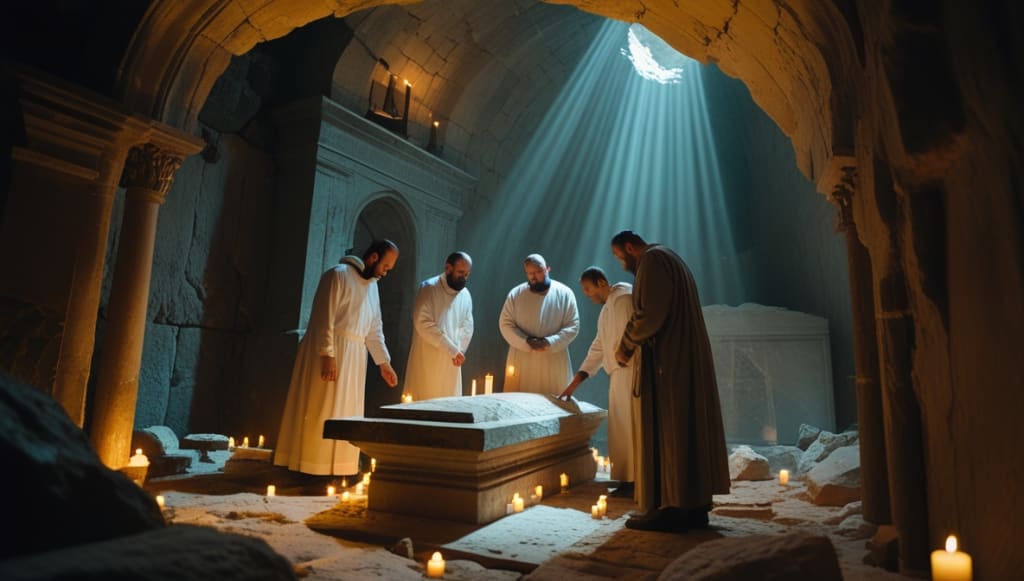
For centuries, people have shown great love, respect, and debate about the Church of the Holy Sepulchre in Jerusalem. Millions of Christians see it as the hallowed ground of Jesus Christ's execution, burial, and resurrection, and its limestone design has witnessed many prayers, pilgrimages, and historic fights. But beneath its renowned domes and flashing lights resides a far bigger enigma: the enclosed grave purportedly bearing Jesus' remains.
For almost five centuries, nobody knew what was beneath the marble slab at the center of the shrine called the Aedicule. Having been closed for at least since 1555, this tomb had developed into a myth—a holy site where belief still exists in the face of little concrete evidence. Later, on October 26, 2016, a group of archaeologists and conservationists cracked its surface. Their discovery would amaze religious people as well as scientists.
The Hidden Tomb Under Thousands of Years' History
The Aedicule, a modest structure above the tomb, had been changed, renovated, and reinforced over years. Fires, invasions, earthquakes, and successive generations of believers had produced a terrible total impact. By 2015, both theological leaders and engineers grew concerned about its likely death. The need for repair became increasingly great.
The project seemed basic, as described: to reinforce the ancient building so it wouldn't fall under the weight of time and guests. Still, actually it was one of the most fragile conservation projects ever undertaken. Three Christian denominations—the Roman Catholic Church, the Greek Orthodox Church, and the Armenian Apostolic Church—share authority over the site. All three had to concur before the first stone could be removed.
Once they had approval, the group went onward with utmost caution. Religious leaders and worldwide media watched every deed and every marble taken away very carefully. It was a significant event in our common past rather than just a criticism.
Opening the Marble Slab
The Aedicule was permeated with a peaceful ambiance that October evening in 2016. Beneath the glare of building lights, people in gloves and safety gear crouched. Monks whispered prayers softly. Cameras taped silently. The top layer of clean marble was slowly lifted. Underneath was another slab, broken but still entire. Unseen by humans for nearly five hundred years lay a limestone flat surface beneath that.
Though ground-penetrating radar had already indicated that the cave walls beyond the slab were still intact, witnessing it personally was unmatched. Dust danced as the ages disappeared. Specialists were able to investigate the first burial site long linked to Jesus for the first time in modern history.
Contrary to wild theories, no bones, relics, or lost riches were found. Rather, something less tangible yet probably more significant evolved: the exposed stone of a first-century limestone tomb directly tied to Christianity's earliest traditions.
Science Meets Faith
Not just the archaeological find but also the location made the event noteworthy. Respect gathered around one stone surface by scientists, monks, and representatives from several faiths—beliefs usually at war. Every person there seemed to realize they were participating in an experience beyond their own lives.
Responsible for the repair, the National Technical University of Athens painstakingly recorded every facet of the room. High-resolution photographs taken by laser scanning revealed characteristics that had remained buried for millennia. Stone and mortar samples were gathered for analysis. Their study showed that segments of the tomb's construction date to at least the fourth century, consonant with historical references of Helena, the mother. Of Constantine the Great, marking the place as Jesus's burial site in the 300s CE.
The Power of the Reveal
The tomb was shut once again after only 60 hours. Even with the little time, historians and archaeologists generated an amazing volume of data and many people all throughout the globe had a deep spiritual experience. Many believers saw the discovery of the tomb as proof of their beliefs. Conversely, it was a rare opportunity for doubters to examine one of the most regarded assertions made in Christianity.
The reaction from the first group of participants was maybe the most illuminating. Some of them looked deeply moved as they left silently, while others merely grinned faintly. Seasoned academics, these individuals were used to objectively evaluate events without feeling any emotion. Still, they could also see the gravity of the circumstances. Rather than merely cleaning stones, they were interacting with hundreds of years of faith, expectancy, and mystery.
What Was Really Unearthed
The 2016 expedition failed to verify the resurrection or find secret wealth even after large media attention. It instead revealed a strong archaeological connection between the modern temple and the first-century tomb. The investigation validated the limestone burial platform and nearby cave walls to be ancient and had been shielded by marble and rubble.
Moreover, strengthening of the Aedicule itself resulted from the refurbishment. Titanium scaffolding currently helps to guarantee the preservation of the shrine for next generations. The restored Aedicule was opened to the public in 2017 following months of reconstruction. Though its marble surfaces were freshly polished, its essence remained intact. It sparkled beneath faint lighting.
Why It Still Matters Today
Unveiling Christ's tomb in 2016 was more than just a scientific triumph. It was an unusual fusion of history, archeology, and a worldwide viewpoint. In a society where digital photos are ubiquitous, the physical act of moving marble and touching ancient stone can feel distant. meant to tell everyone of the need of location.
It reaffirmed thoughts held for centuries by believers. It helped academics to more accurately grasp the beginning of Christianity. Furthermore, it showed both believers and non-believers how history lasts, set in stone, just ready to show itself at the right opportunity.
Last thoughts
Ultimately, what was found in October 2016 was the unchanging connection between the past and the present, not a secret item or a secret message. The marble was a demonstration of the power of faith, memory, and the human desire to engage with history; it hid much more than a tomb.
Antonia Moropoulou, the conservator who led the project, claimed the tomb's discovery was a moment of truth. Science and religion coexisted for a little while, and the world stood still, realizing that some mysteries are not just about concentrating on being in the moment rather than searching for solutions.
About the Creator
Keep reading
More stories from Shahjahan Kabir Khan and writers in Journal and other communities.
The iPhone 17 Might Be the Last iPhone as We Know It
For years, the iPhone has been more than just a phone—it’s been the crown jewel of global capitalism. Sleek, iconic, and everywhere, it represented not only Apple’s dominance but also the miracle of globalization. On the back of every device, one simple phrase told the story of modern tech:
By Shahjahan Kabir Khan4 months ago in Journal
How Modern Aircraft Rely on Advanced Electronic Components
Modern aircraft are marvels of engineering, with thousands of components working together seamlessly to ensure safe and efficient flights. While many people think of the engines or the wings when they imagine the inner workings of an aircraft, electronic components play an equally crucial role. These components are responsible for everything from the cockpit's control systems to the passenger cabin's lighting, and even the aircraft’s navigational systems.
By Beckett Dowhanabout 5 hours ago in Journal



Comments
There are no comments for this story
Be the first to respond and start the conversation.