
Autonomous Delivery Robots Are Booming—Here’s What’s Next
From sidewalks to supply chains, autonomous couriers are reshaping how cities move
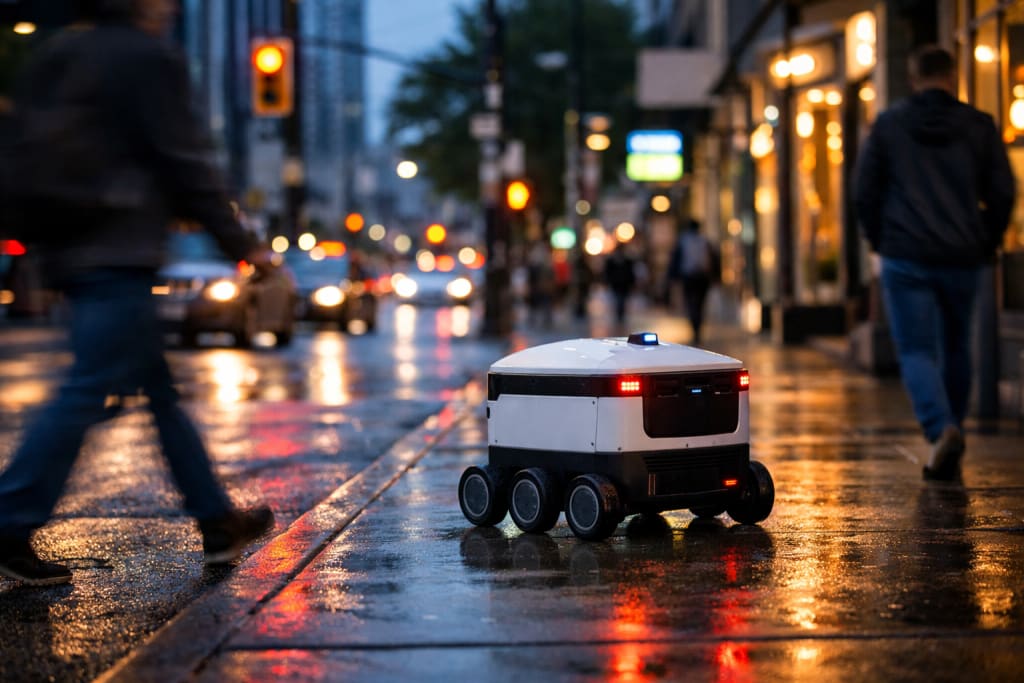
At 9:47 p.m., the street is almost silent. Then you hear it—not an engine, not footsteps—but a soft electric hum. A knee-high robot pauses at the crosswalk, scans the road, and politely waits its turn. Inside its locked compartment is someone’s dinner, still warm, navigating the city without a driver, a tip, or a complaint about traffic.
This isn’t science fiction sneaking up on us—it’s already here. Autonomous delivery robots are quietly slipping into daily routines, reshaping how food, groceries, medicine, and parcels move through neighborhoods. And while most people barely glance down at them, the economic and social ripple effects are enormous.
The Sidewalk Becomes a Supply Chain
The autonomous delivery robots industry didn’t explode overnight. It crept in—first on campuses, then in gated communities, and now onto busy sidewalks in real cities. These robots are not flashy humanoids. They’re practical, boxy, and obsessively focused on one task: getting things from point A to point B without human intervention.
From a market perspective, the numbers tell a clear story. According to Mordor Intelligence, the autonomous delivery robots market is expected to grow from USD 1.11 billion in 2025 to USD 1.33 billion in 2026, and is forecast to reach USD 3.27 billion by 2031, expanding at a 19.74% CAGR over 2026–2031. That kind of growth doesn’t come from novelty—it comes from solving real problems at scale.
Rising labor costs, last-mile inefficiencies, and consumer demand for faster delivery are converging. For retailers and logistics providers, autonomous robots offer consistency: they don’t call in sick, they don’t rush, and they don’t require rerouting during peak hours. For cities, they promise quieter streets and lower emissions.
What the Market Numbers Don’t Say—But Imply
The autonomous delivery robots market size is still small compared to traditional logistics, but that’s exactly what makes this moment interesting. Early markets are where behavior changes first. As deployments scale, the autonomous delivery robots market share will increasingly move from pilot programs to core delivery strategies.
What’s driving this shift isn’t just technology—it’s trust. Robots are learning to navigate crowds, obey crosswalk signals, and avoid pets and toddlers. Each successful delivery builds confidence, not just in the machine, but in the system behind it.
Current autonomous delivery robots market trends point toward:
- Integration with local retailers and restaurants rather than centralized warehouses
- Increased focus on pedestrian-friendly design to coexist with human traffic
- Expansion into healthcare deliveries, especially for prescriptions and test kits
These trends suggest a future where delivery isn’t something you schedule—it’s something that simply happens in the background of daily life.
For investors and urban planners alike, this explains the strong autonomous delivery robots market growth curve. It’s not about replacing humans outright; it’s about redesigning the last mile so people don’t have to do the least efficient part of the job.
The Human Side of a Robot Economy
There’s an emotional tension here that data alone can’t capture. On one hand, autonomous robots spark wonder—tiny machines bravely navigating the chaos of city life. On the other, they raise real questions about work, access, and who benefits first.
In dense urban areas, these robots can reduce delivery times and traffic congestion. In suburban neighborhoods, they promise convenience without additional cars on the road. But their presence also forces communities to ask: who owns the sidewalk, and how do we share it?
This is where the autonomous delivery robots market forecast becomes more than a financial projection. It becomes a social one. Cities that adapt infrastructure—clear sidewalks, smart crossings, updated regulations—will unlock more value from automation. Those that don’t may see friction, not progress.
Where This Road Actually Leads
By 2031, when the market reaches its forecasted USD 3.27 billion, autonomous delivery robots may no longer feel novel. They’ll be part of the urban texture—like bike lanes or food trucks. You might still notice them, but you won’t stop.
The real transformation won’t be technological. It will be psychological. We’ll begin to expect instant, silent delivery as a baseline service, not a premium perk. And once expectations shift, there’s no going back.
The question isn’t whether autonomous delivery robots will scale. The numbers already answered that. The real question is how thoughtfully we integrate them into shared spaces—and whether we shape the system, or let convenience shape us.
So when a small robot pauses politely at a crosswalk near you, do you see a gadget… or the future quietly waiting its turn?
About the Creator
Keep reading
More stories from Andrew Hamilton and writers in Journal and other communities.
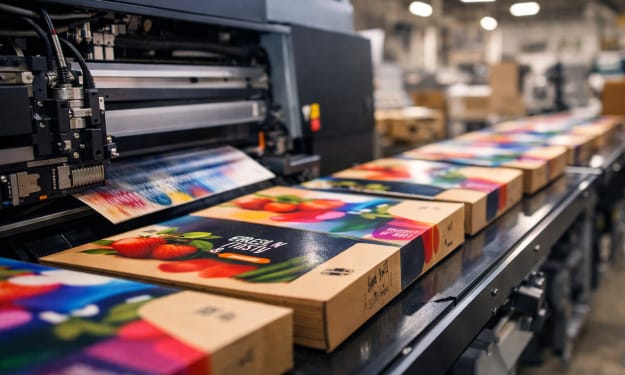
The Silent Revolution in Digital Packaging Printing
The box arrived before the product ever mattered. It sat on the table—bright, textured, personal—carrying a brand story before anything inside was touched. No excess plastic. No wasted ink. Just precision, color, and intent. This wasn’t mass production. It was something smarter. Faster. Almost human.
By Andrew Hamilton2 days ago in Journal
~ Fired ~
— Ai Intrusion ~ Are you Next ~ Is Ai Evolution after your job? — Few workplaces haven't been affected. Ai is in supermarkets, at doctors' offices, and even monitoring farms. I just can't think of anything this machine is not getting into, can you? For instance: Education ~ Law and Tech jobs will one day have a major influence or be taken over by these inanimate machines, with accuracy and vigor. From mechanics' diagnoses to a wide variety of everyday jobs, including fast food workers, with this input having the ability to cut their unnecessary work hours. I'm certain all of us have been touched by this with our short stories and colorful headings, have you? Even comments are very questionable 'Non-Robot' insertions.
By Jay Kantor5 days ago in Journal


Comments
There are no comments for this story
Be the first to respond and start the conversation.