
Automation Advancing: Robotic Process Automation Market to Grow at 23.13% CAGR Through 2034
Robots on the Rise: Robotic Process Automation Market Set to Revolutionize Business Operations Over the Next Decade

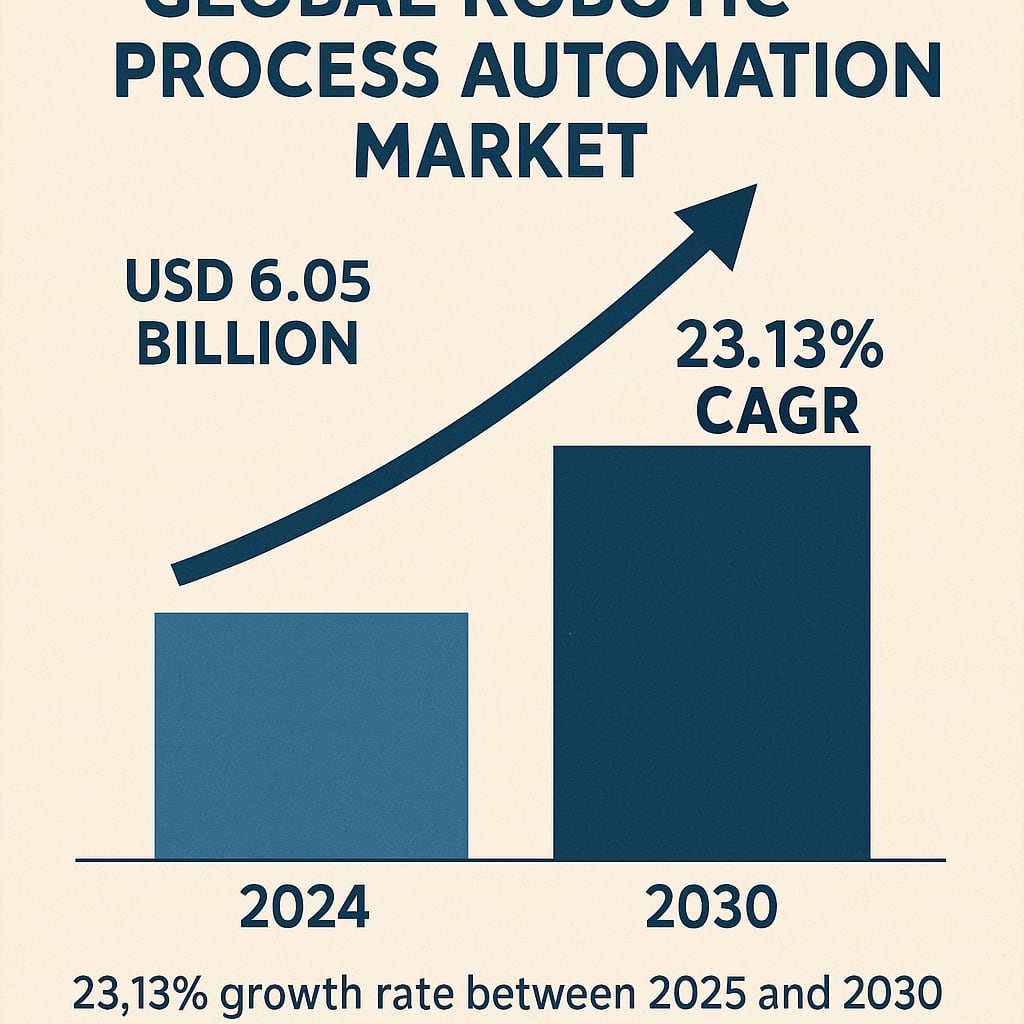
By 2024 the global Robotic Process Automation Market Size is projected to hit USD 6.05 billion and will experience a 23.13% growth rate between 2025 and 2030. Businesses' need for improved operational efficiency and cost savings fuels the market's development.
Streamlining the Enterprise: Robotic Process Automation Reshaping Business Efficiency
The global Robotic Process Automation (RPA) market expands quickly because businesses in diverse industries need automation solutions to increase efficiency and cut costs while enhancing precision. Businesses utilize RPA systems to automate basic rule-based tasks which allows employees to focus on higher-value work. The integration of artificial intelligence and machine learning capabilities along with digital transformation initiatives accelerates market expansion for RPA platforms. Across various sectors such as financial services, healthcare institutions, retail businesses, and manufacturing companies RPA systems enhance operational performance through automation of customer service functions, data management tasks, compliance documentation work, and inventory management systems. The limited availability of qualified experts who can manage and develop RPA systems constitutes a major obstacle to market expansion and inhibits its implementation in small businesses or digitally immature organizations.
MARKET SEGMENTS:
The Global Robotic Process Automation Market is segmented By Type, By Deployment, By Enterprise size, By Operations, and By End-use.
The RPA market's "By Type" segment shows the Services area as the largest revenue contributor
The RPA market divides its type classification into Software and Services categories and Services holds the most substantial share of revenue. Consulting services lead automation readiness projects through organizational process mapping and optimization. Implementation services rank just below consulting services by directing full lifecycle bot deployment across legacy systems and cloud platforms. Training services complete the portfolio which prepares internal teams for both maintenance and expansion. The RPA software segment experiences the fastest growth because of low-code development interfaces demand together with pre-built connectors and rapid proof-of-concept deployments which reduce time-to-value.
Cloud-based deployment leads market share but on-premise installation experiences the highest growth rate.
The deployment segment is divided into, on-premise, and cloud segment. The majority of RPA solution deployments use cloud architectures because they provide scalable resources, subscription-based pricing models and reduce IT infrastructure demands. Cloud-native platforms quickly streamline user registration while consolidating control measures and deliver updates to features automatically. On-premise RPA installations show the highest growth rate because heavily regulated sectors and large corporations with strict data-security requirements choose localized deployments to maintain complete control over sensitive processes while complying with their internal policies.
Request a FREE Sample Copy of this research study - https://www.theresearchinsights.com/reports/robotic-process-automation-market-1153/request-sample
The biggest market share belongs to large enterprises while SMEs demonstrate the quickest growth in adoption rates.
The Enterprise segment is sub segmented into large enterprises, and SMEs. Large corporations dominate RPA revenue generation because they utilize extensive robotic fleets for global back-office operation optimization and digital transformation implementation. Small and medium-sized enterprises (SMEs) demonstrate the fastest growth in the RPA market due to affordable cloud-based robotic process automation services and ready-to-use industry templates. The solutions enable SMEs to implement automation for essential operations like order processing and helpdesk ticketing while avoiding substantial initial expenditures.
The foundation of RPA operations is rule-based automation while knowledge-based RPA is quickly becoming a significant force.
The operations segment is divided into, rule based, and knowledge-based segment. Rule-based bots that perform predictable data extraction and entry tasks remain the leading force in RPA operations because they deliver proven financial returns and are simple to implement. Knowledge-based automation which merges RPA with AI capabilities such as natural language processing and machine learning represents the most rapidly expanding segment. Cognitive bots have the ability to process unstructured data and make decisions based on context while learning from exceptions which allows RPA to be used in more intricate tasks such as customer service support, claims assessment, and document handling.
BFSI has the highest adoption rate among end-use verticals but Pharma & Healthcare lead in terms of high-growth adoption for RPA solutions
The end use segment is divided into, BFSI, Pharma & Healthcare, Retail & Consumer Goods, Information Technology (IT) & Telecom, Communication and Media & Education, Manufacturing, Logistics, Energy & Utilities, and Others segment. BFSI leads as the biggest user of RPA technology across end-use verticals by automating compliance reporting and KYC/AML checks and enabling transaction processing at large scales. Pharma & Healthcare show the fastest growth with organizations implementing bots to handle claims management together with patient-onboarding and supply-chain traceability. The Retail & Consumer Goods sector along with IT & Telecom Media & Education Manufacturing Logistics Energy & Utilities together with an expanding “Others” category implement RPA technology to enhance inventory administration billing processes customer service operations and field-service management.
The Asia Pacific region will achieve the highest CAGR in the RPA market globally between 2025 and 2034.
The Asia Pacific region has become the quickest expanding RPA market thanks to proactive digitalization plans and extensive government support. Large-scale public-private automation investments are being accelerated through programs like Digital India, China's Internet Plus, and Japan's Society 5.0. The growing SME sector along with competitive labor expenses and a robust IT services field are stimulating interest in cloud-based RPA solutions which customers can subscribe to instead of purchasing outright. Regional platform developers are customizing their solutions to include local language support and regulatory compliance standards which boosts adoption rates. Industry leaders in South Korea and China are merging RPA technology with IoT and analytics systems to enhance their manufacturing operations while India and ASEAN nations employ robotic solutions to manage administrative and customer interaction tasks. The combination of these elements establishes Asia Pacific as the leading high-growth region for the RPA market.
North America maintains its position as the primary leader in the worldwide RPA industry.
North America maintains the largest market share in RPA due to its advanced digital transformation environment and substantial enterprise adoption. The United States and Canada maintain a high density of RPA vendor headquarters alongside specialist consulting firms and early adopter Fortune 500 companies. The need to meet regulatory requirements such as SOX, HIPAA, and stringent financial-reporting standards pushes banking, healthcare, and insurance organizations to utilize bots for compliance tracking, audit documentation, and secure management of data. North American enterprises maintain their ability to expand comprehensive enterprise-wide automation programs through a proven Center of Excellence (CoE) model combined with substantial R&D investments and skilled automation engineers. The region’s ecosystem advantage establishes its position as a leader for revenue generation and strategic innovation in the global RPA market.
US Tariff Impact on Robotic Process Automation Market | Trump Tariffs Ignite Global Business Evolution | REQUEST US TARIFF IMPACT ANALYSIS NOW - https://www.theresearchinsights.com/US_Tariff_Impact_Analysis?id=1153
Global Robotic Process Automation Market Dynamics:
Driver: Growing Use of Cutting-Edge Technologies Like AI, Cloud, and Machine Learning Strengthens RPA's Capabilities
Businesses are driving the rise of robotic process automation (RPA) because they require systems to automate business workflows and handle intricate data management. Leading industry players enhance their RPA solutions by integrating advanced technologies including cloud computing and AI with machine learning and cognitive capabilities for better scalability and functionality.
The combination of AI and cloud capabilities within RPA technologies boosts business operations by determining optimal processes while monitoring labour activities and recommending self-regulatory solutions. Modern businesses respond to evolving organizational needs by quickly developing and implementing AI-powered cloud-based RPA technologies. In May 2021 Automation Anywhere Inc. launched a new cloud-based RPA solution which allows businesses to deploy and manage bots while scaling them across server infrastructures efficiently.
The combination of AI and ML technologies enables comprehensive automation throughout systems which can process unstructured data and conduct data analysis to make predictions and enhance robotic decision-making. This intelligent automation solution significantly boosts both process reliability and operational flexibility. The global RPA market is projected to expand at an accelerated pace because cloud computing models such as Platform as a Service (PaaS), Infrastructure as a Service (IaaS), and Software as a Service (SaaS) enable businesses to expand automation projects with speed and cost-effectiveness.
Restraint: The RPA sector faces an acute shortage of skilled professionals necessary for development and governance.
Organizations that recognize the operational advantages of RPA programs face challenges in building and maintaining these initiatives because they lack skilled automation professionals. Deploying RPA effectively requires a diverse skill set that includes process analysts to map and optimize workflows alongside developers who can configure and test bots and IT specialists to integrate RPA tools into enterprise architectures securely. Budget limitations at mid-sized and smaller companies restrict their ability to conduct training programs and hire skilled talent which leads to delayed implementation and bot under-utilization. Firms that lack a defined Centre of Excellence (CoE) and career paths for “automation engineers” face high staff turnover and unreliable bot performance which undermines stakeholder trust and hampers future adoption efforts.
Opportunity: Expansion of Cloud-Native and SME-Focused RPA Offerings
SMEs now have democratized access to RPA platforms through cloud-based services offered as “Automation as a Service”. Companies can avoid significant initial infrastructure costs through subscription-based models which enable them to test pilots and adjust usage according to their business needs. When combined with ready-made industry templates like automated KYC processing for banks and e-commerce order management these platforms quickly deliver value while making technological adoption easier. The adoption of RPA by SMEs creates new business opportunities across retail, hospitality and non-profit sectors which drives growth for service providers and solution partners.
Challenge: Establishing Robust Governance to Prevent Bot Sprawl and Ensure Compliance
The growth of RPA programs results in organizations having to oversee hundreds or thousands of unattended bots in multiple business areas. Lack of a comprehensive governance framework results in “bot sprawl” which creates redundant processes and security risks while complicating maintenance tasks when bots process sensitive information such as personal and financial data. Organizations need well-defined bot management policies including ownership responsibility, version control systems, exception management procedures, and audit processes to address compliance risks such as GDPR and SOX and prevent unauthorized shadow-IT deployments. A dedicated CoE utilizing standardized development templates and security protocols along with performance KPIs is essential to enable scalable and strategic RPA deployment.
ORDER THIS REPORT STUDY NOW - https://www.theresearchinsights.com/license?id=1153
Key Companies:
• Automation Anywhere Inc.
• BlackLine Inc.
• Blue Prism Limited
• EdgeVerve Systems Limited
• FPT Software
• Microsoft
• NICE
• OnviSource, Inc.
• Pegasystems Inc.
• SAP SE
• Tungsten Automation Corporation
• UiPath
• Uniphore
• WorkFusion, Inc.
Recent Developments of Robotic Process Automation Market Report:
• In December 2024, The UAE’s AI, Digital Economy, and Remote Work Applications Office joined forces with UiPath to advance Agentic Automation which uses AI to power automation solutions. The UAE National AI Strategy facilitates this initiative to implement AI solutions throughout government departments and develop native AI expertise. The partnership offers a training program for up to 100 students and public sector employees and provides support to Coders HQ within the National Program for Coders framework.
• In November 2024, Automation Anywhere collaborated with PwC India to provide business automation solutions using Generative AI technology. Automation any where’s technology combined with PwC’s industry expertise serves as the foundation of this strategic alliance to improve operational efficiency in financial services, retail, and healthcare sectors. The collaboration between the two partners will enable organizations to reduce expenses and optimize their procedures while improving customer interactions.
• In June 2024, Automation Anywhere launched an advanced AI platform to optimize business workflow automation. The platform incorporates AI Agent Studio which allows businesses to develop AI bots tailored to proprietary data that function autonomously in digital ecosystems.
• In January 2024, Datamatics Global Services signed a two-year framework agreement with NHS Shared Business Services (SBS) in the UK to implement its TruBot RPA solution. The AI-powered tool will handle multiple administrative functions such as staff onboarding and patient registration while automating billing processes to boost operational efficiency in the public healthcare sector.
• In December 2023, Saudia Private launched its full digital transformation plan which includes the first implementation of Robotic Process Automation. This initiative functions as an element of wider strategies aimed at improving customer experience along with operational excellence.
• In October 2023, NewVision Software gained authorization to implement and resell UiPath solutions as a partner. The partnership seeks to speed up worldwide enterprise automation use while advancing digital transformation and cutting operational expenses.
• In February 2023, Robocorp, The Gen2 RPA leader Robocorp established a strategic partnership with North American automation and consulting firm Neostella to develop their Robot-as-a-Service offerings. This partnership delivers scalable automation solutions to help enterprises achieve their digital transformation goals.
About The Research Insights:
The Research Insights is a globally recognized provider of data analytics and strategic market intelligence. We specialize in delivering comprehensive insights into market dynamics shaped by both internal and external factors. Through our innovative research methodologies, we empower organizations to make data-driven decisions and stay ahead of emerging trends, technologies, and opportunities.
Contact Us:
The Research Insights Pvt. Ltd.
Email: [email protected]
Phone: +1-312-313-8080
About the Creator
Paxton Templeton
I’m a storyteller at heart with a passion for turning data into compelling narratives. With a focus on industry trends, market insights, and growth statistics, I bring clarity to complexity
Keep reading
More stories from Paxton Templeton and writers in Journal and other communities.
Cultivating Progress: Global Agricultural Films Market to Grow at 3.8% CAGR Through 2034
Growing with the Field: Agricultural Films Market Forecast to 2034 The global Agricultural Films Market will grow from US$ 11.7 billion in 2025 to an estimated US$ 16.4 billion by 2034 while maintaining a compound annual growth rate (CAGR) of 3.8%. The primary factors driving growth include rising demand for higher agricultural productivity together with expanded use of protected farming methods such as greenhouses and mulching and increased adoption of advanced films possessing UV resistance and thermic properties. Subsidies and governmental backing in emerging Asia Pacific markets stimulate plasticulture adoption. The market encounters stumbling blocks due to environmental issues related to plastic waste and the unstable price of essential materials such as polyethylene. Sustainable farming methods are creating new chances through the progression of biodegradable and recyclable films. Developing regions face market challenges due to insufficient film collection systems and recycling infrastructure along with low farmer awareness. Precision agriculture gains traction alongside investments in high-performance silage and greenhouse films and a move toward eco-friendly materials. The Asia Pacific region leads the agricultural films market because of extensive crop farming and state-supported agricultural changes while Europe and North America move toward sustainable product development and circular economy methodologies.
By Paxton Templeton9 months ago in Journal
The goals I did not achieve
Every writing goal I made for the year is a wash. It has been this way for a while, but I think it's important to be open about my failures and the reality of how life can get in the way. This is especially true considering the several times I have posted on Vocal about my writing goals, how I was changing my approach, and where I was hoping to be for the upcoming year. I will probably do that again in a couple months, but for now, it is time to acknowledge where I am today.
By Kay Husnick23 days ago in Journal
The ChatGPT Tell-All: I Fixed The 5 Mistakes That Made My Content Sound Fake
How I Stopped Sounding Like a Robot and Saved My Blog (And The 5 Mistakes That Gave Me Away) Let me be brutally honest with you for a second. There was a time last year when I was pretty proud of myself. My content calendar was packed, posts were going up like clockwork, and I felt like I’d finally cracked the code. I had this new, incredible tool—you know the one—and it was like a superpower. Suddenly, the blank page wasn’t scary anymore. I’d hit a button, and poof, a perfectly competent, grammatically pristine article would appear.
By John Arthor3 days ago in Journal


Comments
There are no comments for this story
Be the first to respond and start the conversation.