
Cultivating Progress: Global Agricultural Films Market to Grow at 3.8% CAGR Through 2034
From $11.7B to $16.4B: Agricultural Films Market on a Steady Upward Trajectory

Growing with the Field: Agricultural Films Market Forecast to 2034
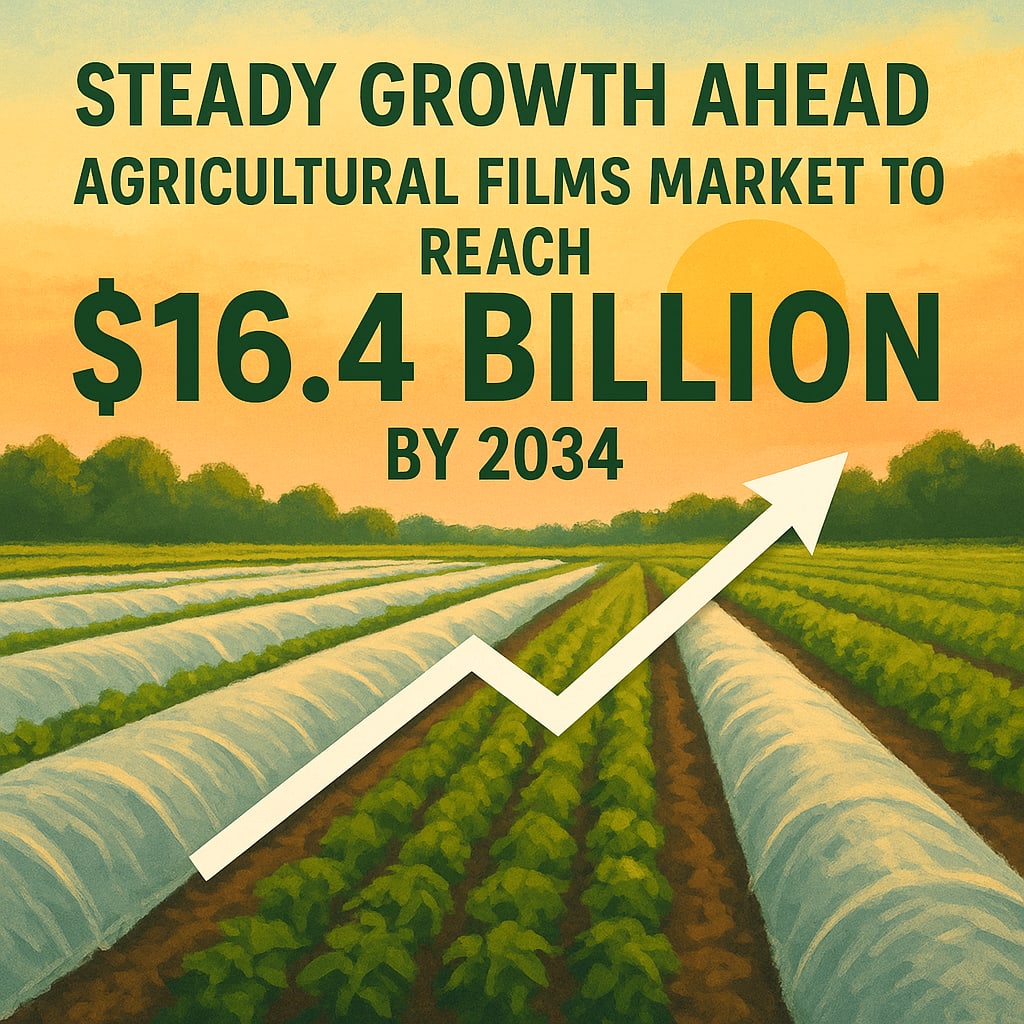
The global Agricultural Films Market will grow from US$ 11.7 billion in 2025 to an estimated US$ 16.4 billion by 2034 while maintaining a compound annual growth rate (CAGR) of 3.8%. The primary factors driving growth include rising demand for higher agricultural productivity together with expanded use of protected farming methods such as greenhouses and mulching and increased adoption of advanced films possessing UV resistance and thermic properties. Subsidies and governmental backing in emerging Asia Pacific markets stimulate plasticulture adoption. The market encounters stumbling blocks due to environmental issues related to plastic waste and the unstable price of essential materials such as polyethylene. Sustainable farming methods are creating new chances through the progression of biodegradable and recyclable films. Developing regions face market challenges due to insufficient film collection systems and recycling infrastructure along with low farmer awareness. Precision agriculture gains traction alongside investments in high-performance silage and greenhouse films and a move toward eco-friendly materials. The Asia Pacific region leads the agricultural films market because of extensive crop farming and state-supported agricultural changes while Europe and North America move toward sustainable product development and circular economy methodologies.
Agricultural Films Market Dynamics –
Drivers:
Protected farming techniques fuelling demand for high quality agricultural films
• International focus on boosting crop output and reducing environmental risks has led to greater use of protected farming methods which has driven up the need for agricultural films. Greenhouses alongside mulching and silage storage generate controlled growing conditions which improve productivity and lower expenses while supporting continuous production throughout the year thereby appealing to both commercial and small-scale agricultural operators. Specialized films in greenhouse farming provide UV protection as well as infrared blocking and condensation control to maintain a stable microclimate. The specialized films used in greenhouses enable maximum light passage and maintain suitable temperature and humidity levels which support the growth of valuable crops like tomatoes and cucumbers as well as flowers in extreme weather areas.
• Mulch films serve as a major component by being extensively applied for weed suppression and soil moisture retention while helping regulate soil temperature and enhancing crop uniformity. The extensive adoption of these techniques in vegetable farming and horticulture demonstrates farmers' efforts to achieve higher planting density while minimizing herbicide application. Farmers employ coloured mulch films including black, silver and white types as part of their agricultural practices. The application of coloured mulch films helps control pests and manage thermal conditions which leads to enhanced crop quality.
• Fodder storage in dairy and livestock sectors requires silage films for effective preservation. These materials stop spoilage by reducing oxygen exposure which preserves nutritional value and extends forage storage life. Protected farming expansion stands as the main driver of agricultural films market growth through increased awareness and beneficial policies alongside technological advancements. The unpredictability of climate patterns makes these films an essential sustainable tool for crop protection and productivity improvement to address global food security concerns.
Request a FREE Sample Copy of this research study - https://www.theresearchinsights.com/reports/agricultural-films-market-644/request-sample
Restraints:
Limited awareness among small farmers coupled with financials problems can impede agricultural films market
• The adoption of agricultural films which improve crop yields and farming efficiency stays restricted among small-scale farmers in rural and developing areas despite their proven advantages. The adoption of film-based agricultural solutions faces constraints because of limited awareness combined with insufficient technical skills and restricted access to financial resources.
• Financial barriers exacerbate the problem. Advanced agricultural films featuring UV protection, thermic control or biodegradation properties usually come with higher initial costs. Small-scale farmers with limited financial flexibility might find initial costs prohibitive without external financial support such as subsidies or credit options. Local cooperatives together with NGOs and government programs support awareness and financial aid but their reach remains fragmented and inconsistent.
• The agricultural films market faces a major obstacle as it attempts to expand its reach into developing economies where large numbers of agricultural populations exist. To deepen agricultural films market penetration in developing economies manufacturers and policymakers need to work together to establish demonstration farms and workshops while offering localized training and affordable films or financing options for smallholders. The agricultural films market requires bridging the gap between knowledge and affordability to unlock its full growth potential and achieve sustainable agricultural development that includes all farmers.
Opportunities:
Biodegradable agricultural films gaining traction for sustainable farming solutions
• The agricultural films market experiences major change through sustainable farming trends which promote biodegradable and compostable film adoption globally. The growing awareness of plastic pollution issues among farmers, policymakers and manufacturers has led to a broader acceptance of sustainable alternatives that maintain crop efficiency while minimizing ecological damage over time.
• Under appropriate conditions these films naturally break down which results in minimal waste and eliminates the need for arduous post-harvest removal tasks. The solution improves soil health while addressing plastic waste problems and cutting down post-harvest operational expenses. These applications consist of mulch films which can be tilled back into soil after their use period and compostable greenhouse films that support seasonal farming while maintaining environmental sustainability.
• Manufacturers in the agricultural films market can now pursue innovative product development and establish unique value offerings because of this transition. European nations have started implementing both incentives and regulatory requirements to boost the adoption of biodegradable farming films. The push from large agricultural businesses and food producers to decarbonize their supply chains is boosting the need for sustainable film products.
Challenges:
Underdeveloped recycling infrastructure can hamper the circular economy process among agricultural films market
• The agricultural films market faces sustainability challenges because recycling infrastructure remains underdeveloped throughout numerous countries particularly in emerging economies. Agricultural films like mulch films and silage wraps boost crop growth yet their disposal creates serious environmental and logistical problems.
• Regulators and environmental advocates are intensifying their examination of the agricultural films market to promote end-of-life solutions for sustainable circular economy practices. The absence of essential infrastructure including collection centers and reprocessing plants makes the concept of recyclability theoretical rather than practical. Regions such as South Asia, Sub-Saharan Africa and portions of Latin America face limitations in both awareness and funding for agricultural plastic waste management.
• The economic benefits of recycling agricultural films remain insufficient to motivate widespread adoption. Investors hesitate to support the recycling sector because processing soiled films costs more than the recycled material's worth. Developed nations have launched initial programs with private sector collaboration to tackle this problem yet global implementation shows uneven results.
• The agricultural films market needs to form partnerships with governments, NGOs and recyclers to develop scalable and financially feasible waste management solutions for sustainable growth. A responsible recycling system requires the implementation of film return incentives alongside uniform recyclable film standards and investment in self-cleaning or separable film technology.
Trends:
Growing demand for horticulture and floriculture driving the global agricultural films market size
• The global interest in ornamental plants and high-value horticultural products drives increased use of protective plastic films which accelerates growth within the agricultural films market. The increasing urbanization combined with rising incomes leads to greater consumer demand for attractive landscapes and healthy produce which forces farmers to use advanced growing methods that depend on specialized agricultural films.
• Greenhouse films with UV stability and diffused light transmission features along with anti-condensation properties now form essential components for floriculture in export-focused areas including Kenya, Colombia, India, and the Netherlands. These functional characteristics facilitate proper photosynthesis and flower growth while reducing disease occurrence due to high humidity and temperature fluctuations. Greenhouse films create controlled growing environments that enable farmers to lengthen their growing seasons while minimizing pesticide use which helps achieve sustainability objectives.
• The agricultural films market exploits this growing demand by providing customized solutions like color-specific mulch films and biodegradable films along with light-modifying greenhouse covers which cater especially to sensitive horticultural and floral crops. The market for agricultural films will experience growth as high-performance products become necessary to support expanding floriculture and horticulture industries driven by lifestyle changes and export opportunities. The improvement of crop appearance, quality and shelf-life with these films establishes them as crucial for contemporary agriculture that prioritizes value.
Agricultural Films Market Segmentation Insights –
Wide range of end use for mulch films driving the growth of agricultural films market:
Product-specific innovations now dominate the agricultural films market because they address various farming needs through specialized options including mulch films and greenhouse films alongside silage films and tunnel films. Different agricultural film types fulfill unique functions that together improve farming efficiency while supporting sustainability and crop quality across diverse climates and agricultural methods.
Mulch films stand as the most popular choice in agricultural use, particularly for vegetable and fruit farming while providing advantages such as soil moisture preservation and temperature control. Biodegradable and photodegradable variants represent recent advancements that address environmental issues while keeping agronomic effectiveness intact. These films serve a crucial role in high-density planting systems and their adoption is accelerating in regions that experience water shortages.
The agricultural films market extends to specialty products like fumigation films and UV-blocking covers which broaden film applications for various crops throughout different regions. Film-based solutions become more important for modern agriculture because of increasing climate variability and the requirement for sustainable intensification.
Horticulture leads the agricultural films market due to expanding demand for advance farming techniques:
The agricultural films market demonstrates dynamic expansion through increased usage in important farming areas including horticulture and floriculture as well as fodder & silage storage and specialized agricultural techniques. Agricultural films enhance productivity levels and crop quality while supporting environmental sustainability in various segments which shows the adoption of precision farming and protected agriculture methods.
Specialized greenhouse films play a critical role in Floriculture which serves the worldwide market for ornamental plants and cut flowers especially in export-focused nations such as the Netherlands, India and Kenya. Specialized greenhouse films provide perfect light diffusion along with UV protection and humidity control that enables consistent flowering and extends product shelf life. New developments in multi-layer barrier film technology enhance both product longevity and environmental sustainability.
Customized agricultural films are increasingly used in nurseries as well as for soil fumigation and crop protection during transportation. The growing need for efficient and crop-specific sustainable solutions directs the agricultural films market toward technological progress and further diversification.
Agricultural Films Market Regional Insights –
Asia Pacific (APAC):
The Asia Pacific region leads the agricultural films market because of its extensive agricultural land and dense population with China and India adopting advanced farming methodologies. Government subsidies in combination with protected cultivation and rising demand for high-yield crops create food security in the region which leads to it being the biggest consumer of mulch and greenhouse films.
Europe:
The horticulture and floriculture sectors of Europe establish its position as the second-largest market with the Netherlands, Spain, and Italy leading the way. The combination of strict environmental regulations and sustainability mandates pushes European farmers to become pioneers in using biodegradable and recyclable agricultural films.
United States:
The United States commands an important regional market position by leveraging extensive commercial farming practices along with substantial silage film use in livestock and dairy sectors. North American film usage continues to increase due to technological innovations and a growing focus on soil health together with precision agriculture adoption. The three regions together create the fundamental demand foundation for agricultural films while each area drives unique market trends and technological advancements.
Key Agricultural Films Market Companies:
The following are the leading companies in the agricultural films market. These companies collectively hold the largest market share and dictate industry trends.
1. Berry Global Inc
2. RKW Group
3. Coveris
4. Ab Rani Plast Oy
5. Industrial Development Company Sal
6. Armando Alvarez Group
7. Kuraray Co., Ltd
8. Plastika Kritis
9. Trioworld Industrier AB
10. Groupe Barbier
Recent Developments for Agricultural Films Market:
• In January 2024, RKW Group launched film and net solutions with non-wovens for the entire supply chain at Fruit Logistica expo in Berlin.
• In April 2025, Berry Global Inc launched Silotite Film&Film (F&F) which is a silage wrap solution.
• In October 2023, Grupo Armando Alvarez collaborated with RedSea for the production and distribution of the new intelligent greenhouse covers.
About The Research Insights:
The Research Insights is a globally recognized provider of data analytics and strategic market intelligence. We specialize in delivering comprehensive insights into market dynamics shaped by both internal and external factors. Through our innovative research methodologies, we empower organizations to make data-driven decisions and stay ahead of emerging trends, technologies, and opportunities.
Contact Us:
The Research Insights Pvt. Ltd.
Email: [email protected]
Phone: +1-312-313-8080
About the Creator
Paxton Templeton
I’m a storyteller at heart with a passion for turning data into compelling narratives. With a focus on industry trends, market insights, and growth statistics, I bring clarity to complexity
Keep reading
More stories from Paxton Templeton and writers in Journal and other communities.
Revolutionizing Industries: Smart Robots Market to Drive Transformation with 26.5% CAGR by 2030
Unlocking Growth Through Automation, Innovation, and AI Integration The Global Smart Robots Market is expected to experience substantial growth, with its valuation projected to reach USD 33.83 billion by 2024. From 2025 to 2030, the market is anticipated to expand at a robust Compound Annual Growth Rate (CAGR) of 26.5%. The increasing adoption of AI and advanced sensor technologies across new applications is set to propel growth in the smart robot’s market.
By Paxton Templeton9 months ago in Journal
Comparing Requirements for Ambulatory Care Facilities
Introduction Ambulatory care facilities (ACFs) provide medical services to patients who do not require overnight hospitalization. These facilities include outpatient clinics, urgent care centers, surgical centers, and specialized treatment sites. While they share a common focus on outpatient care, requirements for operation, staffing, compliance, and safety vary significantly based on facility type and scope of services. Understanding these differences is essential for healthcare administrators, clinical leaders, and investors. Comparing requirements ensures compliance, patient safety, and operational efficiency, while guiding planning, budgeting, and resource allocation.
By Abdul Mueed4 days ago in Journal



Comments
There are no comments for this story
Be the first to respond and start the conversation.