
Australia Wind Power Market: Growth, Share, Trends & Grid Reality
From USD 2.72 billion in 2024 to an anticipated USD 4.78 billion by 2033 (CAGR ~5.80%), wind energy in Australia is accelerating—spurred by policy, storage pairing, and corporate demand, while offshore wind edges into the fore.

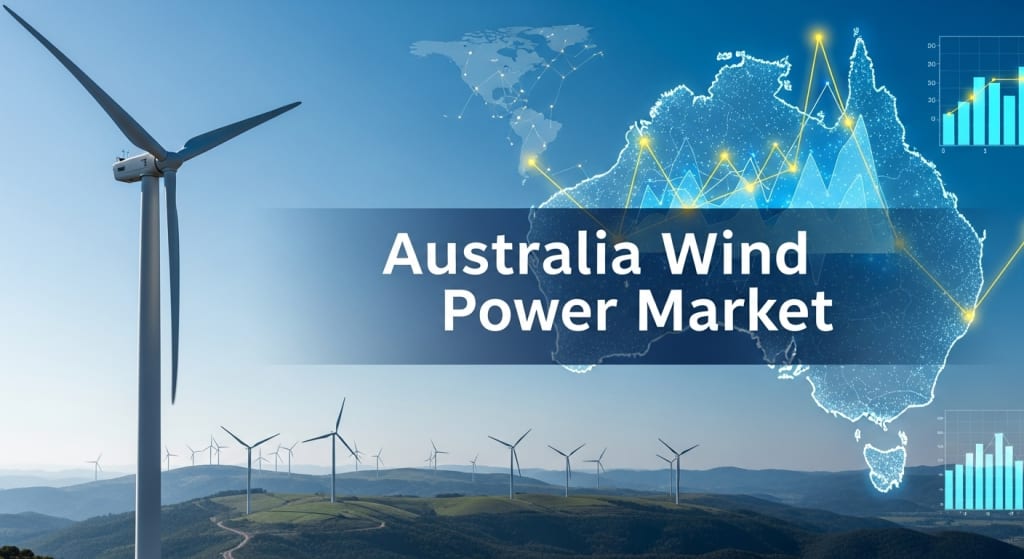
Market Overview
- In 2024, the Australian wind power market was valued at USD 2.72 billion.
- By 2033, it is projected to grow to USD 4.78 billion, at a compound annual growth rate (CAGR) of approximately 5.80% between 2025-2033.
- The report covers both onshore and offshore installations, along with regional breakdowns for New South Wales/ACT; Victoria/Tasmania; Queensland; Northern Territory & Southern Australia; Western Australia.
- Key Figures: The market is supported by declining technology costs, government incentives, improving turbine efficiency, and an increasing portion of corporate demand for clean energy.
Key Trends & Market Drivers
1. Integration with Energy Storage Systems
Wind’s inherent intermittency (i.e. when the wind doesn’t blow) is being offset by pairing projects with large battery storage. For example, utility-scale batteries are increasingly co-locating with wind farms or acting as virtual power plants (VPPs). As battery costs fall and government incentives strengthen, storage is becoming essential to maintaining grid stability and maximizing the value of wind production.
2. Growth in Offshore Wind Zones
Offshore wind is gaining both regulatory support and investor interest. Feasibility licences have been issued (e.g., in Victoria), and governments are mapping zones (Gippsland, Hunter coasts) for offshore projects. Offshore wind offers steadier, often stronger winds and proximity to coastal demand centers—advantages that onshore cannot always share.
3. Corporate Power Purchase Agreements (PPAs)
More companies (miners, retailers, manufacturing firms) are locking in long-term PPAs with wind farms as part of sustainability strategies. These contracts provide predictable revenue, making it easier to finance projects, especially in more remote or challenging sites.
4. Technological Efficiency Improvements
Advances in turbine design (longer blades, taller towers), project scale, predictive maintenance, remote monitoring, and digital tools are reducing costs per megawatt-hour, improving reliability and reducing downtime. These improvements also enable viable wind projects in regions with lower average wind speeds.
5. Policy Support & Renewable Targets
Australia’s clean energy transition is backed by federal and state targets for renewables, along with legislative and regulatory support (e.g., feasibility licensing, auctions for offshore wind, renewable energy certificates). These create clarity and long-term signal for investors.
6. Investor Appetite & ESG Pressures
Domestic and foreign investors are increasingly interested in wind power as part of portfolios with environmental, social, and governance (ESG) mandates. Wind farms are seen not just as energy assets, but as climate solutions with long life spans.
Get a PDF, Request for a Free Sample Report: https://www.imarcgroup.com/australia-wind-power-market/requestsample
Opportunities in the Australia Wind Power Market
Offshore Wind Project Deployment
As zones are declared and regulatory frameworks clarified, offshore wind has huge untapped potential. Companies with experience in deep-water foundations, floating platforms, and marine construction will gain an advantage. Also, offshore projects near population centers reduce transmission losses and cost.
Hybrid & Renewable Integration
Pairing wind with solar + battery projects (hybrid renewable sites) can smooth generation profiles, improve utilization, and reduce curtailment. Investors and developers who build flexible, hybrid generation + storage models will likely see better returns.
Component Manufacturing & Local Supply Chains
Turbine blades, support structures, electrical infrastructure components—there is growing opportunity for domestic production or assembly. Localizing supply chains helps reduce logistics cost, lead time, and exposure to global supply disruptions.
Economic Growth in Regional Communities
Wind farm installation, especially onshore, creates jobs (site preparation, construction, maintenance), and can provide lease income to landowners. Regional areas can leverage these for economic diversification.
Regulatory & Policy Innovation
Governments can accelerate adoption via streamlined approvals, transparent offshore wind tenders, incentives for grid upgrades, and recognition of storage/hybrid systems in energy policy. Policies around transmission infrastructure (interconnectors), community engagement, and environmental safeguards are especially valuable.
Corporate & Institutional Clean Energy Demand
As more companies commit to net-zero targets, demand for clean, predictable renewable energy (including wind) rises. There’s opportunity for financial instruments (green bonds), sustainability-linked PPAs, renewable certificates, and risk mitigation products in the wind ecosystem.
Recent News & Developments in the Australia Wind Power Market
Victoria to Launch First Offshore Wind Auction (September 2025)
The state government in Victoria announced it will hold its first offshore wind auction in September 2025, with contracts to be awarded by October 2026. This is part of Victoria’s target to reach 2GW of offshore wind by 2032, 4GW by 2035, and 9GW by 2040.
“Turbine Made” Blade Recycling Initiative
ACCIONA’s program Turbine Made launched in Victoria, aiming to recycle decommissioned wind turbine blades into new materials. The Waubra Wind Farm contributed a blade for conversion into multifunctional particles for use in sustainable manufacturing. This initiative is helping manage blade waste and support circular economy goals.
Feasibility Licences in Gippsland & Other Zones
Several offshore wind projects have secured feasibility licences (e.g., Gippsland, Victoria), including large proposed projects that could collectively generate tens of gigawatts. These represent early but concrete steps towards large-scale offshore deployment.
Growing Capacity in Onshore Wind & PPAs
Onshore wind continues to be the backbone of wind power in Australia, with new projects being developed, often tied to PPAs. Corporate entities are signing deals to source electricity from wind farms, aiding vs volatility in wholesale markets. This expands both capacity and stability of revenue for operators.
Component Market Growth
The wind turbine component segment—the market for blades, towers, electrical and support parts—is also growing. In 2024 this segment was approx USD 2.7 billion and is projected to reach ~USD 4.6 billion by 2033 (CAGR ~6.07%). This growth reflects higher demand, both domestic and through imports, investments in component innovation, and supply chain activity.
Browse Full Report with TOC & List of Figures: https://www.imarcgroup.com/australia-wind-power-market
For Communities & Regions: Wind farms—both onshore and offshore—offer economic opportunities (construction jobs, long-term maintenance employment, land leases), improved infrastructure, and local investment. Regions with strong wind resources stand to benefit materially.
For Energy Systems & Grid Stability: As Australia phases out fossil generators and scales up renewables, wind’s variability must be managed. Storage, grid upgrades, interconnectors, hybrid systems—all become essential. Policies that support grid reliability will determine how well wind integrates into the mix.
For Investors & Clean Energy Developers: Wind offers a relatively mature, scalable path to supply renewable energy. Projects backed by strong PPAs, good resource quality, and located in zones with favorable regulation are more likely to succeed. Component manufacturing is another area with potential upside.
For Policymakers: Meeting emissions targets (net-zero by 2050), national renewable energy goals, and balancing affordability & reliability require supportive frameworks. Transparent permitting, offshore zone management, investment in transmission, and financial incentives are levers.
For Environmental & Sustainability Goals: Wind power contributes significantly to decarbonization. Initiatives like blade recycling address lifecycle issues. Offshore vs onshore siting decisions must carefully weigh environmental, marine, and community impacts.
About the Creator
Kevin Cooper
Hi, I'm Kavin Cooper — a tech enthusiast who loves exploring the latest innovations, gadgets, and trends. Passionate about technology and always curious to learn and share insights with the world!
Keep reading
More stories from Kevin Cooper and writers in Journal and other communities.
Australia Modular Construction Market: Growth, Trends, Drivers, Greener & Smarter
Market Overview In 2024, the Australia modular construction market was valued at USD 11.3 billion. By 2033, the market is expected to grow to about USD 16.4 billion, exhibit¬ing a compound annual growth rate (CAGR) of approximately 4.22% from 2025-2033. The report segments by Type (Permanent, Relocatable), Module Type (Four-sided; Open-sided; Partially open-sided; Mixed modules and floor cassettes; Modules supported by a primary structure; Others), Material (Steel; Concrete; Wood; Plastic; Others), and End Use (Residential; Commercial; Education; Retail; Hospitality; Healthcare; Others). Key drivers: rising housing demand, government infrastructure investment, environmental concerns pushing sustainability, labour shortages in traditional construction, and technological advances in off-site production.
By Kevin Cooper3 months ago in Journal
How Much Does It Cost to Start an Outpatient Rehab Treatment Facility
Introduction to Outpatient Rehab Facility Costs Establishing an outpatient rehabilitation treatment facility requires a nuanced understanding of both healthcare delivery and business economics. Unlike residential centers, outpatient programs typically involve lower capital intensity, yet they still demand substantial upfront investment. Costs vary widely based on geography, service scope, and regulatory rigor. A modest facility may require a few hundred thousand dollars to launch, while a comprehensive center offering multiple therapies can exceed seven figures. Prudent financial forecasting at the outset reduces fiscal turbulence later and creates a foundation for sustainable operations.
By Fida Hassain5 days ago in Journal
Wild Card Weekend Recap: What Happens Now?
I think I figured out why I love Wild Card Weekend so much. It's because it's the first playoff anything of the calendar year. The NFL season starts in the fall, and once upon a time, the champion was crowned either on or slightly before New Year's. The evolution of the NFL schedule has resulted in the playoffs starting just into the New Year, and currently, the final week of the season falls on the first weekend of the New Year, with Wild Card Weekend coming a week after that. So yes, chronologically, the NFL's Wild Card Weekend serves as the first playoff anything of the calendar year.
By Clyde E. Dawkins7 days ago in Unbalanced



Comments
There are no comments for this story
Be the first to respond and start the conversation.