
Australia Modular Construction Market: Growth, Trends, Drivers, Greener & Smarter
From USD 11.3 billion in 2024 to a forecast USD 16.4 billion by 2033 (CAGR ~4.22%), modular construction is gaining serious ground in Australia—as governments, builders, and communities look for solutions to housing demand, cost pressures, and environmental challenges.

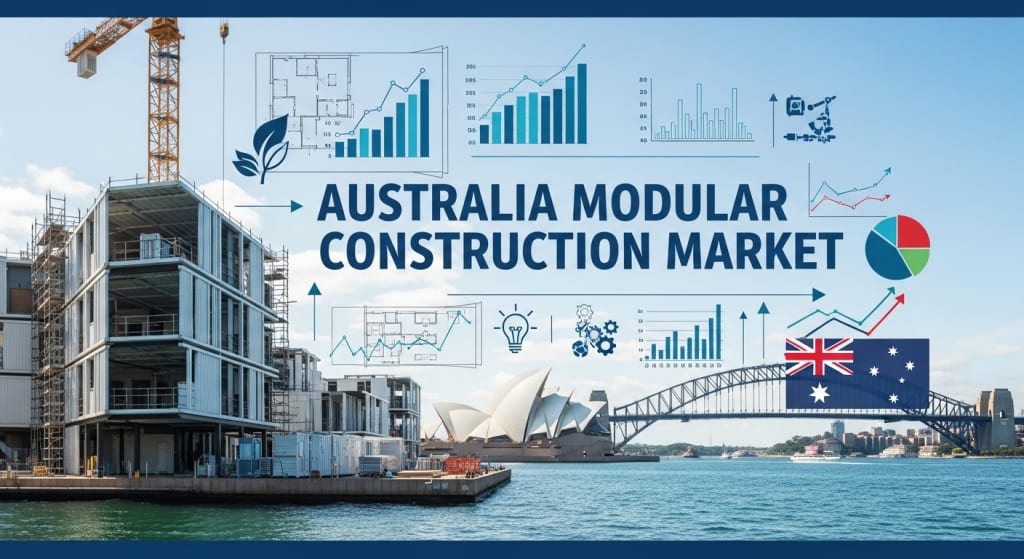
Market Overview
- In 2024, the Australia modular construction market was valued at USD 11.3 billion.
- By 2033, the market is expected to grow to about USD 16.4 billion, exhibit¬ing a compound annual growth rate (CAGR) of approximately 4.22% from 2025-2033.
- The report segments by Type (Permanent, Relocatable), Module Type (Four-sided; Open-sided; Partially open-sided; Mixed modules and floor cassettes; Modules supported by a primary structure; Others), Material (Steel; Concrete; Wood; Plastic; Others), and End Use (Residential; Commercial; Education; Retail; Hospitality; Healthcare; Others).
- Key drivers: rising housing demand, government infrastructure investment, environmental concerns pushing sustainability, labour shortages in traditional construction, and technological advances in off-site production.
Key Trends & Market Drivers
1. Housing Demand & Urbanization
Australia’s population continues to rise, pushing demand for more housing—especially affordable, social, and fast-build options. Modular construction addresses this with quicker delivery times and scalable units.
2. Government Infrastructure Investment & Policy Support
Substantial public spending on infrastructure and housing (federal and state levels) is increasingly including prefabrication and modular projects. For instance, the Albanese government has committed funds to modular/prefab housing initiatives under its 1.2 million homes target.
3. Labour Shortages & Efficiency Gains
Traditional construction faces shortages of skilled labour. Modular approaches shift much work off-site to factories, reducing dependency on on-site labour, improving safety, speeding construction, and enabling better scheduling.
4. Sustainability, Waste Reduction & Material Innovation
Modular construction tends to produce less waste, allows for reuse or recycling of modules, uses lighter or engineered materials, and fits with green building standards. Use of improved insulation, energy-efficient components, and reduced carbon footprint through factory control are important trends.
5. Technological Integration & Automation
Robotics, factory automation, digital collaboration tools, prefabricated panel systems, and consistent quality control are being embraced. Companies like Modscape have been developing robotic lines for panelised wall systems to increase precision, reduce waste, and speed production.
Get a PDF, Request For a Free Sample Report: https://www.imarcgroup.com/australia-modular-construction-market/requestsample
Opportunities in the Australian Modular Construction Market
Social & Affordable Housing Scale-Up
One of the more impactful opportunities is in delivering social housing using modular construction. Projects that combine modular homes for seniors, people with disability, or low-income households can achieve speed and cost efficiencies without compromising design or quality.
Regional & Remote Applications
Remote areas, Indigenous communities, or far-out locations face challenges in conventional building (transport costs, labour, logistics). Modular modules manufactured in factories and transported for assembly offer viable solutions. Also good for institutional buildings (schools, clinics) in remote zones.
Private Sector Residential & Customised Homes
Demand for individual or custom modular homes is rising, especially among cost-conscious urban buyers or those seeking alternate housing models. As quality and aesthetics improve (with steel or wood frames, premium finishes), modular homes are being seen less as temporary or utilitarian and more designer, permanent.
Commercial & Institutional Buildings
Offices, education buildings (classrooms, prefabricated schools), healthcare facilities can benefit from modularity, especially where speed matters. Example: modular data centre modules, modular school structures shipped to remote areas.
Innovation in Certification & Regulatory Frameworks
Streamlining building approvals, harmonizing state-by-state regulations, establishing national or voluntary certification for offsite construction, and recognizing modular standards will reduce delays and increase adoption. Government support of this nature is already being discussed/applied.
Sustainability as a Selling Point
Buyers increasingly care about energy use, carbon footprint, supply chain transparency. Modular homes with green certification, efficient materials, waste reduction, perhaps net-zero or solar-ready features, will find a competitive edge.
Recent News & Developments in the Australia Modular Construction Market
July 2025 – First modular buildings installed at Cairns affordable housing precinct, FCC Construction Australia installed the first modular buildings at Queensland’s Woree precinct: 1,008 prefabricated modules making up 16 architecturally designed buildings, delivering homes for seniors and people living with disability. This project is among the largest social and affordable modular housing projects in Australia/Southern Hemisphere.
Mid-2025 – Regulatory block in Townsville modular homes plan, Instant Expandable Homes NQ (Townsville) producing modular/container-based affordable homes faced obstacles due to building code regulations (accessibility, standards, import compliance). Shows that regulatory barriers are still a key bottleneck in adoption.
Earlier 2025 – Government commitment: $54 million for prefab & modular housing, As part of meeting the 1.2 million homes by 2029 target, the Australian government allocated funding for modular/prefab home construction, and announced plans to develop a voluntary national certification process for offsite construction.
Recent months – BoxMod modular homes in Adelaide, A developer producing modular homes in a Chinese mega-factory for the South Australian market has come under spotlight: offering high quality, fully fitted two-bedroom homes for just under AUD 300,000 excluding land. Also, a pilot scheme of 120 prefabricated homes under the Regional Key Worker Housing Scheme was launched.
Browse Full Report with TOC & List of Figures: https://www.imarcgroup.com/australia-modular-construction-market
For homebuyers & renters, modular construction promises faster build times, lower costs (once regulatory and transport costs are managed), better quality control, and possibly more design flexibility. It can help alleviate housing shortages.
For developers & builders, modular offers efficiency gains, less dependency on on-site labour, fewer delays caused by weather or site conditions, and ability to scale production. Also reduced waste and environmental costs may reduce overheads and improve credentials.
For governments & policy-makers, modular is a tool to meet housing targets (including social, affordable, remote housing), reduce infrastructure backlog, and meet sustainability/climate goals. But regulatory clarity and streamlining approvals are essential.
For investors, there is growing opportunity in modular housing, factory development, supply chains (materials, transport), and in commercial modular buildings. Projects that mitigate regulatory and cost risk are more likely to yield returns.
For the environment & communities, modular construction can significantly reduce material waste, lower embodied carbon, improve energy efficiency, and potentially reduce site disturbance. Projects done right can bring quicker relief to housing shortages, especially for vulnerable populations.
About the Creator
Kevin Cooper
Hi, I'm Kavin Cooper — a tech enthusiast who loves exploring the latest innovations, gadgets, and trends. Passionate about technology and always curious to learn and share insights with the world!
Keep reading
More stories from Kevin Cooper and writers in Journal and other communities.
Australia General Insurance Market: Share, Growth, Trends & Riding the Storm of Change
Market Overview In 2024, the size of Australia’s general insurance market was USD 18,148.40 million. Forecasts expect the market to grow to USD 33,029.83 million by 2033, with a compound annual growth rate (CAGR) of 6.88% over 2025-2033. Key market segments by type include Property, Motor, MAT (marine, aviation, transit), and Miscellaneous lines of insurance. Geographically, the market is divided among regions: Australian Capital Territory & New South Wales; Victoria & Tasmania; Queensland; Northern Territory & Southern Australia; and Western Australia.
By Kevin Cooper3 months ago in Journal
7 Creative Side Hustles Retirees Can Do From Home
You’ve just retired — how are you bored already? Yet just months, weeks or even days after clocking out for the last time, you’re itching for your next adventure — or at least your next gig. You’d like to have a little extra income coming in, but you also want something that lets you flex your creative muscles. And it sure would be nice if you could work from home — you retired from office life for a reason.
By ELIA MWAPINGA5 days ago in Journal
Miss Persephone's Manual to a Seemingly Ordinary Life
Miss Persephone was found at the dining table, her blue eyes swollen, her tears arriving and retreating like the tides of the ocean. Earlier that day, her family had visited her in the retirement home where she had lived for eight years. It was her eightieth birthday.
By Imola Tóth3 days ago in Fiction



Comments
There are no comments for this story
Be the first to respond and start the conversation.