
Australia Agricultural Machinery Market: Precision Growth, Demand, Trends & Sustainable Farming
From USD 4.0 billion in 2024 to an expected USD 6.4 billion by 2033, Australia’s agricultural machinery sector is being reshaped by precision tech, rising repair-rights battles, and sustainability mandates.

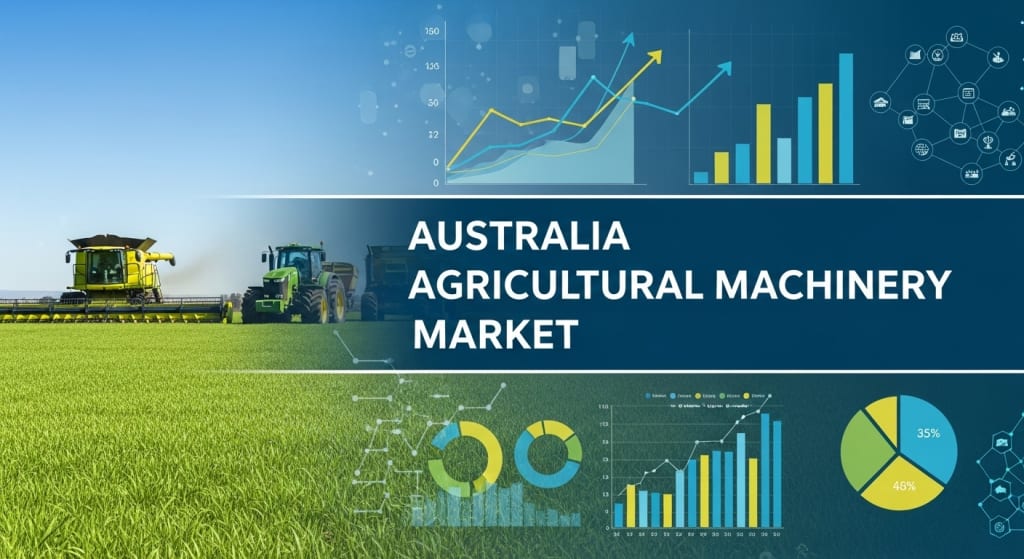
Market Overview
- In 2024, the Australian agricultural machinery market was valued at approximately USD 4.0 billion.
- It is forecast to grow to around USD 6.4 billion by 2033, with a Compound Annual Growth Rate (CAGR) of roughly 5.18% over 2025-2033.
- Key product segments include tractors; ploughing & cultivating machinery (ploughs, harrows, cultivators, tillers, etc.); planting machinery (seed drills, planters, spreaders, etc.); harvesting machinery (mowers, balers, etc.); haying machinery; irrigation machinery.
- The machinery is applied across regions in Australia—New South Wales, Victoria, Queensland, Western Australia, South Australia, Tasmania, Northern Territory—with differing climates, crop types, farm sizes, and technological uptake influencing demand.
Key Trends & Market Drivers
1. Precision & Smart Farming
Adoption of GPS guidance systems, sensors, drones, remote monitoring, and automation is growing. Farmers are seeking machinery that enables targeted soil treatment, precise spraying or fertilization, and monitoring crop health in real time. These tools reduce waste, improve yield, and help address climate variability.
2. Government Policies & Financial Incentives
Grants, subsidies, tax incentives help lower the barrier for advanced machinery investment. Support is especially critical for smaller or remote farms that might otherwise struggle to afford high-end equipment. Policies supporting sustainable farming, drought resilience, and modernisation are strong market drivers.
3. Sustainable & Environmentally Responsible Farming
Environmental concerns are influencing machinery design and choice: lower emissions, efficient fuel use, equipment that supports conservation tillage, better irrigation technologies, reduced input overuse.
4. Rising Costs & Labor Shortages
Fuel costs, maintenance, labor costs are pushing farmers toward more efficient equipment and greater mechanization. Labor shortages—seasonal work, remote regions—are accelerating interest in autonomous or semi-autonomous machinery.
5. Push for Repair Rights
Farmers are increasingly advocating the right to repair equipment (tractors, harvesters) themselves, including access to diagnostic tools and software. Proprietary software in machinery can lead to long downtimes and high costs if farmers must wait for authorized service.
Get a PDF, Request for a Free Sample Report: https://www.imarcgroup.com/australia-agricultural-machinery-market/requestsample
Opportunities in the Australia Agricultural Machinery Market
Digital Platforms & Remote Monitoring
Tools for predictive maintenance, remote diagnostics, performance tracking, and equipment optimization are under-utilized. Platforms that let farmers monitor machinery health, detect issues early, and reduce downtime will become more valuable.
Electrification & Low-Emission Machinery
While many large machines still run on diesel, there’s increasing interest in hybrid or electric alternatives—especially for smaller tractors, utility vehicles, or for use in environments with high fuel/transport costs. Advances in battery tech and charging infrastructure can unlock this.
Modular / Customisable Equipment
Farmers want machinery matched to their farm size, crop type, terrain. Customisation (e.g., adjustable modules, optional features) can reduce over-investment in unnecessary features. Manufacturers offering configuration tools or modular designs may gain preference.
Leasing, Rental, Shared Equipment Models
High upfront cost is a barrier. Equipment rental or shared ownership models, seasonal leases, or co-ops can let smaller farms access advanced machinery without full ownership burdens.
Right to Repair & Regulatory Reform
Legislation mandating access to diagnostic tools, open repairability, and support for third-party servicing would reduce costs and downtime for farmers. This is an area where change seems likely and could reshape service norms.
Technology in Drought & Climate Resilience
Machinery that helps cope with drought, heat, variable rainfall—irrigation systems, moisture sensors, better planting equipment—will be in greater demand as climate pressures intensify.
Market Growth in Regional & Remote Areas
With infrastructure improving, demand in remote and frontier farming zones could grow faster, particularly for machines that are rugged, maintainable locally, and less dependent on complex supply chains.
Recent News & Developments in the Australia Agricultural Machinery Market:
Right to Repair Movement Gains Momentum (January 2025)
Australian farmers have publicly pushed for laws requiring access to diagnostic software and repair tools. Groups like the National Farmers Federation’s right to repair taskforce and GrainGrowers argue that mandatory data sharing could reduce costs and prevent losses during critical periods like harvest season.
Henty Machinery Field Days 2025 (Late September 2025)
A major event in Southern Australia, the Henty Field Days showcased over $200 million in agricultural machinery and technology products. Exhibitors demonstrated robotics, drones, and smart equipment. The event drew nearly 60,000 attendees. It highlighted the importance of machinery innovations and community engagement in agriculture.
Western Australian Farmers Boost Wheat Yields Despite Rainfall Declines (Mid-2025)
Farmers in Western Australia have managed to raise wheat yields significantly, even while rainfall declined over decades—by using improved soil management equipment like deep tillage tools, advanced cultivators, seed drills etc., which enable roots to access water deeper in soil. This demands investment in machinery tailored to climate stress.
Agriculture Sector Value Hits Near Record Levels (Late 2024 to early 2025)
Agriculture’s total production value is forecasted to reach AUD $88.4 billion for 2024-25, largely driven by meat exports and improved crop output. Strong production and export growth put pressure on farms to scale equipment and maintain reliability.
Browse Full Report with TOC & List of Figures: https://www.imarcgroup.com/australia-agricultural-machinery-market
For Farmers: Modernizing the machinery fleet means better yields, lower costs, less risk. Access to smart tech, repair support, and efficient equipment will directly impact profitability—especially for smaller operations or those in remote/variable climates.
For Manufacturers & Tech Providers: Demand is shifting. Those who design for sustainability, provide digital service, support open repair, develop electric solutions, or offer flexible financial models stand to gain. Branding around durability, service, and eco-credentials will be increasingly important.
For Policymakers & Regulators: Ensuring that financial incentives, regulatory frameworks, and repair rights keep pace with technological change is key. Support for agricultural R&D, infrastructure (e.g. rural power, broadband), and access to machinery finance are critical levers. Legislation like “right to repair” could have large economic paybacks.
For the Sector & Economy: Agriculture remains central to Australia’s export economy. Machinery investment underpins productivity, export capacity, climate resilience. As global food demand rises, Australian producers with modern gear are better positioned internationally.
For Environment & Climate Resilience: Machinery that supports sustainable practices (reduced emissions, precision inputs, soil health) helps reduce farming’s environmental footprint. In an era of climate stress, such equipment supports both adaptation and mitigation.
About the Creator
Kevin Cooper
Hi, I'm Kavin Cooper — a tech enthusiast who loves exploring the latest innovations, gadgets, and trends. Passionate about technology and always curious to learn and share insights with the world!
Keep reading
More stories from Kevin Cooper and writers in Journal and other communities.
Australia Wind Power Market: Growth, Share, Trends & Grid Reality
Market Overview In 2024, the Australian wind power market was valued at USD 2.72 billion. By 2033, it is projected to grow to USD 4.78 billion, at a compound annual growth rate (CAGR) of approximately 5.80% between 2025-2033. The report covers both onshore and offshore installations, along with regional breakdowns for New South Wales/ACT; Victoria/Tasmania; Queensland; Northern Territory & Southern Australia; Western Australia. Key Figures: The market is supported by declining technology costs, government incentives, improving turbine efficiency, and an increasing portion of corporate demand for clean energy.
By Kevin Cooper3 months ago in Journal
The goals I did not achieve
Every writing goal I made for the year is a wash. It has been this way for a while, but I think it's important to be open about my failures and the reality of how life can get in the way. This is especially true considering the several times I have posted on Vocal about my writing goals, how I was changing my approach, and where I was hoping to be for the upcoming year. I will probably do that again in a couple months, but for now, it is time to acknowledge where I am today.
By Kay Husnick24 days ago in Journal
When You Want to Pray but Do Not Know What to Say
One of the quiet struggles many people experience in their faith is not doubt, but silence. Not God’s silence, but our own. There are moments when we sit down to pray and realize we have no words. No polished thoughts. No clear requests. Just a sense of heaviness, confusion, or fatigue. It can feel like prayer requires language we do not possess.
By Sound and Spirit2 days ago in Journal
How, Too
Many people wonder how, too. You are not alone, and I am an expert. I will teach you how, too! First, you need to remit a small application fee and fill out an application describing the nature of your financial situation and how often payments will be made, as this will have great bearing on how well I teach you how, too.
By Harper Lewis3 days ago in Fiction




Comments
There are no comments for this story
Be the first to respond and start the conversation.