
An experiment showed how chimpanzees can "reason" in a similar way to humans
A team of researchers from Europe and the United States conducted the study in Uganda. They detected a capacity for active reflection never before documented in non-human animals

The ability to evaluate evidence and modify beliefs in light of new information was once considered a uniquely human trait.
Now, scientists from several institutions in Europe and the United States have discovered that chimpanzees not only form beliefs about their environment but also change them based on the strength of the evidence.
They published their study in the journal Science, published by the American Association for the Advancement of Science (AAAS).
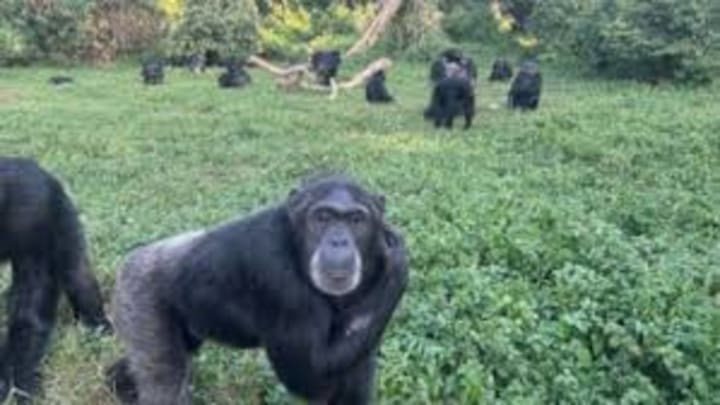
In a series of experiments conducted at the Ngamba Island chimpanzee sanctuary in Uganda, researchers documented how these primates distinguish between different types of evidence and adjust their decisions based on the strength of the available information.
Kristin Andrews, a philosopher at the City University of New York specializing in animal cognition, highlighted the significance of these findings: “It’s very exciting to recognize that we share the planet with other intensely intelligent beings.”
This observation reinforces the idea that chimpanzees possess a cognitive sophistication that approaches that of humans.
Rational evaluation of evidence in chimpanzees
The study was led by Jan Engelmann, a comparative psychologist at the University of California, Berkeley.
It consisted of a series of tests in which chimpanzees had to choose between two boxes, each containing different clues about the presence of food.
In the first test, one box allowed them to see a piece of apple through a glass panel, while the other only made a sound when shaken, indicating that it contained an object, but without any direct visual evidence.
The chimpanzees who first saw the box with the glass panel chose it and maintained their choice even when offered the option to switch to the box that only made noise.
In contrast, those who initially chose the noisy box changed their minds when they saw the more compelling visual evidence in the other box.
Christopher Krupenye, an animal cognition researcher at Johns Hopkins University, emphasized the significance of this work in the journal Science: “The study is elegant and thorough, and it marks a milestone in the question of whether humans are unique in our ability to rationally weigh evidence.”
He added that the results “go a long way toward suggesting that chimpanzees may have a genuine capacity for active reflection.”
Subsequent experiments further explored the complexity of the chimpanzees' reasoning.
In one variation, the animals could only see traces of food behind one of the boxes, while the other, when shaken, produced a more convincing sound.
In this case, the chimpanzees preferred the noisy box and changed their choice if they had first seen the weaker evidence.
Andrews particularly valued this result: “Getting this kind of clear evidence that animals revise their beliefs is very exciting.”
She explained that the fact that the chimpanzees changed their choice demonstrates their confidence in the type of information received and their ability to prioritize evidence: first, direct visual evidence, then auditory evidence, and finally, less clear cues.
Suzanne MacDonald, a comparative psychologist at York University, emphasized that “this is the first research to show that chimpanzees not only weigh evidence to form their beliefs about the world, but also modify those beliefs based on the strength of the evidence.” She considered the chimpanzees' behavior to be “truly amazing.”
Deception and Changes of Mind
The research also explored the chimpanzees' reactions to manipulated tests.
When shown a box with a supposed glass panel that was actually just an image of an apple, the animals switched their choice to the other box upon discovering the deception.
In another test, the chimpanzees initially chose the box with the visible apple, but changed their preference when they heard a second piece of apple being placed in the other box.
Brian Hare, an evolutionary anthropologist at Duke University, emphasized the importance of extending these tests to other species to determine at what point in human evolution these abilities emerged. “The next step will be to test this ability in other species,” Hare said.
Meanwhile, Andrews added that adapting the task for other animals will require considering what type of evidence is most relevant to each species, such as scent in dogs.
Working in sanctuaries, rather than laboratories, was also highlighted as a model for ethical research and animal welfare. “There is a way to do science where everyone wins,” she remarked.
About the Creator
Omar Rastelli
I'm Argentine, from the northern province of Buenos Aires. I love books, computers, travel, and the friendship of the peoples of the world. I reside in "The Land of Enchantment" New Mexico, USA...
Keep reading
More stories from Omar Rastelli and writers in Journal and other communities.
“The footprint of death”: they revealed how viruses manage to multiply in the body and evade the defenses
A breakthrough in cell biology is rewriting our understanding of how viruses can spread within the body. Scientists from Australia and Canada have identified that, after a cell dies, certain pathogens are able to exploit the remaining debris—the so-called "death footprint"—to move and infect new cells, thus circumventing some of the immune defenses.
By Omar Rastelli3 months ago in Journal
The goals I did not achieve
Every writing goal I made for the year is a wash. It has been this way for a while, but I think it's important to be open about my failures and the reality of how life can get in the way. This is especially true considering the several times I have posted on Vocal about my writing goals, how I was changing my approach, and where I was hoping to be for the upcoming year. I will probably do that again in a couple months, but for now, it is time to acknowledge where I am today.
By Kay Husnick22 days ago in Journal
Twin Flame Connections by Zodiac Sign: Patterns You Keep Repeating.
Twin flame relationships are unlike any other connection. They are intense, transformative, and often mirror unresolved emotional patterns. Many people notice that they attract the same type of twin flame connection repeatedly. Astrology provides a clear lens to understand these recurring dynamics. Your zodiac sign influences how you attract, connect with, and react to your twin flame, revealing patterns that keep repeating across lifetimes or relationships.
By Wilson Igbasi5 days ago in Journal



Comments
There are no comments for this story
Be the first to respond and start the conversation.