
Advantages of A-Frame Legs in Large Gantry Cranes
Enhancing Stability, Wind Resistance, and Load Control
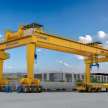

Large gantry cranes play a critical role in heavy industries such as shipbuilding, container terminals, steel yards, precast concrete plants, wind power manufacturing, and infrastructure construction. As lifting capacities increase and spans become wider, the structural design of gantry cranes becomes increasingly important to ensure safety, stability, efficiency, and long-term reliability. Among various leg configurations used in large gantry cranes, A-frame legs have emerged as a highly advantageous structural solution.
An A-frame leg design, characterized by two inclined columns connected at the top and spreading outward toward the ground, forms a triangular load-bearing structure. This geometry provides superior strength and stability compared with traditional single-column or portal-type legs. This article explores the key advantages of A-frame legs in large gantry cranes, explaining why they are widely adopted in heavy-duty and high-performance lifting applications.
1. Superior Structural Stability for Heavy Loads
One of the most significant advantages of A-frame legs is their exceptional structural stability, especially under heavy loads. Large gantry cranes often handle loads ranging from dozens to hundreds of tons, generating substantial vertical forces, horizontal forces, and dynamic stresses.
The triangular geometry of the A-frame allows loads to be distributed more evenly through the structure and transferred efficiently to the ground. Unlike straight vertical legs that mainly rely on bending resistance, A-frame legs convert a significant portion of bending moments into axial compression forces, which steel structures can resist more effectively.
As a result:
- Structural deformation is reduced
- Overall stiffness is improved
- Risk of instability under maximum load conditions is minimized
This makes A-frame legs particularly suitable for ultra-heavy-duty gantry cranes and applications involving frequent high-load lifting cycles.
2. Enhanced Resistance to Lateral Forces
Large gantry cranes are subject not only to vertical lifting forces but also to significant lateral loads caused by:
- Crane traveling and acceleration
- Wind pressure, especially in outdoor installations
- Load sway and sudden braking
- Seismic forces in certain regions
A-frame legs provide excellent resistance to these lateral forces due to their wide base and inclined members. The wider footprint increases the moment arm against overturning forces, significantly improving the crane's resistance to side loads.
Compared with single-leg or portal-leg designs, A-frame legs:
- Reduce lateral displacement
- Improve crane stability during traveling
- Enhance safety during operation in windy or harsh environments
This makes A frame gantry cranes ideal for ports, shipyards, open steel yards, and coastal areas, where wind loads are a major design consideration.
3. Improved Load Distribution to Foundations and Rails
Foundation design is a critical factor in large gantry crane projects, as inadequate load distribution can lead to excessive settlement, rail misalignment, or long-term structural damage. A-frame legs excel in this aspect by spreading loads over a larger base area.
Because the inclined legs transfer forces diagonally downward, the load is distributed more evenly across:
- Crane rails
- Wheel assemblies
- Concrete foundations
- Ground-bearing structures
This improved load distribution:
- Reduces peak stresses on individual wheels
- Minimizes uneven rail wear
- Extends the service life of crane tracks and foundations
For projects with challenging soil conditions or limited foundation-bearing capacity, A-frame legs can significantly reduce civil construction complexity and cost.
4. Reduced Structural Weight for Large Spans
As gantry crane spans increase, structural self-weight becomes a major concern. Excessive dead weight leads to higher material costs, increased wheel loads, and larger foundations.
A-frame leg designs allow engineers to optimize material usage by achieving high strength and stiffness with relatively less steel. The triangular structure efficiently resists loads with reduced reliance on thick plates or oversized columns.
Key benefits include:
- Lower overall steel consumption
- Reduced dead load on rails and foundations
- Improved energy efficiency during crane operation
This makes A-frame legs particularly attractive for long-span gantry cranes, where weight optimization is critical to project feasibility.
5. Enhanced Dynamic Performance and Reduced Vibration
Dynamic performance is an essential consideration for large gantry cranes, especially those operating at higher speeds or handling precision loads. Structural flexibility can lead to vibration, oscillation, and load sway, negatively affecting safety and productivity.
A-frame legs provide increased rigidity and damping characteristics, which help:
- Reduce vibration during lifting and traveling
- Minimize load sway
- Improve positioning accuracy
This advantage is particularly valuable in applications such as:
- Precast concrete component handling
- Large equipment assembly
- Shipyard block lifting
- Wind turbine component installation
Improved dynamic behavior not only enhances operational safety but also increases overall crane efficiency and operator confidence.
6. Better Adaptability to Cantilever and Asymmetric Designs
Many large gantry cranes are designed with cantilevers or asymmetric configurations to extend their working range beyond the rails. These designs introduce uneven load distribution and higher torsional stresses.
A-frame legs are well-suited for such configurations because:
- The inclined geometry effectively resists torsion
- Forces from cantilever loads are transmitted more smoothly to the ground
- Structural balance is easier to achieve through leg geometry optimization
As a result, A-frame legs are commonly used in:
- Shipyard gantry cranes with long cantilevers
- Rail-mounted gantry cranes for container handling
- Gantry cranes serving multiple work zones
7. Improved Safety Margin and Structural Redundancy
Safety is paramount in large gantry crane operations, where structural failure can result in catastrophic consequences. A-frame leg structures inherently offer higher safety margins due to their redundant load paths.
If one member experiences abnormal stress or localized damage:
- Loads can be redistributed through the triangular framework
- Sudden collapse risks are significantly reduced
- Maintenance teams have more time to detect and address issues
This redundancy enhances the crane’s reliability over its entire service life, especially in demanding industrial environments.
8. Long-Term Durability and Lower Maintenance Costs
Large gantry cranes are long-term investments, often expected to operate reliably for 20 to 30 years or more. A-frame legs contribute to extended service life by reducing fatigue stress concentrations.
Benefits include:
- Lower stress ranges in critical welded joints
- Reduced risk of crack initiation
- Improved resistance to cyclic loading
As a result, cranes with A-frame legs typically experience:
- Fewer structural repairs
- Longer inspection intervals
- Lower total lifecycle maintenance costs
This makes A-frame leg gantry cranes a cost-effective solution for high-duty-cycle applications.
9. Compatibility with Modern Design Standards and Advanced Analysis
A-frame leg designs align well with modern engineering practices, including:
- Finite element analysis (FEA)
- Performance-based structural design
- International crane standards and codes
The predictable force paths and stable geometry of A-frame legs make them easier to analyze accurately and optimize during the design phase. This allows manufacturers to deliver cranes that meet stringent safety, performance, and compliance requirements.
10. Proven Performance in Heavy-Duty Industrial Applications
The widespread adoption of A-frame legs in large gantry cranes is supported by decades of successful use across industries. From massive shipyard cranes lifting hundreds of tons to rail-mounted gantry cranes operating in busy container terminals, A-frame leg designs have consistently demonstrated their reliability and performance.
Their proven track record reinforces confidence among:
- Project owners
- Engineers and consultants
- Crane operators
- EPC contractors
Conclusion
A-frame legs offer a combination of structural efficiency, superior stability, enhanced safety, and long-term durability, making them an ideal choice for large gantry cranes operating under demanding conditions. By effectively managing heavy loads, lateral forces, and dynamic stresses, A-frame leg designs enable larger spans, higher lifting capacities, and safer operations.
For industries seeking reliable, high-performance gantry crane solutions, the advantages of A-frame legs extend far beyond structural aesthetics—they represent a strategic engineering choice that enhances operational efficiency, reduces lifecycle costs, and ensures long-term reliability in heavy lifting applications.
About the Creator
Aicrane01
Welcome to the Aicrane Blog, your practical guide to lifting solutions. Discover articles covering overhead cranes, gantry cranes, winches, steel structures, boat lifts, and more.
Website: https://steelmillcranes.com/
The goals I did not achieve
Every writing goal I made for the year is a wash. It has been this way for a while, but I think it's important to be open about my failures and the reality of how life can get in the way. This is especially true considering the several times I have posted on Vocal about my writing goals, how I was changing my approach, and where I was hoping to be for the upcoming year. I will probably do that again in a couple months, but for now, it is time to acknowledge where I am today.
By Kay Husnick21 days ago in Journal



Comments
There are no comments for this story
Be the first to respond and start the conversation.