
ADAS Takes the Wheel: Market Thrives as Governments Mandate Vehicle Safety Technologies
This surge reflects a paradigm shift: Today’s vehicles transcend their basic function as modes of transport to become intelligent co-pilots that actively work to prevent accidents.

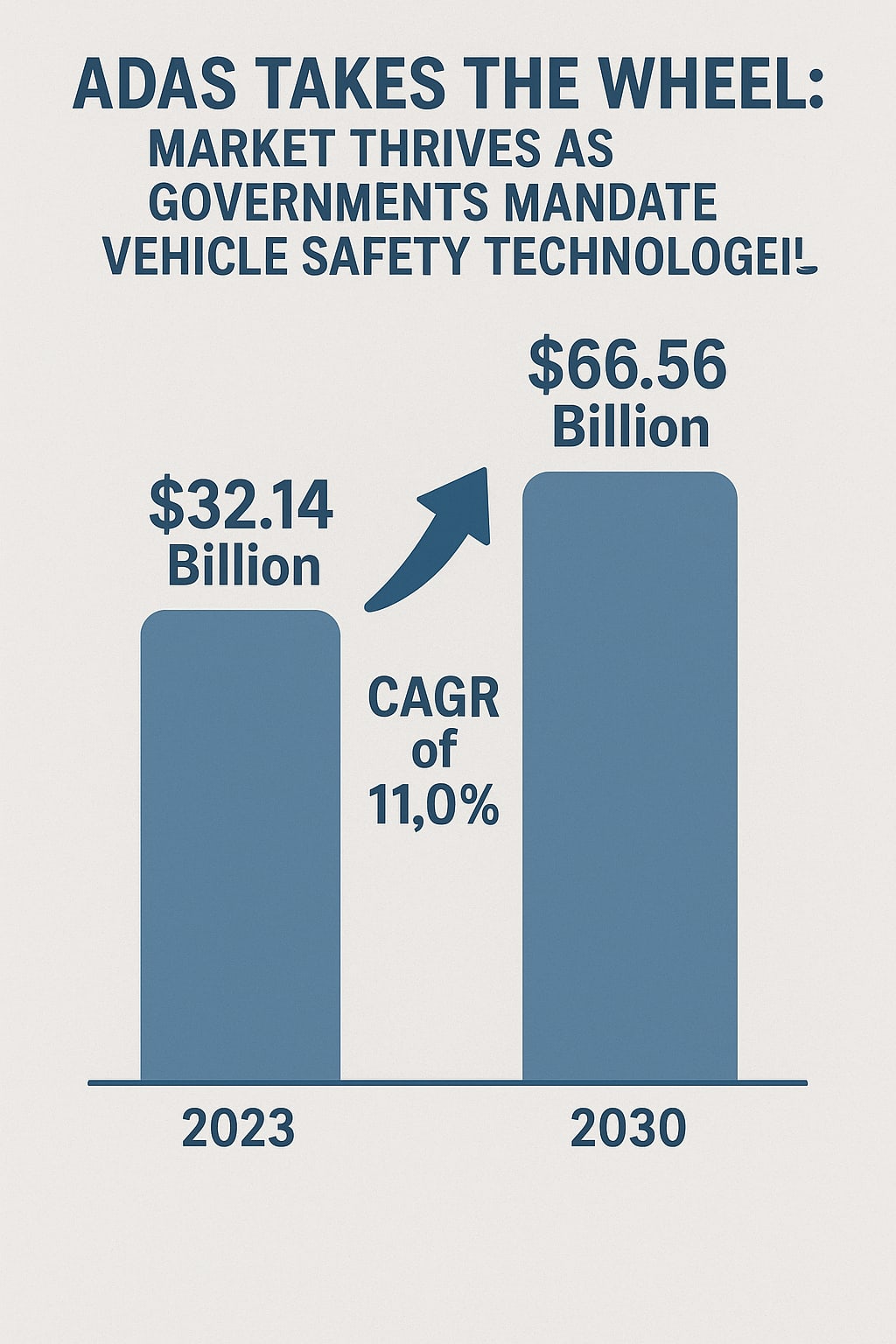
The automotive industry is evolving rapidly with Advanced Driver Assistance Systems (ADAS) leading the transformation because of increased emphasis on road safety and autonomous mobility. Intelligent systems like lane-keeping assistance, adaptive cruise control and automatic emergency braking have progressed from luxury options to becoming standard vehicle components because of government requirements and customer demands for safer cars. The ADAS market which stood at USD 32.14 billion in 2023 will reach USD 66.56 billion by 2030 while growing at an 11% compound annual growth rate.
What is ADAS?
Advanced Driver Assistance Systems work as a collection of technologies that automate vehicle functions to increase safety and comfort during driving. Through utilization of sensors and cameras alongside radar and LiDAR technologies paired with AI algorithms these systems process environmental information to evaluate potential dangers before alerting drivers or initiating corrective measures.
Core ADAS features include:
The system incorporates Lane Departure Warning (LDW) and Lane Keeping Assist (LKA) technologies.
- Adaptive Cruise Control (ACC)
- Automatic Emergency Braking (AEB)
- Blind Spot Detection
- Traffic Sign Recognition
- Driver Monitoring Systems (DMS)
Key Drivers of Market Growth
1. Government Regulations & Safety Mandates
Regulatory intervention serves as a significant driving force behind the widespread adoption of ADAS. National governments across the globe are implementing regulations that require new vehicles to incorporate specific ADAS features to decrease traffic accidents and fatalities.
The General Safety Regulation of the European Union now makes it mandatory for new vehicles to come equipped with intelligent speed assistance and emergency lane-keeping as standard features.
The National Highway Traffic Safety Administration (NHTSA) of the United States together with the Insurance Institute for Highway Safety (IIHS) have issued powerful support statements for advanced automotive technologies such as automatic emergency braking (AEB) and pedestrian detection systems.
Similar safety regulations are being put into effect by nations such as Japan, South Korea, and China which speeds up worldwide implementation.
2. Rise in Road Traffic Accidents
The World Health Organization confirms over 1.3 million yearly fatalities from road traffic accidents which underscores an urgent necessity for advanced preventive technologies. The use of ADAS helps to reduce human mistakes which cause more than 90% of vehicle crashes.
3. Technological Innovation
Advancements in sensor tech along with real-time data analysis and AI development together with V2X communication capabilities enhance ADAS systems by making them more precise and dependable while reducing costs. The combination of LiDAR technology and edge AI chips enhances system performance while creating new functional capabilities.
4. Consumer Demand for Safety and Convenience
Today’s drivers appreciate automated driving systems most when navigating city traffic and extensive highway trips. Manufacturers are now fitting mid-range and entry-level cars with ADAS systems to make them more attractive to buyers.
Market Segmentation and Trends
By System Type: The majority of today's ADAS market consists of adaptive cruise control and AEB systems while driver monitoring systems and traffic jam assist grow in popularity.
By Vehicle Type: Passenger vehicles dominate current adoption rates but commercial vehicles have increased their presence especially within logistics and public transport sectors.
By Component: Most ADAS systems depend on cameras, ultrasonic sensors, radar technology, and LiDAR devices. The standard approach in sensor technology now involves integrating information from multiple data sources.
Regional Outlook
Europe: Europe dominates the market thanks to rigorous safety regulations focusing on new passenger vehicles.
North America: Policy frameworks along with consumer awareness drive North American ADAS adoption. American car manufacturers are actively developing vehicles with Level 2 and Level 3 autonomous driving features.
Asia-Pacific: The Asia-Pacific leads growth through the swift motorization of China and India combined with aggressive safety regulations and investments in smart cities.
Latin America & MEA: Automotive OEM investments and global safety initiatives are supporting the development of ADAS markets in Latin America and MEA.
Challenges and Considerations
The ADAS market encounters multiple obstacles even though it maintains rapid expansion.
The high expense of complex systems containing LiDAR and thermal imaging technology restricts their availability to budget-conscious segments.
Aftermarket repair processes and insurance claims face challenges because of the necessity for sensor calibration and maintenance.
Safety hazards arise when drivers treat ADAS systems as fully autonomous because they misunderstand the assistive technology's limitations.
Effective education and well-designed human-machine interfaces (HMIs) prevent misuse and overconfidence in ADAS technology.
Future Outlook: Toward Autonomy
ADAS represents an important transitional phase in the development of autonomous vehicles. Each technological advancement from systems like automatic braking to partial highway autonomy brings us closer to fully autonomous vehicles.
Emerging trends to watch include:
Electric vehicles (EVs) will provide energy-efficient route planning capabilities through system integration.
ADAS systems that connect to the cloud enable vehicle software to receive continuous updates while sharing critical hazard information
Artificial intelligence systems use predictive analytics to foresee driver actions and improve reaction speeds.
Conclusion
ADAS has evolved from an innovative technology to become an essential component of modern vehicles. Government requirements for critical safety features combined with consumer adoption of digital protection measures are driving high market growth. The development of ADAS through enhanced sensor capabilities and regulatory requirements, combined with increased demand for self-driving tools, enables it to transform how we travel while assuming control of the vehicle.
About the Creator
Silvie Karson
Passionate storyteller exploring the world of trends. With a background in digital marketing, I craft compelling narratives that inform and inspire. Whether diving into deep-dive features, growth analysis, or trend analysis.
Keep reading
More stories from Silvie Karson and writers in Journal and other communities.
Green Energy on the Move: Solar Tracker Market Thrives with Improved ROI and Tech Advancements
The worldwide shift toward sustainable energy sources positions solar power to become a pivotal element in future renewable energy systems. The solar tracker market has transitioned from a technical niche to a fast-growing sector thanks to technological progress and improved ROI alongside enhanced energy efficiency. The solar tracker market worth stood at USD 5.75 billion in 2023 and is expected to soar to USD 29.31 billion by 2030 with a compound annual growth rate of 26.2%.
By Silvie Karson7 months ago in Journal
Miss Persephone's Manual to a Seemingly Ordinary Life
Miss Persephone was found at the dining table, her blue eyes swollen, her tears arriving and retreating like the tides of the ocean. Earlier that day, her family had visited her in the retirement home where she had lived for eight years. It was her eightieth birthday.
By Imola Tóth4 days ago in Fiction



Comments
There are no comments for this story
Be the first to respond and start the conversation.