
A Stump in the Landscape: Reflections on Sycamore Gap
Jenny and Peter Hexham from Drake Australia write...
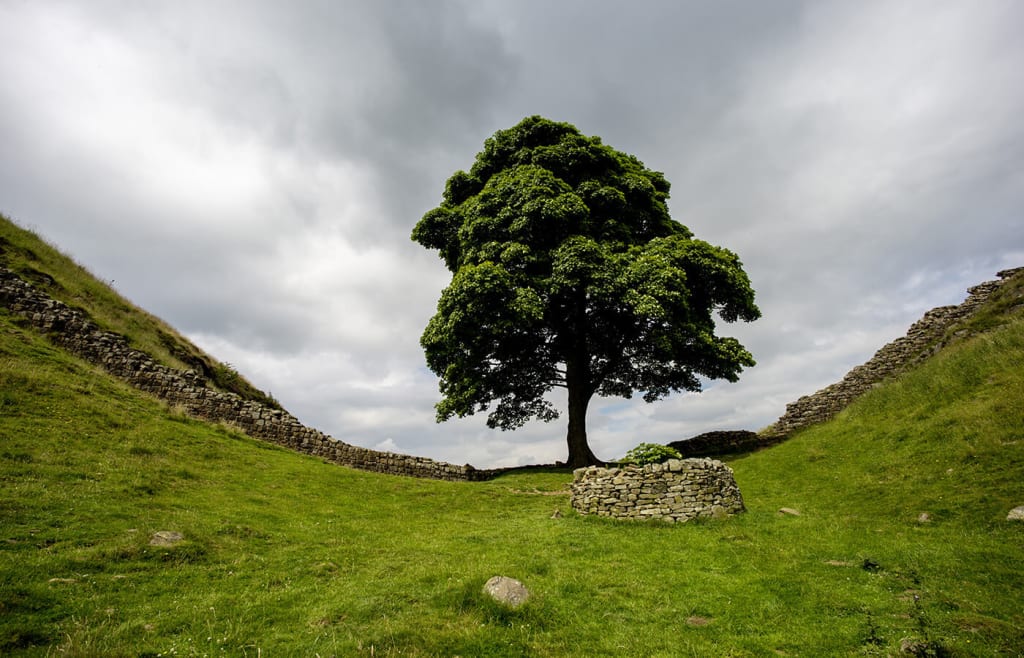
A Stump in the Landscape: Reflections on Sycamore Gap from Afar
By Jenny and Peter Hexham, from Drake, Australia
Last time we posted, our writing was of a lovely town in the north of England: Hexham. Our surname.
The town, we wrote was full of life. Spry seniors, lively, fun loving teenaged girls and boys, and more besides. We loved the school - Queen Elizabeth High, or QEHS as it is known. A teacher sent us two messages today. The first told us how the tree had come to be cut down. The other that the men involved had been convicted.
We didn’t expect to be moved to tears by a tree.
Our travels through Northumberland gave us many beautiful moments — the wide skies, the rolling moorland, the stone-built villages that seemed to have been dropped into the landscape centuries ago. But the memory that remains most vivid, most bittersweet, is of a single tree: the one that stood at Sycamore Gap.
We saw it during a blustery walk along Hadrian’s Wall, wrapped in scarves and puffed jackets, hands stiff with cold. The wind whistled through the gap, and there it was — standing alone in a natural dip between two slopes, perfectly placed as if by an artist. That great sycamore didn’t just anchor the landscape. It commanded it.
There was a reverence in how people paused before it. Families posed for photos, walkers sipped thermos tea while gazing silently at its branches. Some called it "the Robin Hood tree" — not for myth, but because it featured in Robin Hood: Prince of Thieves. But to us, it didn’t need celebrity. Its power was in its solitude. Its defiance. Its quiet strength.
When we returned home to Australia, we would occasionally look through our travel photos. That tree always made us smile. It was a reminder of a special trip, and of the still, strange beauty that Northumberland offered.
And then, we heard the news.
Someone — a teenager, it was said — had taken a chainsaw to it. In the dead of night. A tree that had stood for perhaps 300 years was brought down in a matter of minutes. We didn’t believe it at first. It seemed too senseless. Too cruel. Even from the other side of the world, we felt the blow.
We watched the footage. Read the tributes. Saw photos of locals in tears, of tourists laying flowers, of the lonely stump left behind. A gaping emptiness where something graceful once stood.
It’s strange how attached we can become to a single tree. But Sycamore Gap wasn’t just any tree. It was a symbol — of place, of time, of endurance. It stood apart and somehow connected everything around it. Its loss reminded us of something we don't often like to admit: that even the most rooted things can vanish in an instant.
There is also something generational in our grief. We are, after all, visitors from the other side of the world. But we come from a land where ancient trees — even those thousands of years old — are still felled for roads, or fire, or worse. We know too well how easily nature is taken for granted. How slowly it grows, and how quickly it can be lost.
The destruction of Sycamore Gap felt personal because it was symbolic. It stood for heritage, beauty, balance. Its fall felt like an insult to the land — and to those who still believe that something simple and natural can hold deep value.
We’ve talked about it often. What should happen next? Should another tree be planted in its place? Should the stump be left as it is, a kind of memorial? Opinions differ, and rightly so. What matters more is that people are talking. That they're feeling. That the absence has meaning.
For us, it’s become a quiet symbol — of loss, yes, but also of memory. The gap remains. But so too does the impact the tree made.
Back home now, we still remember that windy Northumberland day. We remember the cold on our cheeks, the distant caw of rooks, the laughter of walkers. But most of all, we remember the stillness. The sense that we were standing before something old and wise, and maybe even sacred.
We hope that, in time, something will grow again — not just from the earth, but from the community. From reverence. From learning.
And perhaps the next time we visit, we’ll walk that same stretch of Hadrian’s Wall. We’ll look across the gap. And we’ll remember what once stood there — and why it mattered.
Jenny and Peter Hexham of Drake, Australia
#Hexham #Northumberland #SycamoreGap
About the Creator
Jenny and Peter Hexham from Drake NSW
Jenny is a science teacher from Drake NSW
Peter is a bean counter from the USA
They travel widely and often
They have teenage kids
Keep reading
More stories from Jenny and Peter Hexham from Drake NSW and writers in Journal and other communities.
The beauty of a traditional English wedding
An English Wedding: Tradition, Charm, and Celebration There is something unmistakably enchanting about an English wedding. Perhaps it is the blend of history and modernity, where centuries-old traditions meet contemporary creativity. Perhaps it is the settings—ancient stone churches, manor houses, or sunlit gardens—that lend the occasion a storybook air. Or perhaps it is the people, gathering from near and far, bound by the universal desire to celebrate love. Whatever the reason, an English wedding has a distinctive character that sets it apart from weddings elsewhere.
By Jenny and Peter Hexham from Drake NSW4 months ago in Humans
Discover the Hidden Wonders of the Everest High Pass Trek
There is a trail in the Himalayas that promises adventure, awe, and memories that last a lifetime. The Everest Three High Passes Trek is one of the most thrilling journeys you can take in Nepal. It goes beyond the classic Everest Base Camp trek, taking you over three high passes, each offering incredible views, serene villages, and a chance to experience the heart of the Himalayas. If you are ready to discover hidden wonders, this trek is calling your name.
By Olivia Flores2 days ago in Journal
The Devil's Cut
“Comrade, finally you’re awake.” The voice was smooth, sensual. A flickering incandescent bar was all that lit the white, sterile room. All Vladimir remembered was everything going black. He tried to move his arms and found them strapped to the gurney.
By Matthew J. Fromm7 days ago in Fiction




Comments
There are no comments for this story
Be the first to respond and start the conversation.