
A Rabbi, a Repost, and a Pretendship: How Nuance Got Lost
Psychological breaking down


This morning, I awoke to a series of messages from someone I hadn’t interacted with meaningfully in nearly two decades. The messages were accusatory, labeling me as antisemitic for reposting a video that questioned the ethical implications of a religious figure’s involvement in the adult entertainment industry. The abruptness and severity of the accusation were startling, especially considering our minimal history and their lack of effort to understand my perspective.
Person: “Why did you repost this” “I know we don’t really know each other. But you should know that other people can see what you repost. And some of them are Jewish. 😞”
Referring to a video which I’ll get into it as you read but psychologically this is they’re presentation.
“Why did you repost this?” This is a confrontational opener; it is short, direct, and lacking warmth or curiosity. It’s not phrased as a sincere question seeking understanding, but rather as a rhetorical demand that sets the stage for judgment. It implies wrongdoing from the outset and positions the speaker as morally superior.
“I know we don’t really know each other.” This brief admission actually works to undermine the legitimacy of the entire confrontation. By acknowledging that there is no real relationship, it becomes clear that the speaker is not invested in dialogue but instead is leveraging this moment to perform a kind of social correction. It frames the rest of the message as an unsolicited intervention from someone with little knowledge of the person they are addressing.
“But you should know that other people can see what you repost. And some of them are Jewish.” This statement uses passive-aggressive guilt to imply that you are responsible for how other people feel, particularly a marginalized group. Rather than inviting a dialogue, it attempts to enforce shame through association. The vague “some of them are Jewish” centers others’ hypothetical feelings without clarifying whether they themselves was offended, distancing from their own accountability in starting the confrontation. It uses emotional coercion masked as moral guidance in combination of sad emoji adds a performative softness meant to show disappointment but it actually amplifies the manipulation, reinforcing guilt while maintaining a tone of moral high ground. It infantilizes the disagreement, making it feel like the accuser is “sad” rather than aggressive, which can confuse and destabilize the person receiving it. It is clearer than basic math that this is not about intellectual conversation based on their approach.
My message to answer their question “I appreciate you reaching out. Just to clarify, I repost content on a wide range of topics to reflect different perspectives, raise awareness, or prompt thought—not necessarily to endorse everything that’s said. I’m fully aware that reposts are public and mindful of what I share. The topic of Pornhub came up last year when the Rabbi took over, which I found interesting from a broader societal angle. That said, if something I post doesn’t resonate with you or makes you uncomfortable, I completely understand if you’d prefer to mute or unfollow. I’m not here to upset anyone, just sharing content that sparks thought or conversation”
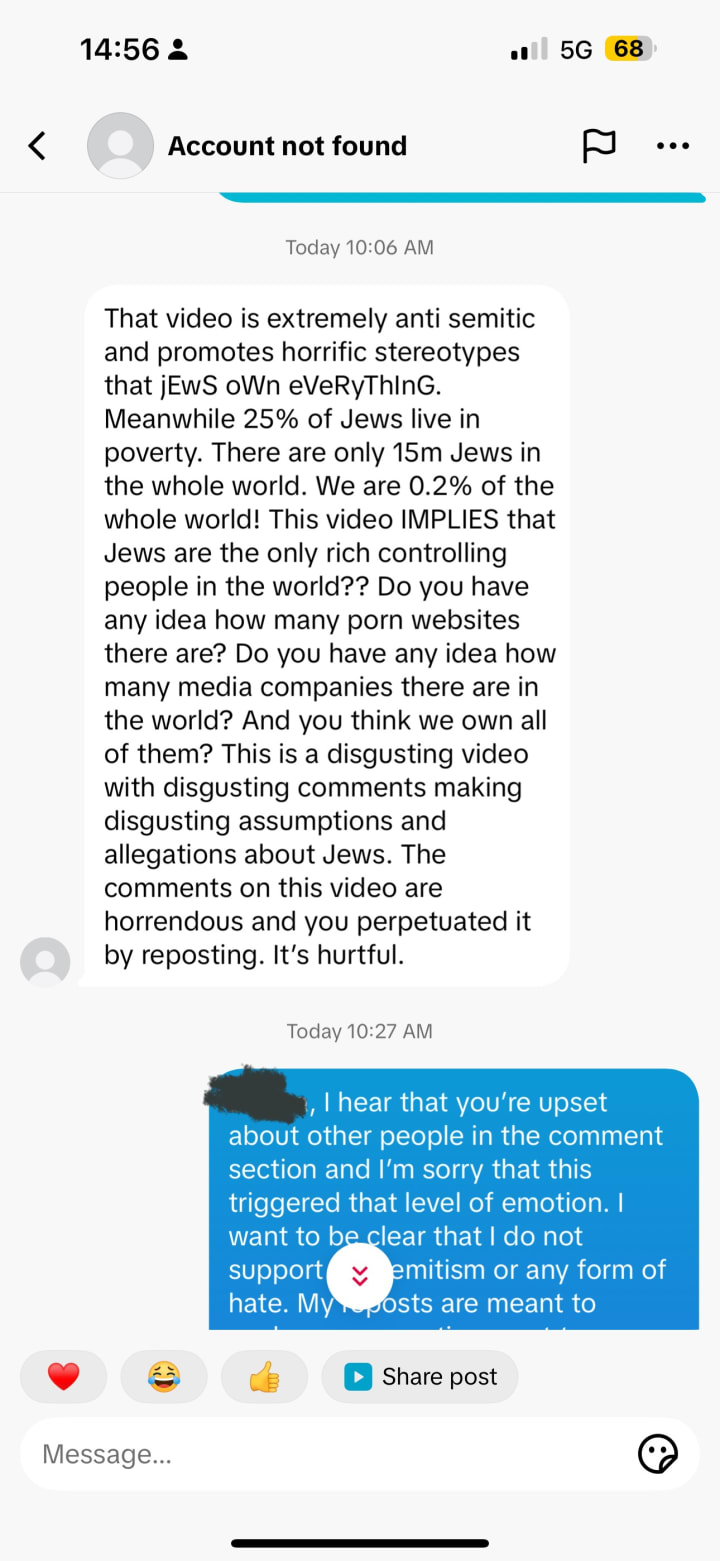
Their response “That video is extremely anti semitic and promotes horrific stereotypes that jEwS oWn eVeRyThInG. Meanwhile 25% of Jews live in poverty. There are only 15m Jews in the whole world. We are 0.2% of the whole world! This video IMPLIES that Jews are the only rich controlling people in the world?? Do you have any idea how many porn websites there are? Do you have any idea how many media companies there are in the world? And you think we own all of them? This is a disgusting video with disgusting comments making disgusting assumptions and allegations about Jews. The comments on this video are horrendous and you perpetuated it by reposting. It’s hurtful.”
Well that escalated quickly. The message rapidly escalated from accusation to outrage, listing facts and statistics in a way meant to overwhelm and emotionally shame. The use of capitalization, repetition, and rhetorical questions amplifies the sense of attack rather than inviting reflection. It evokes what psychologists refer to as emotional flooding, where the goal is not understanding but overpowering the recipient.
“And you think we own all of them?” They attributes beliefs to me that I never stated. Nowhere did I suggest Jews own “all” media or porn sites, yet they project this interpretation onto my repost, effectively mind-reading my intent without asking. This rhetorical tactic is used to build a straw man creating a distorted version of my actions to justify their emotional response. Their style of writing with random upper and lower case letters is widely recognized as a form of sarcastic mimicry or mocking imitation on the internet. It’s often used to mock a perceived ridiculous opinion, belittle a group of people for believing a certain thing or signal disdain in an exaggerated, dismissive way.
The use of “jEwS oWn eVeRyThInG” was not quoting me (I never said that), but instead it’s creating a caricature of a stereotype and then projecting that caricature onto the listener. I still maintained poise, respect towards others and attempting respectful and meaningful dialogue; especially because we have never had a meaningful conversation in 20 years.
My response “{name, I hear that you’re upset about other people in the comment section and I’m sorry that this triggered that level of emotion. I want to be clear that I do not support antisemitism or any form of hate. My reposts are meant to explore conversations, not to promote collective blame. The video, to me, raised an ethical question about a religious figure’s business ties—something that would be questioned in any religious context. I repost things that span every angle of society about race, gender, power, religion, corruption, justice and that includes difficult or uncomfortable topics. I don’t control the comment section, and I certainly don’t endorse hate. I want to be very clear: I do not support hate or prejudice in any form. The post in question was about a specific figure in a position of religious authority and the dissonance between their role and their business ventures. That dissonance would be questioned no matter the religion. That said, I don’t believe engaging with one controversial video means I’m promoting an entire ideology. I repost widely, and with purpose. If that doesn’t align with your values, I fully understand.”
Their response “Actually it wasn’t JUST about ONE Jewish person owning part of ONE company. It was about multiple jews and multiple companies. You control what you repost and I am telling you how it makes you look. It doesn’t look like you’re promoting thought. It looks like you’re promoting antisemitism.” “Also, context is important. And it seems like you’ve never bothered to research the context. So here you go. https://thejewishindependent.com.au/a-rabbi-is-overseeing-pornhub-thats-actually-not-so-weird”
(I knew of this article prior and the original article is from another site: https://forward.com/culture/654804/pornhub-rabbi-solomon-friedman-jewish/
For context, The article explores why it’s not as surprising as it might seem that Solomon Friedman a man who holds rabbinical credentials is involved with Pornhub as a top executive. Friedman, who co-founded Ethical Capital Partners, is not a practicing rabbi but a criminal defense lawyer known for defending controversial clients. The piece explains that while many find the connection between religion and porn jarring, Judaism is historically more sex-positive than many assume, and Friedman’s work with Pornhub is framed around ethical reform and digital safety, not religious leadership.
The article emphasizes that the real scandal isn’t that porn exists it’s how poorly it has been regulated. Friedman’s current focus is on improving consent verification and moderating harmful content. The piece also acknowledges the antisemitic conspiracy theories that have emerged online, falsely suggesting Jewish control of porn as a weapon against white populations. These conspiracies have led to hate directed at Friedman and his family.Ultimately, the article argues that Friedman’s role in Pornhub is only controversial to people harboring antisemitic views, while others may see him as uniquely qualified to help make the industry more ethical.
The video I reposted didn’t claim that “Jews own everything,” nor did it promote hatred or conspiracy theories. What it did was raise a provocative but valid questions of “Why would any person of religious standing regardless of faith want to be involved in the ownership or leadership of a global pornography platform?” This is a question that would raise eyebrows if the figure in question were a priest, an imam, a monk, or any other religious leader. It’s about the perceived ethical contradiction between public religious values and the private business of profiting from adult content. That was the heart of the video’s point and ironically, even the article they sent me confirms that this very tension is what has made Friedman’s role so newsworthy in the first place.
“25% of Jews live in poverty… only 15 million Jews… 0.2% of the world” These facts, while true, are used here not to educate, but to emotionally guilt and frame themselves (and Jews as a collective) as under siege regardless of the actual content or intent of the video. It shifts the conversation away from a specific rabbi’s ethical contradictions and toward a narrative of group victimization thus invalidating any nuanced inquiry as inherently bigoted.
“This is a disgusting video with disgusting comments making disgusting assumptions…” The word “disgusting” is repeated three times, which is a moral absolutist tactic. It leaves no room for complexity, shades of gray, or dialogue it is a verdict, not a discussion. The implication is “If you repost this, you are complicit in this disgust”. This is textbook guilt-by-association, a way of using shame to force compliance.
They are furious about the comment section, which I don’t control. Yet holds me responsible for what random strangers or bots said in the comments. This is emotional displacement a defense mechanism where the speaker redirects feelings from the real source (e.g., daily antisemitic content they see on their FYP) onto a safer or more convenient target (me), whom they perceives as easier to confront.
There is and never was any invitation to clarify. No pause to consider who I am or how broadly I engage with topics because I’m sure they’ve witnessed a bevy of topics I repost of all global news, social injustices, cats, domestic abuse, psychological disorders, mental awareness, medical, funny, AITA, parenting and more. This is an emotional ruling that leaves me with no dignified place to stand except submission.
My response “{name}, we barely know each other. We worked together for a few hours almost 20 years ago, and I made several efforts over the years to build a friendship or even learn from you—but there was never real interest on your end. I’ve been kind, responsive, and even helped when you asked about building your platform, but there’s never been any real rapport between us.
I repost a wide range of content—from global protests in Palestine, Israel, India, and the U.S., to domestic abuse awareness, political debates, crimes, nature clips, and yes, even cat videos. I do this intentionally, to engage with the algorithm and to stay aware of a wide spectrum of topics—many of which I revisit or research further.
This particular video may have upset you—more so because of the comment section. I understand that. But your initial message and approach was accusatory, condescending, and deeply presumptive toward someone you don’t actually know. That’s the part that struck me the most.
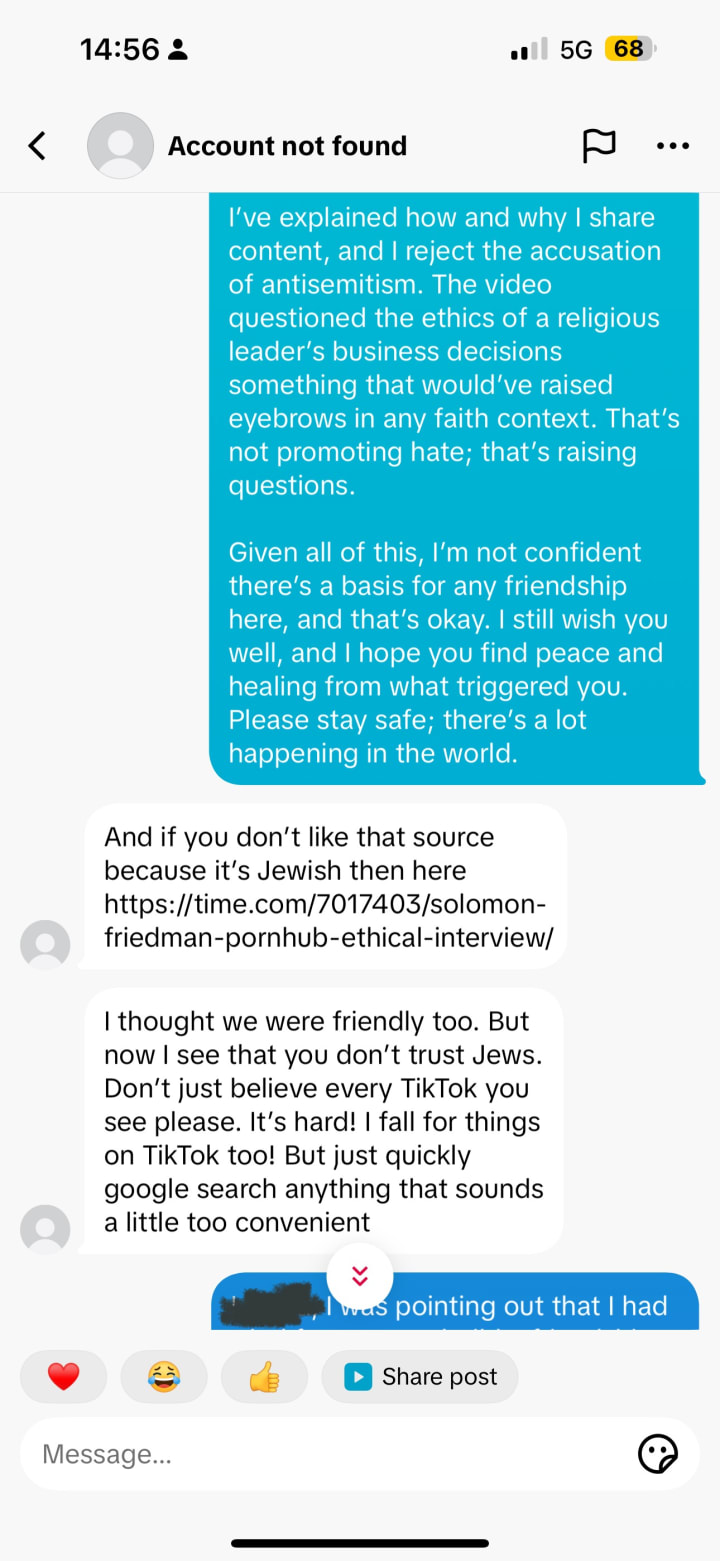
I’ve explained how and why I share content, and I reject the accusation of antisemitism. The video questioned the ethics of a religious leader’s business decisions something that would’ve raised eyebrows in any faith context. That’s not promoting hate; that’s raising questions.
Given all of this, I’m not confident there’s a basis for any friendship here, and that’s okay. I still wish you well, and I hope you find peace and healing from what triggered you. Please stay safe; there’s a lot happening in the world.”
The superficiality of the “friendship” should end; nothing good can come of this.
Their response: “And if you don’t like that source because it’s Jewish then here https://time.com/7017403/solomon-friedman-pornhub-ethical-interview/” “I thought we were friendly too. But now I see that you don’t trust Jews. Don’t just believe every TikTok you see please. It’s hard! I fall for things on TikTok too! But just quickly google search anything that sounds a little too convenient”
well alright, I guess I’ll be psychologically analyzing more.
The “If you don’t like that source because it’s Jewish…” This line accuses me of antisemitism again, but passively & it implies that any disagreement I might have with the article would stem not from content or argument, but from prejudice against Jews. This is a projection of their own bias they expect that I will reject a source due to identity, even though I never said anything that would remotely indicate that.
The tone assumes that I’m irrational or closed-minded and tries to control the narrative before I can even respond. This rhetorical move shuts down the possibility of respectful disagreement and instead builds a narrative where they are “educating” a prejudiced person who “needs fixing.”
They’re “I thought we were friendly too…” This is emotional bait. It is supposed to evoke a sense of personal betrayal to justify their escalation, even though our connection was superficial and mostly one-sided over 20 years. It reframes a disagreement about content as a moral betrayal of a personal bond one that was never mutually established in the first place.
“Now I see that you don’t trust Jews.” Still managing to jump to conclusions faster and better than grasshoppers. This is one of the most damaging and unfounded claims. They are assigning malicious intent onto me based not on what I said or meant but on their own internal narrative; this is classic psychological projection. It’s not based on my behavior but in their fears, biases, or emotional triggers, which they’re now transferring onto someone else.
“Don’t just believe every TikTok you see… I fall for things too!” This is patronizing by implying lack critical thinking. It presents itself as casual advice but it carries the tone of someone speaking down. The false equivalence (“I fall for things too!”) further erodes your credibility by comparing your intentional engagement with a wide range of content to gullible scrolling. I found that condescending. I repost everything from political commentary to global human rights issues to wildlife rescues to updates on U.S. legal systems. I don’t repost to promote hate. I repost to learn, and to encourage others to think critically. If anything, the article they sent me proved that this issue is nuanced and ethically complicated not something to be erased under accusations and shame. However, I had made it clear there is no basis for a friendship.
I do need to correct the “friendly” because we met for less than 2 hours and exchanged a handful of lines while working. It’s barely being an acquaintance rapport. My formal addressing is demonstration of we are not friends.
I responded: “{name}, I was pointing out that I had tried for years to build a friendship or rapport with you—something you’ve never shown genuine interest in. Your first message in this thread had a passive-aggressive tone, and it was clear from the beginning that you weren’t reaching out for conversation, but seeking for confrontation.
I’ve had thoughtful discussions on difficult topics with people from all backgrounds, including those who are Jewish. But in this case, it’s clear you’ve jumped to conclusions about my intent and aren’t engaging with what I’ve actually said.
I acknowledge your perspective, but I do not share your interpretation of my actions or beliefs. I don’t see further discussion as productive. I truly did enjoy supporting your page in the past, and I wish you well moving forward.”
They responded “You have to understand that I’m literally inundated with these horrific videos and lies every day on my FYP, but I’m very good at blowing past it. When I saw you reposted it, a person I respected and thought was intelligent, I thought I had an opportunity to actually speak to you about it and help you understand what Jews are going through every single day. But instead of simply apologizing and taking note and saying you would do more research, you doubled down”
Hmmm, what a person interacts with is how they’re algorithm will appear but I digress.
The “I’m literally inundated with these horrific videos and lies every day on my FYP…” they start with trauma-centered framing positioning themselves as someone suffering under the weight of social media hate; something a bevy of cultures do experience especially for myself. While their emotional experience may be real and valid (and I validated), they immediately shift that emotional burden onto me by implying that repost is part of the trauma. This strategy is powerful because it creates an unspoken equation of “I am hurt daily, and now you are part of that hurt.”
“…a person I respected and thought was intelligent…” This is praise comes with a leash complimenting with the intent only to withdraw it immediately as a consequence of me not reacting how they wanted. It’s a passive-aggressive way to say “You let me down by not agreeing with me.” It’s not a reflection of real respect. It’s emotional leverage dressed up as flattery.
“I thought I had an opportunity to actually speak to you about it and help you understand…”This line is manipulative because they’re trying to rewrite their tone after the fact. Their initial message was not an invitation to speak again it was a passive-aggressive warning like the “Other people can see what you repost. And some of them are Jewish.” And now reframing that original tone as if they came in with good faith and was met with defiance. This is called retrospective moral justification, and it’s often used to soften the perception of an aggressive or condescending approach after the damage has already been done.
“Instead of simply apologizing and taking note… you doubled down.” This is a major red flag. They are laying out what they expected me to do (apologize, admit fault, and promise change), and because I didn’t meet their script, they are condemning my reaction as immoral or ignorant.
This is taking an authoritarian tone by expecting submission, not discussion, a dismissive of nuance ignoring the thoughtful, calm responses provided and moral gatekeeping treating disagreement as a failure of character rather than a difference in perspective. It’s not about dialogue anymore. It’s about punishment for noncompliance.
This conversation needs to end.
My response “{name}, I recognize that your experience online has made you feel overwhelmed and targeted, and that’s valid. But your message to me didn’t come from a place of mutual respect or curiosity—it came with judgment, assumptions, and a clear lack of interest in who I am or how I actually use my platform.
I’ve explained myself thoroughly, and I’m not going to apologize for something that wasn’t said with hate or prejudice. You’re interpreting intent that simply isn’t there, and it’s not fair. I’m closing this conversation now. I wish you peace and healing”
I saw that they were going to continue with the infamous “…” but I had already removed them from my platforms and removed myself; and instead of continuing they blocked me which I presume is more therapeutic for them. In all honesty, had they blocked me I would have respected that and would not have noticed.
The entire “relationship” was always a superficial connection. Our acquaintance began almost 20 years ago during a brief collaboration on a short film. Since then, I had made several attempts to establish a friendship, reaching out occasionally, offering support, and even assisting them with building their social media presence when they sought advice. Despite these efforts, our interactions remained superficial, with little reciprocation on their part.
I explained in a respectful dialogue that my reposts span various subjects, including global political issues, social justice, and cultural phenomena, all intended to foster discussion and awareness. Despite my explanation, they persisted with other intent.
Psychologically, their approach can be seen as a form of projection, attributing their fears and biases onto me without substantial evidence. The lack of genuine inquiry into my perspective and the immediate jump to condemnation suggest a desire not for dialogue but for asserting moral superiority.
This incident underscores the challenges of navigating complex topics in today’s polarized climate. Accusations of bigotry are serious and should be approached with care and a willingness to understand context. When individuals choose to confront others, especially those they barely know, with hostility rather than curiosity, it stifles meaningful conversation and growth.
In the end, I chose to disengage, removing them from my social media circles to preserve my peace. While I remain open to discussions that are rooted in mutual respect and a genuine desire to understand, I recognize that not all interactions will meet these standards. This experience serves as a reminder of the importance of approaching sensitive topics with empathy, context, and a willingness to listen, comprehend, respond respectfully with true dialogue; and it is okay to agree to disagree and it is ok to also walk away from people. I look forward to feedback as always.
******************* without Doxing*******






About the Creator
Cadma
A sweetie pie with fire in her eyes
Instagram @CurlyCadma
TikTok @Cadmania
Www.YouTube.com/bittenappletv
Treading Water
"Lies don't die they grow, and everything you try to hide eventually shows." - MGK "Treading Water." I first began Vocal in 2021, April to be exact. I had just turned 34 that Feburary and I was struggling with sobrity, anxiety and depression. The post is titled "55 days Sober." (its linked if you would like to read it. Its so weird to think that was written almost half a decade ago, so much has changed but so much hasn't. It's almost been two weeks since I turned 39 and I have so many mixed emotions. Thinking back to being 29, about to turn 30 thinking man I'm "old" but also not know the journey that would lay ahead.
By Kimmiekins4about 15 hours ago in Journal



Comments (1)
Cadma, you navigated this contentious interaction so, so well. The accusatory tone this person is immediately unsettling, and the guilt-tripping is evident. When you become unable to criticize a person due to their religion without others jumping to conclusions as they so often do, that’s a problem!