
A Knight of the Seven Kingdoms Episode 4 Review: The Trial Is Set and the Realm Holds Its Breath
What Happens in A Knight of the Seven Kingdoms Episode 4?

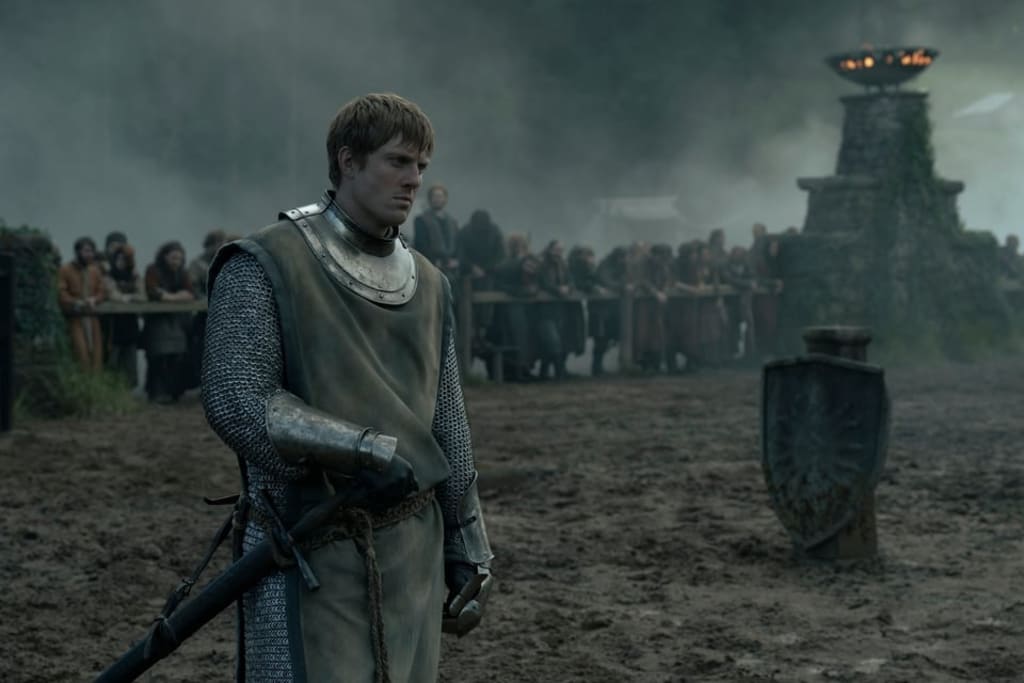
Episode 4 of A Knight of the Seven Kingdoms finally lines up the pieces for what the entire story has been building toward — the legendary Trial of Seven. And between the political tension, book callbacks, and one massive last-minute reveal, this episode feels like the calm before a very violent storm.
Let’s unpack everything.
Don't miss out on reading:
- A Knight of the Seven Kingdoms Episode 1 Review
- A Knight of the Seven Kingdoms Episode 2 Review
- A Knight of the Seven Kingdoms Episode 3 Review
Dunk’s Trial Becomes a Political Powder Keg
The central plot is simple on the surface: Dunk needs six knights to stand beside him.
But in Westeros, nothing is ever just about honor.
What starts as a knight defending his name quickly turns into a miniature civil war within the royal family itself. By the end of the episode, Baelor’s decision to join Dunk’s side transforms the coming battle into yet another Targaryen clash — the kind the realm is frankly exhausted by after the House of the Dragon era conflicts and the Blackfyre uprising.
You can practically hear King Daeron II sighing somewhere off-screen.
Why the Trial of Seven Matters So Much
The episode title, Seven, points directly to the Trial of Seven — the centerpiece of A Hedge Knight, the first story in Tales of Dunk and Egg by George R. R. Martin.
Unlike a normal trial by combat, this one forces the accused to personally fight alongside six chosen champions.
Fail to find six allies? You’re guilty.
Lose the fight? The gods judged you guilty.
Win? Justice, supposedly, prevails.
The tradition dates back to the Andal invasion and the Faith of the Seven — the idea being that if fourteen warriors fight in the gods’ names, divine judgment becomes clearer.
Or, more realistically, it just makes for a much better spectacle.
Dunk’s Real Enemy Isn’t Aerion — It’s Isolation
Aerion pushes for a Trial of Seven not out of faith, but strategy.
He knows Dunk’s greatest strength is brute force. In a one-on-one duel, Aerion would likely lose. But if Dunk can’t assemble a team, the fight never happens — and Aerion wins by default.
That’s why so much of the episode focuses on alliances rather than swords.
Egg’s behind-the-scenes recruiting turns out to be the real reason Dunk has any chance at all.
Without him, Dunk would walk into the field alone.
The Realm’s Growing Hatred of the Targaryens
One of the episode’s strongest themes is how much the royal family’s reputation has deteriorated.
Between the Dance of the Dragons, the Blackfyre conflict, and princes behaving like Aerion, the realm is tired of royal bloodshed. Lionel Baratheon doesn’t even hide it — he openly relishes the chance to bloody the king’s kin.
It’s a reminder that this world isn’t just shaped by dragons, but by how rulers treat their people.
The Flashbacks That Define Dunk
Dunk’s time in the cell isn’t just plot setup.
It reconnects him with his past in Flea Bottom, reinforcing that he’s still the same orphan trying to survive. That contrast — a nobody forced into a fight with princes — is what makes him compelling.
It also explains why he clings so fiercely to the idea of true knighthood.
For Dunk, honor isn’t tradition. It’s survival.
Egg’s Secret, His Future, and a Hint of Destiny
The reveal of Egg’s identity continues to ripple outward.
He apologizes for deceiving Dunk, but Baelor’s response is key: intention doesn’t erase consequences. It’s one of the show’s quiet reminders that good intentions in Westeros often lead to disaster.
We also get confirmation of Egg’s future. With only four Aegons having ruled so far, he’s destined to become Aegon V — a prophecy that hangs over every scene he’s in.
And if Jon Snow had ever taken the throne, he’d have been Aegon VI. Westeros loves repeating itself.
Dragon Dreams and Foreshadowing
Daeron’s dragon dream might be the episode’s most ominous moment.
A dead dragon covering the battlefield while Dunk survives? That’s not symbolism you throw in lightly.
Targaryen prophetic dreams have a long track record of coming true, and this one clearly points toward tragedy in the coming Trial.
No spoilers needed — the mood alone tells you this won’t end cleanly.
The Fossoway Betrayal and the Cost of Honor
Steffon Fossoway’s betrayal lands hard because it exposes the difference between talking about honor and actually living it.
His defection in exchange for status highlights a recurring truth of Westeros: titles are often worth more than loyalty.
Meanwhile, Dunk refuses to knight Raymun — which the show cleverly frames as ambiguous. Is Dunk unqualified to knight anyone? Or simply afraid of getting his friend killed?
The uncertainty adds another layer to Dunk’s identity crisis.
The Knighthood Scene That Echoes Across Westeros
Lionel Baratheon knighting Raymun delivers one of the episode’s most emotionally satisfying moments.
The oath echoes the one spoken later by Jaime Lannister to Brienne of Tarth in Game of Thrones, tying Dunk’s story directly into the legacy of knighthood that stretches centuries forward.
It’s one of those subtle continuity touches longtime fans appreciate.
Dunk’s Speech — And Why It Matters
When Dunk calls the crowd honorless, he isn’t just pleading for help.
He’s challenging the entire moral framework of Westeros.
This world usually punishes good men — just ask Ned Stark. But Dunk represents the counterargument: that decency can still survive here.
Not without consequences, though.
Baelor’s Entrance Changes Everything
The episode ends exactly where it needed to.
Just when Dunk seems doomed, Baelor rides in to join his side, turning the Trial into a royal family showdown.
It’s the moment the story shifts from personal survival to historical significance.
About the Creator
Bella Anderson
I love talking about what I do every day, about earning money online, etc. Follow me if you want to learn how to make easy money.
Keep reading
More stories from Bella Anderson and writers in Journal and other communities.
Wuthering Heights Movie Review: Passion, Pettiness, and a Whole Lot of Thirst
Emerald Fennell steps behind the camera for a new adaptation of Wuthering Heights, bringing Emily Brontë’s stormy classic back to the big screen. Set in the 1700s, the film stars Margot Robbie as Catherine Earnshaw and Jacob Elordi as Heathcliff—a brooding outsider taken in by Catherine’s father when they’re children.
By Bella Anderson6 days ago in Journal
~ Fired ~
— Ai Intrusion ~ Are you Next ~ Is Ai Evolution after your job? — Few workplaces haven't been affected. Ai is in supermarkets, at doctors' offices, and even monitoring farms. I just can't think of anything this machine is not getting into, can you? For instance: Education ~ Law and Tech jobs will one day have a major influence or be taken over by these inanimate machines, with accuracy and vigor. From mechanics' diagnoses to a wide variety of everyday jobs, including fast food workers, with this input having the ability to cut their unnecessary work hours. I'm certain all of us have been touched by this with our short stories and colorful headings, have you? Even comments are very questionable 'Non-Robot' insertions.
By Jay Kantor17 days ago in Journal
Automotive Camera Market: Why Cars Are Seeing More Than You Do
A family drives home after school pickup. As the sun dips low, the headlights come on and the dashboard illuminates with guidance icons. But it is not just the driver watching the road. Cameras placed around the vehicle constantly scan lanes, detect obstacles, and feed data into systems that help steer, warn, and sometimes intervene.
By james roberta day ago in Journal


Comments
There are no comments for this story
Be the first to respond and start the conversation.