

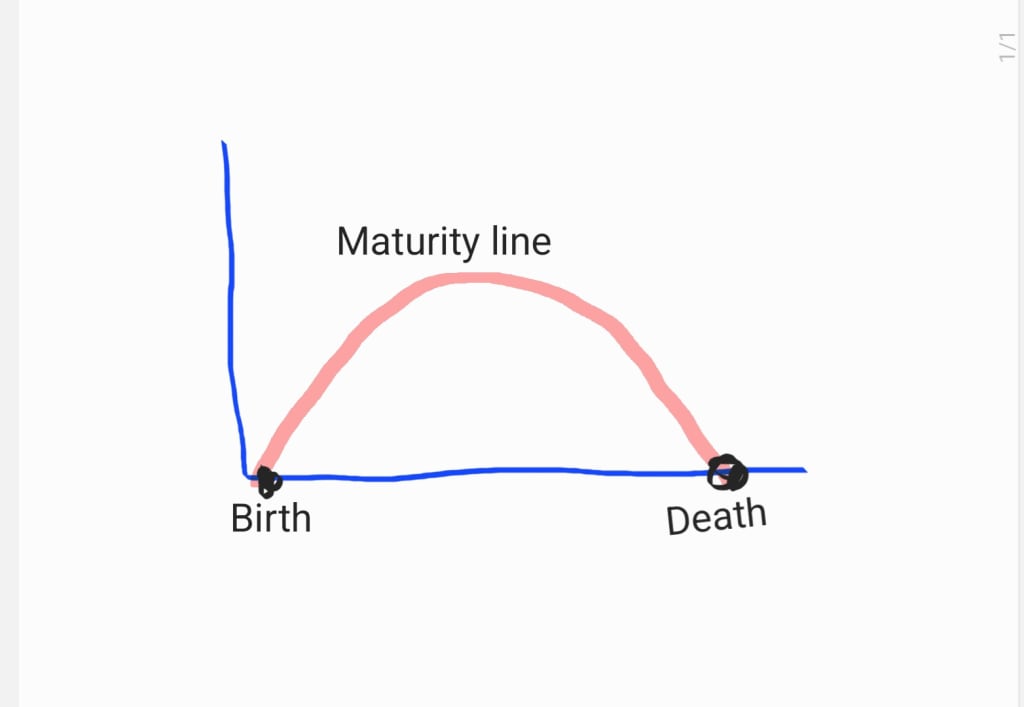
Maturity is often perceived as a fixed destination, a point where one becomes “fully developed” in thought, emotion, and understanding. However, a closer examination reveals that maturity is a continuous process that unfolds in distinct stages throughout life. Rather than a static trait, it ebbs and flows, shaped by personal experiences, age, and adaptability to change. Here, I present my perspective that views maturity as a graph with phases, each one reflecting a different depth of understanding and interaction with the world.
The Early Stage: Emerging Awareness
From the moment a human being enters the world, a small seed of maturity is already present. As an infant, there is an innate awareness—however limited—of comfort, discomfort, hunger, and connection. A newborn’s cries signal discomfort or needs, reflecting an early, instinctual form of maturity. As days go by, this young child develops further awareness, recognizing and forming attachments to those who provide care and comfort, such as parents and close relatives.
In the early years, each experience, be it learning to walk, recognizing familiar faces, or responding to one’s environment, is a foundational layer of maturity. This stage is marked by an upward curve in maturity, as each new experience and interaction adds to the child’s understanding of the world. Maturity here is characterized by a developing consciousness, a realization of one’s surroundings, and the first steps towards empathy and social connection.
The Growth Phase: Adolescence to Early Adulthood
As the individual moves into adolescence, maturity takes on a new dimension. This phase brings a stronger sense of self-identity, a deepening awareness of social norms, and the beginning of personal responsibilities. Adolescents start to grapple with complex emotions, question authority, and form their independent opinions, often testing the boundaries set by society and family.
In early adulthood, the maturity curve continues its ascent as individuals begin to assume greater responsibilities, from education and career to relationships. These years are marked by significant milestones—pursuing higher education, entering the workforce, or building lasting relationships. This stage culminates in a kind of “equilibrium” of maturity, where a person is typically seen as responsible, self-sufficient, and prepared to navigate the challenges of adult life. By the time they reach their thirties or forties, many have achieved what could be considered peak maturity, where their knowledge, experience, and understanding converge in a balanced, stable state.
The Middle Plateau: Achieving Life Balance
For most, the maturity curve reaches its peak during middle age, often around the time of marriage and family-building. This stage is characterized by stability, where one has accumulated enough life experiences to make informed, balanced decisions. It’s a period of consolidation—of values, relationships, and professional achievements. Here, maturity manifests in an ability to handle complex life situations with composure, empathy, and wisdom.
At this stage, individuals often find themselves in mentorship roles, guiding the younger generation, imparting values, and offering advice rooted in experience. They exhibit a profound sense of responsibility not only to themselves and their families but also to society at large. This stage can be seen as the “maturity equilibrium,” where a person’s understanding of life, shaped by years of learning and adaptation, reaches its fullest form.
The Declining Phase: Adaptation and Limitations in Later Life
However, as individuals move beyond their sixties and seventies, the maturity curve does not remain static. It begins to descend, not because they have lost their acquired wisdom, but because the world around them continues to change rapidly. Older adults often struggle to keep pace with technological advancements, social changes, and emerging cultural norms that feel foreign and, at times, overwhelming. A person in their eighties, for instance, may find it challenging to understand or engage with today’s digital age, where smartphones, social media, and artificial intelligence play a dominant role.
This declining phase is not a loss of maturity in its true sense but rather a limitation in adaptability. The wisdom accumulated over decades remains intact, but the ability to connect with the present environment may be restricted. This phenomenon is particularly evident in fields that rely heavily on new technologies. For instance, many older adults may find it difficult to navigate complex digital devices or adapt to new forms of communication that the younger generations take for granted.
A Reflective Comparison: The Cyclical Nature of Maturity
By comparing these stages, it becomes evident that maturity is not a straight path but rather a cyclical journey with peaks and declines. In the early stages, maturity begins with instinctual awareness and gradually grows as individuals encounter life’s complexities. It reaches a peak in adulthood, where responsibilities, experiences, and learned wisdom culminate in balanced decision-making. As individuals enter their later years, this curve of maturity declines not in terms of depth or wisdom but in the ability to remain adaptable to new, emerging realities.
This perspective challenges the notion that maturity is something one “attains” once and for all. Instead, it proposes that maturity is a lifelong journey—a graph that rises and falls, reflecting the realities of growth, stability, and inevitable decline. While younger generations gain maturity through rapid learning and adaptation, older generations hold a wealth of life-wisdom that, while timeless, may not always translate seamlessly into modern contexts.
Conclusion:
The concept of maturity as a fluctuating journey rather than a final destination allows for a more compassionate understanding of human development. Each phase, from infancy to the later years, brings a different type of maturity—each one valuable in its context. In youth, maturity is about growth and exploration; in adulthood, it is about stability and wisdom; in older age, it is about reflection and selective adaptation.
This cyclical view reminds us that maturity is not an absolute state. Rather, it is an ongoing, evolving process, and each phase has its own challenges and rewards. Embracing this perspective enables us to appreciate the unique contributions of every stage of life, recognizing that while maturity may decline in adaptability, it never diminishes in depth or value. In this way, maturity is truly a lifelong journey, marked by growth, equilibrium, and graceful adaptation to the passage of time.
About the Creator
Keep reading
More stories from Mohammad Hussaib and writers in Journal and other communities.
The Last Whisper
The Wind carried a soft, haunting whisper through the old village, as though a voice long forgotten had returned for its final words. That evening, as the mist thickened around the cliffs, young Marlowe found an envelope wedged between the bricks of his grandfather's cottage—one with his name, but written decades before he was even born.
By Mohammad Hussaibabout a year ago in Fiction
The Long Way Home
“You don’t have to stay,” she says again. I nod, again. “I know.” We’ve been having this conversation in fragments for the last hour. It keeps restarting, like neither of us quite trusts the ending. People move around us with paper plates and careful voices. Someone laughs too loudly near the doorway and immediately apologizes to no one in particular. Grief makes everyone clumsy.
By Megan Stroupabout 15 hours ago in Journal



Comments
There are no comments for this story
Be the first to respond and start the conversation.