
A Cineaste's Resolution
Coming to terms with the endgame of media consumption.
I don’t deserve my eyes.
It’s a thought that zigzags across the multi-colored void of my eyelids after any self-induced migraine, while I use the bedsheets to seal off incoming noise and oxygen. Sometimes I think staring up at the general direction of the pain will make it subside, and sometimes it works. I don’t know the science behind this, but like many unknowns, it probably chalks up to placebo. Ignorance as aid. That pill didn’t make the pain disappear, we did, in believing pills are magic. I’m gonna give my children a mint whenever they complain of headache. The attention is what counts, like a mother’s kiss on their baby’s split finger.
Aron Ralston found his arm trapped under a rock in Bluejohn Canyon while alone on a hike. He lasted one-hundred-and-twenty-seven hours with minimal liquids including his own urine before opting to remove the entrapped forearm with a dull pocket knife. I’m using that same arm this morning, making it cramp and feed me fingernails and lift cold coffee from table to mouth. Its job is menial but valued. Do I invite arthritis when I pop its knuckles? Would Aron Ralston pop his knuckles if he broke away with both hands?
I always forget to appreciate the moments when my head doesn’t ache, despite vowing to do so in the throes of hurt. It really is the most infuriating debilitation, usually a result of ocular abuse. My eyes are too close to a screen, for too long, with not enough light and too much information coming in.
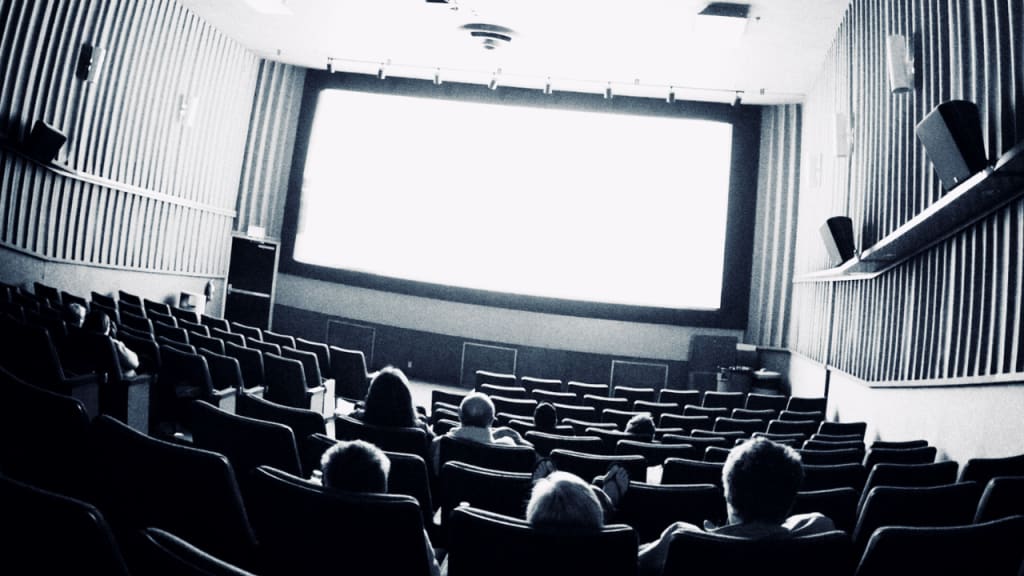
The eye moves in snapshots. Try to move your line of sight from left to right in a smooth motion—it’s impossible. It’s odd how something so round and lubricated can behave so mechanically staccato, in such constructed increments. These are the frames of your life. Here is where the thin line between time wasted and well spent doesn’t exist, maybe because it never did. “Well, that’s two hours I’ll never get back,” an upset filmgoer will say, but time would work no differently had the experience been a positive one. That’s a net loss. Why do we even go to the cinema? To escape time, to have ticketed out-of-body episodes in the dark. It’s a step under Cryosleep. We stumble out in a fog, mumbling incoherences to our partners and selves, daylight piercing the daydream. Maybe the literal meaning is wrong entirely. Maybe the upset filmgoer’s life would’ve been enriched several times over if it aligned with the film’s motives. A film is a reflection of who we are at any given point in time, extensions of ourselves. They are as valid as any event remembered, each one projected on the back of our eyelids, albeit with fading fidelity over time. Filmgoing has been described as an ego-centric, self-congratulatory activity, under the popular academic assumption that the screen is a mirror. We look for ourselves in characters, scenarios, minute gestures, and flog it for lack of realism. Films make us feel part of one whole, so a lack of recognition can make us feel slighted. Through and through, they are communal and addictive.
Over the course of the last year, I watched four-hundred-and-twenty-eight films. Although a handful were short form (one to fifty minutes), my log is primarily made up of feature-length pieces (approx. ninety-plus minutes). Every time I sit down to watch something, it’s for the love of stories. A story need not be grandiose; it can be a husband making the morning’s first cup of coffee for his wife. Although I admire technique in the moment, a film should be felt before being understood.
Ironically, a good film makes me want to explode. Put another vulgar and valid way, Emily Dickinson can identify great art if it makes her feel “as if the top of [her] head were taken off.” The information has come in, now what can we do with it? We have been moved, but where are we going? The answer for a lot of people is to create something of their own. Object is auxiliary; the goal is creation. Build a birdhouse, write a poem. First-time writers sound like someone else for a while or forever—because pure originality is besides the point—and tune into the things that make their heart known to them. A lot of it is shoddy, but it’s a unique joy to fill pages even with nonsense, like talking about nothing with a close friend. Words are leaving your mouth, but your mind is elsewhere, in the future and past, in your friend’s future and past, while you fidget with the remote, wondering whether or not the couch could fit your sleeping body and if you’re a good enough friend to occupy it. No outside listener would remember this indirect conversation, and no one would enjoy reading the notebook of nonsense. The important thing is paying attention, to ourselves and others. These seemingly inconsequential moments pave our lives and determine its trajectory.
Filmgoing is an empath’s sport. A film succeeds if it breaks our hearts, gets a laugh, makes us afraid of the dark. Abuse the characters too much and we resent it as “torture porn.” Outside of hand-over-fist concessions and ticket purchases, we offer empathetic attention, and attention is the sole component of love. The transaction's inner machinations are seedier. Privy to a viewer's need for recognition and meaning, filmmakers often cater to comfort, dealing in callbacks and points of reference to reward us for storing drivel in our heads. A long-forgotten internet meme triggers a laugh of recognition, which is a step away from pity. Commodified nostalgia aims to convince us that we have not wasted the years we've been given. Test audience feedback and fan theories will all be tended to, spoon-fed from a platter. Popular films used to be the pulse, now they’re the finger.
And still the ageless hunt continues, for pleasure, inspiration, unification, a kick of dopamine. Libraries boast exhaustive shelves upon shelves, the sheer item number daunting and unknowable, regardless of database. One particular book I’ve loaned, sitting next to me now, exists outside of any library computer. The honor system is all that tethers it back home. This is an essential part of the hunt, a familiar concept to any eclectic curator: a sense of the unknown, discovering a book or film that is only there by happenstance, forgotten until now. Exploring it all is a naïve and impossible feat. And still the hunt continues.
It’s not that I can’t keep up with the scattershot, pick of the week, top ten, best of—I can barely keep up with my own interests. Eyes are bigger than the stomach. What I want to do and watch and read greatly exceeds the energy I have contained in a twenty-four-hour cycle (minus the regular six hours of sleep permitted by excess coffee and media consumption [blue light emitted by electronics prolongs mental alertness]). Of all people—excluding passing acquaintances—I have seriously befriended maybe ten of them. In the grand scheme of film and literature, I have probably consumed about the same. This year, and all forthcoming, I must reckon with the objective truth that I will never do, read, or watch everything that intrigues me. There are masterpieces I’ll never discover, gazes I’ll never meet, lands I’ll never tread. There is something deeply sad about that, but this is the world, and it is enough.
"See enough and write it down." — Joan Didion
About the Creator
Keep reading
More stories from Michael Acciarino and writers in Journal and other communities.
Great Enough to Be Remembered
The last word fourteen-year-old Billy Moss wanted to say on earth was “cut!” He had spent the better part of his life consuming video media and an egregious sum of carbohydrates. The second thing he’d devoted his life to, if but unconsciously, was sleeping.
By Michael Acciarino4 years ago in Fiction
The goals I did not achieve
Every writing goal I made for the year is a wash. It has been this way for a while, but I think it's important to be open about my failures and the reality of how life can get in the way. This is especially true considering the several times I have posted on Vocal about my writing goals, how I was changing my approach, and where I was hoping to be for the upcoming year. I will probably do that again in a couple months, but for now, it is time to acknowledge where I am today.
By Kay Husnick17 days ago in Journal
Creating a Business Plan for Online Health Services
Full Introduction As we navigate 2026, the online health services market has matured from a pandemic-era necessity into a permanent, multi-billion dollar pillar of the healthcare system. A business plan for a virtual health venture today must account for a landscape dominated by hybrid care models, advanced AI integration, and a rigorous regulatory environment regarding data privacy. Current projections indicate the global digital health market will reach nearly $500 billion this year, with an annual growth rate exceeding 20 percent. To succeed in this competitive space, your plan must clearly articulate how you will solve modern healthcare barriers such as provider burnout, rising costs, and the need for seamless, asynchronous patient communication.
By Abdul Mueed6 days ago in Journal
Standing While Falling
Quotation from Friedrich Nietzsche "He who wrestles long with monsters should beware lest he himself become a monster. And if you gaze long into an abyss, the abyss also gazes into you. Man is not destroyed by suffering, but by the meaning he makes of it."
By LUCCIAN LAYTH6 days ago in Critique


Comments
There are no comments for this story
Be the first to respond and start the conversation.