
Creating a Business Plan for Online Health Services
Business

Full Introduction
As we navigate 2026, the online health services market has matured from a pandemic-era necessity into a permanent, multi-billion dollar pillar of the healthcare system. A business plan for a virtual health venture today must account for a landscape dominated by hybrid care models, advanced AI integration, and a rigorous regulatory environment regarding data privacy. Current projections indicate the global digital health market will reach nearly $500 billion this year, with an annual growth rate exceeding 20 percent. To succeed in this competitive space, your plan must clearly articulate how you will solve modern healthcare barriers such as provider burnout, rising costs, and the need for seamless, asynchronous patient communication.
Expanding Care Through Digital Platforms
Virtual care has become an essential part of modern healthcare delivery. Entrepreneurs exploring how to start your own telehealth business must plan for licensure compliance, secure technology platforms, reimbursement policies, and data protection. Business planning should also include clinical workflows, staffing models, and marketing strategies. When implemented correctly, telehealth services improve access to care, reduce overhead costs, and create flexibility for both patients and providers while maintaining regulatory compliance.
Executive Summary and Value Proposition
The executive summary serves as the high-level roadmap for investors and stakeholders, distilling your entire business strategy into a single compelling page. In 2026, a winning value proposition often focuses on a virtual-first specialty program—such as mental health, chronic disease management, or longevity—rather than a generic urgent care model. You must clearly state whether you are building a custom platform or utilizing a white-label solution, as this significantly impacts your initial capital requirements. Your summary should highlight your mission, your founding team’s clinical and technical expertise, and a concise statement on how your service model achieves better patient outcomes at a lower cost than traditional in-person care.
Market Analysis and Target Demographic
A thorough market analysis in 2026 requires more than just high-level statistics; it requires a deep dive into specific patient personas and niche opportunities. Successful virtual health startups are increasingly focusing on "narrow" patient populations, such as women’s health for those over 45 or pediatric neurodivergence, to stand out in a saturated market. Your analysis should evaluate local and national competitors, identifying gaps in their service delivery—such as long wait times or poor integration with wearable technology. Additionally, you must address the regulatory environment of your target regions, including state-specific licensing requirements and the latest federal updates to telehealth reimbursement policies.
Operational Plan and Technical Infrastructure
The operations section of your 2026 business plan must detail the "digital backbone" required to deliver care safely and efficiently. This includes a clear strategy for HIPAA-compliant data storage, end-to-end encrypted video conferencing, and seamless integration with Electronic Health Records. You should outline your "Clinic-in-a-Box" or "Virtual-First" workflow, explaining how patient intake, triage, and pharmacy routing will be automated to reduce administrative burden on clinicians. Furthermore, your plan must specify the hardware requirements for your team, such as high-quality webcams and secure remote workstations, as well as any remote patient monitoring (RPM) devices you intend to distribute to clients.
Financial Projections and Funding Requirements
Financial planning for online health services in 2026 requires significant upfront capital for technology and compliance. Initial capital expenditure (CAPEX) for a mid-sized platform build-out often totals around $280,000, with an additional working capital buffer of approximately $660,000 to cover operational deficits during the first year. Your pro forma statements should project revenue across various streams, such as per-visit fees, monthly subscriptions, or corporate wellness contracts. Most digital health models currently aim for a break-even point within thirteen to eighteen months, provided that marketing spend is optimized and practitioner payouts are balanced against revenue growth.
Sales and Marketing Strategy
Marketing an online health service in 2026 is no longer just about social media ads; it is about building a high-signal brand in a high-noise environment. Your strategy should prioritize search engine optimization for niche clinical terms and partnerships with local professional networks. Content marketing that showcases your expertise—such as whitepapers on patient outcomes or educational webinars—is essential for building the trust required in healthcare. You should also detail your "patient acquisition cost" (PAC) and how you plan to leverage automated follow-ups and patient portals to improve retention and long-term lifetime value.
Final Conclusion
Creating a business plan for online health services is a complex but rewarding task that requires a perfect balance of clinical rigor and entrepreneurial agility. In the current 2026 environment, the most successful plans are those that treat virtual care not as a separate channel, but as a primary, integrated service line. By focusing on niche patient needs, investing in robust compliance infrastructure, and maintaining clear financial discipline, you can build a practice that is both scalable and profoundly impactful. Ultimately, your business plan is the foundation upon which you will build a modern healthcare experience that is accessible, equitable, and sustainable for the future.
About the Creator
Keep reading
More stories from Abdul Mueed and writers in Journal and other communities.
Evaluating Technical Staffing Proposals in 2026
Full Introduction As of early 2026, the technical staffing landscape has shifted from a volume-based model to a precision-focused, skills-based paradigm. Evaluating a staffing proposal today requires more than a simple comparison of hourly rates; it demands a deep dive into the vendor’s integration of AI, their ability to verify technical depth in an era of AI-polished resumes, and their alignment with your specific engineering culture. A high-quality proposal in 2026 should move beyond simple headhunting to demonstrate how the agency will reduce your time to productivity and ensure long-term retention in a highly fluid labor market.
By Abdul Mueed4 days ago in Journal
The goals I did not achieve
Every writing goal I made for the year is a wash. It has been this way for a while, but I think it's important to be open about my failures and the reality of how life can get in the way. This is especially true considering the several times I have posted on Vocal about my writing goals, how I was changing my approach, and where I was hoping to be for the upcoming year. I will probably do that again in a couple months, but for now, it is time to acknowledge where I am today.
By Kay Husnick15 days ago in Journal
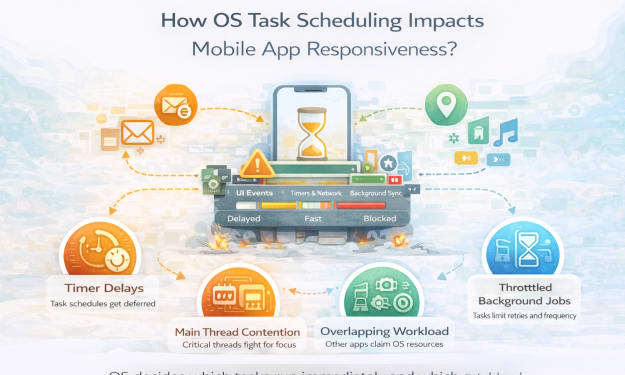
How OS Task Scheduling Impacts Mobile App Responsiveness?
I didn’t understand task scheduling until it embarrassed me. The app looked fine on my phone. Smooth taps. Clean transitions. Then support tickets started piling up from users on older devices. Same build. Same code. Very different experience.
By Mike Pichai6 days ago in Journal
'20/20'
"Do It Again" the track that would ultimately open the Beach Boys final album on Capitol Records which was released on February 10th 1969 had originally been released as a single in August of 1968. The track was the first of many post-Pet Sounds era throwbacks to the early Beach Boys sound which would become continually more cliched and eventually lead the Beach Boys to the level of self-parody they would eventually succumb to in the 1980s while their closest contemporaries The Beatles nearing the end of their run in 1969 would go on to be viewed as the most influential band of all time. However, the song itself is not bad on its surface, and it opens with a futuristic sounding (for 1969) drumbeat captured by then-Beach Boys engineer Stephen Desper using tape delays on the drums performed by Dennis Wilson and John Guerin. The song has been re-recorded numerous times over the years on various Beach Boys-related projects most notably the 2011 re-recording at Capitol studios featuring the five surviving Beach Boys at the time backed instrumentally by various members of both the Brian Wilson Band and Mike Loves touring "Beach Boys" to promote the then upcoming Beach Boys 50th Anniversary reunion tour in 2012. The hammering and power drill sound at the end of the song was an excerpt from a track called "Workshop" that was to be a part of the uncompleted "SMiLE" album.
By Sean Callaghan5 days ago in Beat



Comments
There are no comments for this story
Be the first to respond and start the conversation.