
Morocco Earthquake - How Did the Earth Move with a Magnitude of 6.8 After 399 Years?
Morocco Earthquake - How Did the Earth Move with a Magnitude of 6.8 After 399 Years?

Morocco Earthquake - How Did the Earth Move with a Magnitude of 6.8 After 399 Years?
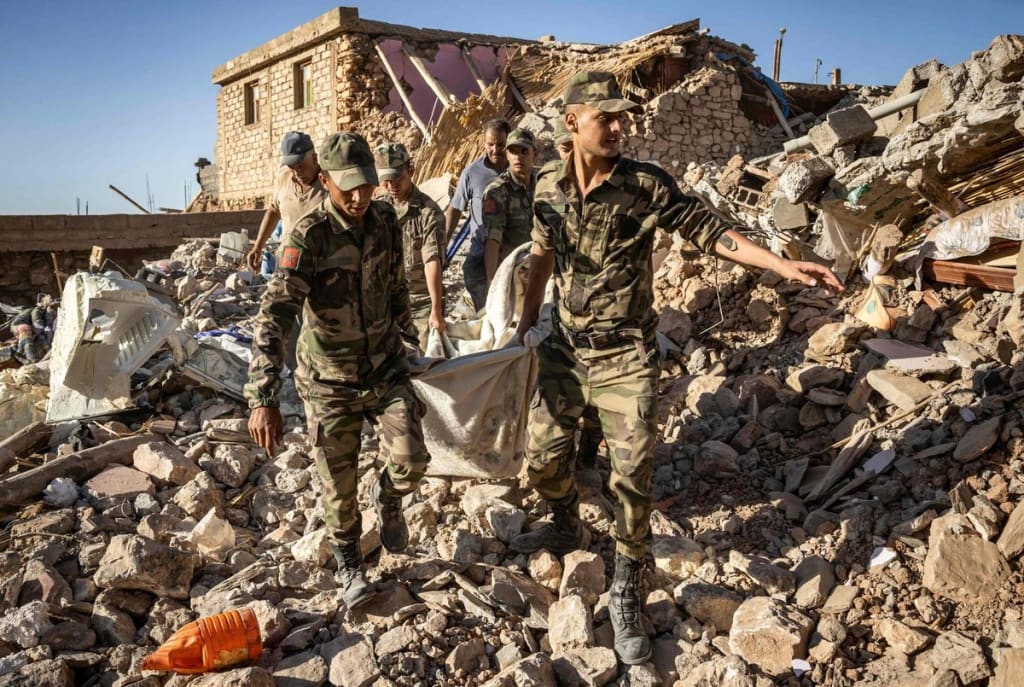
After nearly 399 years since the earthquake on May 11, 1624 - which struck the city of Fes and was described in a study published in 2017 as one of the worst natural disasters in Morocco's history - the country experienced a similar earthquake on the evening of Friday, September 9, 2023.
A 6.8 magnitude earthquake struck approximately 70 kilometers southwest of Marrakech at 11:11 PM local time. This earthquake was felt in wide areas in the north and northeast of Morocco, and its effects were even noticed in parts of Algeria, Spain, and Portugal.
In terms of earthquake intensity, a 6.8 magnitude earthquake is considered strong, and even moderate earthquakes can cause significant damage in this region. For instance, about 140 kilometers to the southwest of the recent earthquake location, a 5.8 magnitude earthquake in 1960 resulted in the deaths of 12,000 to 15,000 people.
Compared to the 1960 earthquake, the recent one had about ten times more energy release (in earthquake magnitude scales, each whole number increase represents a tenfold increase in amplitude). However, the catastrophic destruction in the 1960 earthquake was partly due to poorly constructed buildings made of compressed earth, sand, and gravel for walls and structures, which collapsed completely. Inadequate construction practices often contribute significantly to earthquake disasters.
While the 1960 earthquake prompted changes in building codes in Morocco, many buildings, especially rural homes, did not adhere to these codes. According to Bill McGuire, a professor of geophysical and climate hazards at University College London, the rarity of large earthquakes in Morocco contributes to the lack of preparedness, as buildings are not typically constructed to withstand strong earthquakes.
Based on the earthquake magnitude and the weakness of local buildings, the U.S. Geological Survey's (USGS) Global Seismic Network's Immediate Assessment System (PAGER) estimated a significant number of fatalities. However, the USGS emphasized that these estimates are uncertain due to the lack of sufficiently strong earthquakes in this part of Morocco to train their artificial intelligence-based system to make accurate predictions.
The rarity of earthquakes also limits the ability of the Global Seismic Network's Immediate Assessment System to provide accurate estimates of losses and hinders researchers' ability to develop a precise understanding of the reasons behind the 6.8 magnitude earthquake occurring in a different location than the May 11, 1624 earthquake.
According to the U.S. Geological Survey, earthquakes with a magnitude of 6 or higher are not common in this region. Since 1900, there hasn't been any earthquake with a magnitude of 6 or higher within 500 kilometers of this earthquake's location. Only 9 earthquakes with a magnitude of 5 or higher have occurred, and most of these were to the east of the September 8, 2023 earthquake.
So, what happened?
Zakaria Hmeimy, the Deputy President of the International Union of Earth Sciences Ethics, told Al Jazeera, "There is significant difficulty in understanding what happened in Morocco. In addition to the rarity of large earthquakes in the past, which helps us understand what happened in September 8, 2023, Morocco's location is extremely complex."
Hmeimy explains, "Morocco lies along the boundary of an incomprehensible and slow-moving tectonic plate that separates North Africa (the Nubian Plate or African Plate) from Europe (the Eurasian Plate). The Eurasian Plate moves south and east relative to the Nubian Plate at a rate of only 4 millimeters per year."
Tectonic plates are massive rock masses that move very slowly relative to each other, usually a few centimeters per year. This movement, even if slow, generates significant stress along plate boundaries, leading to the development of faults and, subsequently, earthquakes.
Hmeimy adds, "The tectonic plate boundary in Morocco is highly complex, with multiple active fault zones instead of a well-defined single fault. Given the slow relative movements, it's challenging to use geodesy tools (the science that deals with the size, shape, dimensions, and magnetic field of the Earth) to precisely determine the active faults and their actual slip rates."
Which Faults Ruptured?
Due to this complex situation, the U.S. Geological Survey has not definitively identified the fault that ruptured and caused the earthquake. Instead, they have proposed some possibilities based on what is known as the "source mechanism," which describes the deformation within the source region generating seismic waves and indicates the direction of slip.
Sherif El Hady, the head of the Seismology Department at the National Research Institute of Astronomy and Geophysics in Egypt, suggests, "According to the source mechanism studies, there are two possibilities: a dipping thrust fault on a low-angle fault that dips southwestward or a sliding fault on a steeply dipping fault that dips northwestward."
He adds that the U.S. agency suggests that "the primary candidate for the fault that hosted the rupture is most likely the North Atlas Fault, a dipping thrust fault that slopes southward and follows the northern edge of the Atlas Mountain range."
El Hady emphasizes that the clear uncertainty in interpreting the Morocco earthquake underscores the importance of paying more attention to earthquake studies in Morocco. Given the complexity of Morocco's geological setting and the scarcity of large earthquakes, there is still much to learn about the hazards posed by faults in the region.
Will There Be Aftershocks?
This uncertainty also extends to the important question of the possibility of aftershocks because all major earthquakes, like the one in Morocco, are typically followed by aftershocks.
Aftershocks, as described by El Hady, are earthquakes associated with changes in pressure resulting from a previous, larger earthquake. He says, "Morocco has already recorded an aftershock with a magnitude of 4.9, and there have undoubtedly been smaller aftershocks as well."
In some less common cases, an earthquake can lead to another of the same or even larger magnitude, as happened with the earthquake in Turkey and northern Syria in February of the previous year. However, Zakaria Hmeimy rules out the possibility of this happening in Morocco and says, "The first earthquake in Turkey occurred on the eastern Anatolian fault, and the subsequent one, which was close in magnitude, happened on the northern Anatolian fault. These are coupled faults. However, the faults in Morocco are not coupled, so it's unlikely that aftershocks of the same size or larger would occur."
However, he emphasizes that even smaller aftershocks pose a significant danger to the region, and people should not return to their homes, which may have been damaged in the initial earthquake, because aftershocks can cause the collapse of structurally weak buildings.
About the Creator
Said zoubir
My name is Sa'id Zoubir, and I work for the newspaper affiliated with the Al Jazeera Media Network.
Publish everything related to exclusive news.
Keep reading
More stories from Said zoubir and writers in Interview and other communities.
Bono Among the Nominees: FIFA Announces "The Best" Award Candidates
Bono Among the Nominees: FIFA Announces "The Best" Award Candidates The International Federation of Association Football (FIFA) revealed today, Thursday, the lists of nominees for The Best awards in the world for the year 2023.
By Said zoubir2 years ago in Humans
Center Stage with Paul Stewart
*** I'm keen to republish the interviews I did for my series with Vocal creators. It's been a few years and I thought it might be nice to revisit these wonderful conversations. I'll be releasing them one at a time for a few weeks/months.
By Heather Hubler3 days ago in Interview




Comments
There are no comments for this story
Be the first to respond and start the conversation.