
Three Men in a Boat (To Say Nothing of the Dog)
“The Hilarious Misadventures of Three Friends and a Dog”

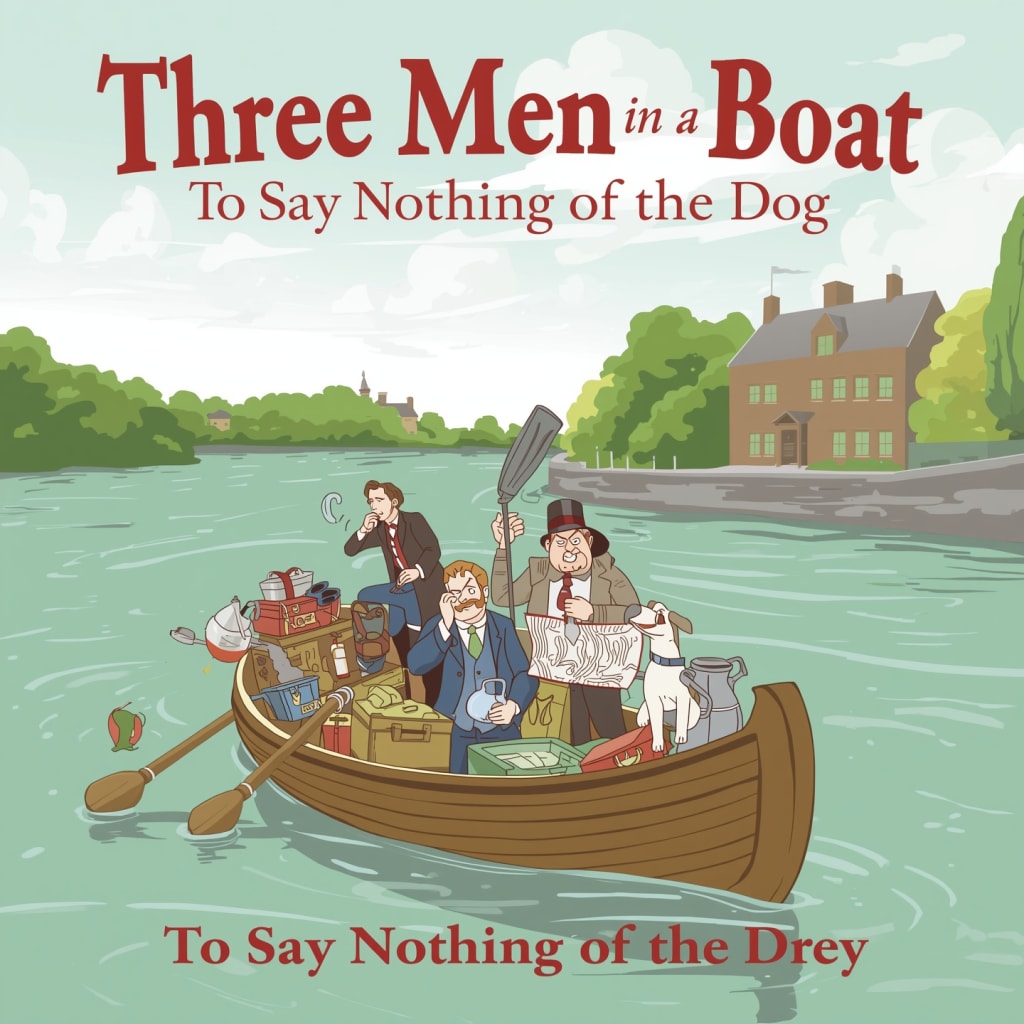
Three Men in a Boat (To Say Nothing of the Dog)
It all began with a conversation in a stuffy London room, where three friends sat convinced they were all terribly overworked and dangerously close to death. George, who spent his days in a bank, swore his pulse had developed an alarming irregularity. Harris, always dramatic, declared that his liver had practically resigned from service. As for the narrator—let’s call him J.—he was certain that medical science would soon name a new disease after him, given the spectacular array of symptoms he displayed.
The only creature in the room who seemed remotely healthy was Montmorency, the fox terrier, who sat by the fireplace wearing the smug expression of someone who thought his humans were idiots.
After much self-diagnosis and unnecessary groaning, the three men reached a conclusion: what they needed was rest. But not ordinary rest—no, certainly not sitting at home where wives, landladies, and neighbors might find them “useful.” They needed a holiday. Something adventurous, but not too dangerous. Something invigorating, but not exhausting. After discarding ideas of cycling tours, seaside trips, and climbing mountains, they settled on the perfect solution: a boating trip along the Thames.
Thus, it was decided—three men (and one dog) would journey up the river.
The next few days were filled with chaos as they prepared. Lists were drawn, and then re-drawn when they realized they had packed twelve bottles of toothpaste but no soap. Arguments broke out about what constituted “essential.” George argued for a frying pan large enough to cook a sheep; Harris insisted on bringing two banjos despite no one knowing how to play; J. claimed the only necessary item was a bottle of medicine labeled “for everything.” Montmorency tried to help by burying socks in the garden.
When at last they set off, the boat looked less like a vessel and more like a floating jumble sale. Blankets, bags, kettles, frying pans, fishing rods, and the occasional loaf of bread stuck out at odd angles. Passersby on the riverbank chuckled as they watched the three men wobble into the current, arguing over whose turn it was to row.
Life on the river was anything but calm. Meals became a daily comedy of errors. One morning, Harris attempted to make scrambled eggs, which quickly turned into a sticky yellow substance resembling glue more than food. On another occasion, J. discovered that making tea outdoors invited every insect within three miles to join the picnic. Montmorency contributed by sticking his nose in the kettle whenever no one was looking.
Then there was the matter of navigation. George claimed to have a natural instinct for steering, which meant the boat continually rammed into the riverbank. Harris declared maps were unnecessary—“The river is only one long road; you can’t possibly get lost”—right before leading them two miles upstream in the wrong direction. J. himself tried to take charge, but was often too busy daydreaming about medieval knights and river history to notice the boat drifting sideways.
Still, the Thames had its charms. The men admired grand houses along the river, imagined the ghosts of monks and kings, and occasionally managed a pleasant moment of peace before the next disaster struck.
The high point—or perhaps the low—came when Harris volunteered to cook an elaborate stew. He threw in potatoes, onions, half a cabbage, some cold beef, a leftover pie, and, for reasons unknown, a tin of pineapple (without removing the tin). As the stew bubbled suspiciously, Montmorency sat watching with intense interest, as though expecting a small animal to crawl out of it. When the dish was finally served, George took one bite and declared it “a cross between a nightmare and a crime.” They buried the remains on the riverbank in case it tried to come back to life.
Not every episode was funny at the time. They battled with rain that soaked everything they owned, mosquitoes that treated them as an all-you-can-eat buffet, and locks that never opened when they should. But in hindsight, each misfortune became a story to laugh at, and that, after all, was the point of the trip.
At last, after two weeks of rowing, blisters, bad cooking, and Montmorency’s mischief, the three men decided they had had quite enough of “the simple life.” One stormy evening, as rain pounded on the boat and wind threatened to capsize it, George suggested something radical: “What if we… go back to London, find a nice warm restaurant, and eat a proper meal?”
The idea was met with unanimous approval. They abandoned the boat, hurried to the nearest train, and by nightfall were seated in a cozy dining room with roast beef, potatoes, and glasses of wine.
As they toasted their “successful” holiday, Montmorency dozed happily at their feet, no doubt convinced that he had been the only competent member of the expedition.
Thus ended the grand adventure of three men in a boat (to say nothing of the dog)—a holiday full of disasters, arguments, and culinary crimes, yet remembered with laughter as one of the happiest times of
About the Creator
The Day I Found Myself: A Transformative Journey
The Day I Found Myself: A Transformative Journey There are days that slip by unnoticed, blending into one another without leaving a mark. And then there are days that change everything—the ones that divide life into before and after. For me, the day I found myself was not filled with fireworks or applause. It was quiet, almost ordinary, but within its silence came the most transformative realization of my life.
By Muhammad4 months ago in Motivation
EXCLUSIVE: The Pompous Post Investigates “Milton Barrington III, Esquire” - A Lawyer Who Has Failed the Bar Exam Nine Times but Refuses to Stop Practicing Law Anyway.
The Pompous Post has always stood for truth, accountability, and protecting the public from quietly confident disasters. Which brings us to Milton Barrington III, Esquire.
By The Pompous Post3 days ago in Humor



Comments
There are no comments for this story
Be the first to respond and start the conversation.