
“The Misadventures of Mr. Bashir’s Goat”
When Eid sacrifice turns into a village-wide chase

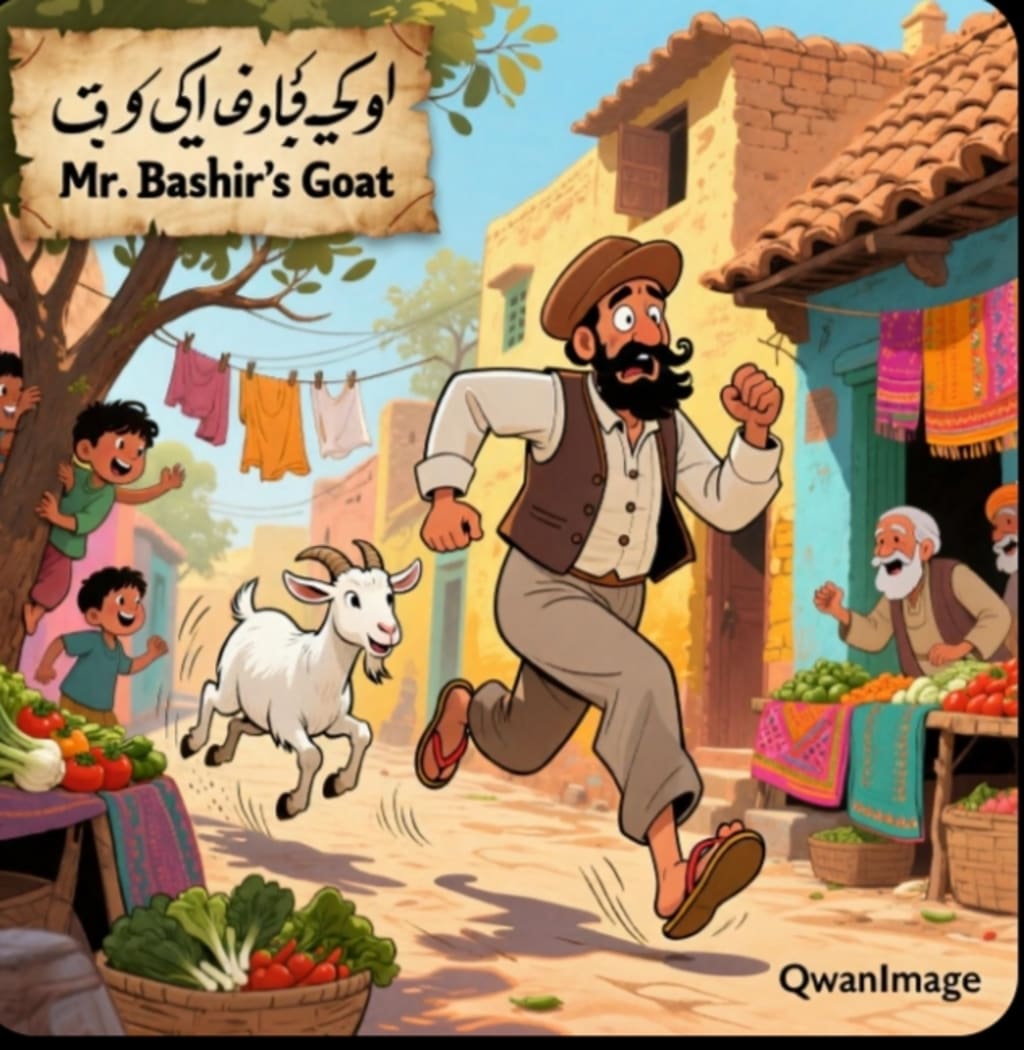
In the sleepy village of Chamanpur, where the rooster crowed like a clock and the gossip traveled faster than the wind, lived a man named Mr. Bashir. He was a man of stature—both in height and in self-opinion. With a thick, well-groomed mustache that curled at the ends like a vintage cartoon villain’s, and a waistcoat that strained just a little too hard across his belly, Bashir carried himself like a man who’d never lost an argument.
Every Eid-ul-Adha, he turned the occasion into a personal competition. Not with malice, mind you—but with flair. While others quietly bought their goats and made their sacrifices, Bashir treated it like a royal event.
“This year,” he announced one afternoon at the tea stall, sipping his chai with dramatic flair, “I have brought a goat so noble, even the mountains bowed when I led him down.”
The villagers exchanged glances. Some rolled their eyes. Others leaned in, curious.
“The animal eats only fresh grass,” Bashir continued, “and I give him bottled water—filtered, mind you. His name? Badshah. King.”
The goat, standing beside him on a red velvet rope, lifted his head as if he’d heard his name on a royal summons. He was impressive—snow-white, broad-shouldered, with horns that gleamed like polished wood and eyes that held a quiet, unshakable confidence.
Children gathered around, whispering, “He looks like he should wear a crown.”
No one noticed the way Badshah eyed the rooftops.
The morning of Eid arrived with golden light and the smell of cardamom in the air. Women stirred pots of sheer khurma, men prayed in crisp white kurtas, and Bashir stood in his courtyard, adjusting his cap, ready for what he called “the ceremonial moment.”
“Bring the king,” he declared.
His nephew Imran tugged gently on the rope. Badshah took one step forward. Then another. Then, with a sudden flick of his head, he yanked the rope free and bolted—like a furry comet shot from a cannon.
“Arre!” Bashir yelped, dropping his knife.
The chase began.
Badshah tore through the village like a four-legged hurricane. He zigged past the bakery, sending trays of naan flying. He zagged through the market, scattering onions and tomatoes like confetti. Auntie Zohra’s freshly hung laundry? Gone—half-eaten, half-dragged through the dirt.
Bashir charged after him, his slippers flapping, his breath coming in short, furious bursts. “Stop that goat!” he bellowed, tripping over a bucket and landing in a pile of hay.
The entire village turned out to watch. Kids climbed trees. Old men leaned on canes, laughing so hard they had to hold their sides. Someone brought out a hand drum and started playing a beat that went, “Goat, goat, running so fast—Bashir’s pride won’t last!”
At one point, Badshah leapt onto the low wall of the mosque, stood perfectly still, and looked out over the rooftops like a ruler surveying his kingdom.
“Look at him!” someone cried. “He’s posing!”
Uncle Nazeer wiped tears from his eyes. “I’ve seen three Eids, but never one like this.”
By now, the whole thing had become legend. A teenager filming on his phone uploaded the clip with the caption: “The Goat That Said No to Eid.” By noon, even relatives in Lahore were calling to ask, “Is it true the goat climbed a rickshaw and refused to come down?”
Back in the courtyard, Bashir sat on a stool, defeated. His wife placed a cup of tea in his hands.
“You were showing off again,” she said, not unkindly. “A goat doesn’t care if he drinks bottled water. He just wants to live.”
Two hours later, Badshah was finally cornered—behind the school, chewing peacefully on a pair of socks that didn’t belong to him.
They brought in the vet. After a quick check-up, the diagnosis came: “He’s fine. Just… full. Ate half the garden, a scarf, and what looks like a notebook.”
“No sacrifice today,” the vet said firmly. “Let him rest.”
The village fell silent. Then, slowly, applause broke out.
And so, Badshah was spared.
Not because he was sacred. Not because of rules or religion. But because, in a quiet way, he had reminded them all of something simple: that pride can trip you up, and sometimes, the most noble act isn’t sacrifice—but mercy.
Bashir, humbled and a little sore, looked at the goat and sighed. “Alright, King. You win.”
From that day on, Badshah lived in the village like a retired hero. Children fed him carrots. Old men scratched his back. He napped in the sun, undisturbed, the undisputed champion of Chamanpur.
And the next Eid?
Bashir bought a small brown goat. Quiet. Calm. No almonds. No filters.
And when the moment came, the sacrifice was done in peace—without fanfare, without chase.
Just respect.
And maybe, just a little, a whisper of gratitude—for a goat who taught a proud man how to laugh at himself
About the Creator
meerjanan
A curious storyteller with a passion for turning simple moments into meaningful words. Writing about life, purpose, and the quiet strength we often overlook. Follow for stories that inspire, heal, and empower.
Reader insights
Nice work
Very well written. Keep up the good work!
Top insights
Compelling and original writing
Creative use of language & vocab
Easy to read and follow
Well-structured & engaging content
Excellent storytelling
Original narrative & well developed characters
Expert insights and opinions
Arguments were carefully researched and presented
Eye opening
Niche topic & fresh perspectives
Heartfelt and relatable
The story invoked strong personal emotions
Masterful proofreading
Zero grammar & spelling mistakes
On-point and relevant
Writing reflected the title & theme
Two Grumpy Old Men Solve the Problem
Marty and Steve were two grumpy old men who lived together. They had known each other for years. Marty had been a bachelor all his life. Steve said it was because no one could stand to ever live with him. Marty’s standard reply was “Well, you are, so what sort of a moron does that make you!”
By Calvin London9 days ago in Humor
The World Is on Fire, But My Freezer’s Been Stockpiling Since 2017
📦 Section 1: Frozen Time Capsules – A Love Letter to Foods That Shouldn't Be Alive There comes a moment in every adult’s life when you open your freezer, stare into the icy abyss, and realize you’ve been harboring culinary fugitives from the past.
By The Pompous Postabout 5 hours ago in Humor
Becca
"Everything is so... flat." Denille said stupidly as she looked around her new neighborhood. She looked around at the muted desert where even the smallest sign of life seemed to have given up. The plant life was shrubs that were half cooked by the heat and where there should have been a lawn, a mess of white rocks laid glistening in the sun. Even the sky looked stretched thin, like the sun had ironed it smooth. She’d moved from Riverside, where at least there were hills, but here in Barstow, everything felt baked and brittle.
By Sara Wilson7 days ago in Fiction


Comments (1)
Good