
The genius and anti-genius of good and bad poetry.
Being Shakespearesque, or McGonagallesque. Absurdism.

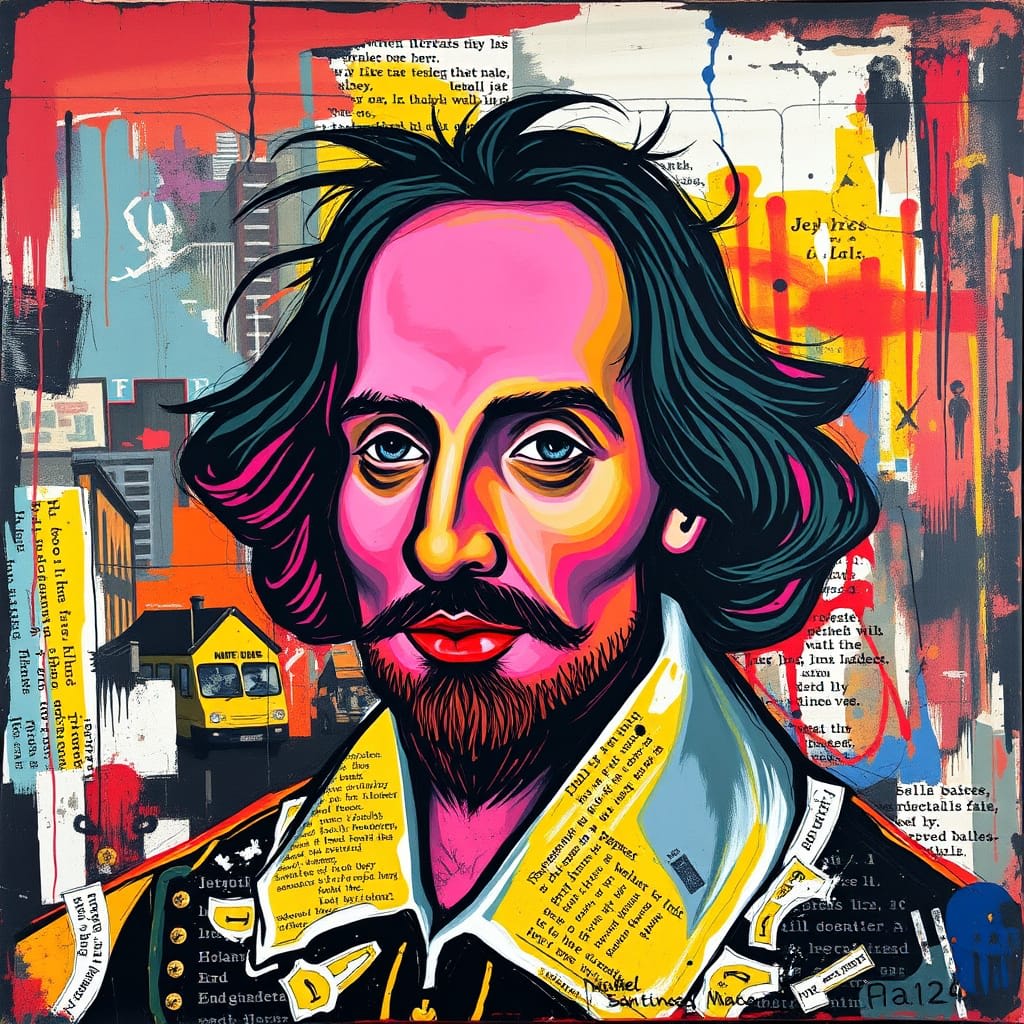
"Not marble nor the gilded monuments of princes, shall outlive this powerful rhyme". Quoth William.
To be a great poet, Shakespeare of Stratford-Upon- Avon knew, is to be immortal.
"It is not nothing to be the worst poet in the world, heaven knows the world is not undersupplied with bad poets". Quoth the other William, he of McGonagallesque questionable fame.
"Pah, your name is but a byword for doggerel, you are a Private-Eye running joke, Rees and will be for generations".
"Why art thou being so mean and cranky Stratford, have I offended thee with my fame being right there alongside your lofty verses. Does it hurt for me to be as remembered as thyself, my so called 'bad poetry' lives on just as long as your self-professed 'good' verses".
"Tear him for his bad verses". Yelps the mob in Julius Caesar.
To be bad at poetry is to compete in a crowded field, so if a bad poet amongst all the millions is remembered, bully for he or she. Some of us 'poets' may fall at the top, some...well, somewhere in the middle and most of us will be at the very bottom of the really bad poets pile.
Should we investigate why Mr. McGonagall's bad poetry is of some consequence to poets everywhere. For though born 200 years ago, William Rees-Mc. (the private-eye version) is still popular today.
A Scottish poet and public performer, he gained notoriety as an extremely bad poet who exhibited no recognition of, or concern for, his peers' opinions of his work. (Why should he, who deems poetry to be bad or good, it is in the heart of the beholder to judge). I believe.
Willy wrote, "The Tay Bridge Disaster" and "The Famous Tay Whale", which are widely regarded as some of the worst in English literature. Although groups throughout Scotland engaged him to make recitations from his work, and contemporary descriptions indicated that listeners were appreciating McGonagall's skill as a comic music hall character. Collections of his verse remain popular, with several volumes available today.
Mc has been lampooned as deaf to poetic metaphor and unable to scan correctly. His only apparent understanding of poetry was his belief that it needed to rhyme.
McGonagall's fame stems from the humorous effects these shortcomings are considered to generate in his work. Some scholars argue that his inappropriate rhythms, weak vocabulary, and ill-advised imagery combine to make his work amongst the most unintentionally amusing dramatic poetry in the English language.
This poet's work is in a long tradition of narrative ballads and verse written and published about great events and tragedies and widely circulated among the local population as handbills. No radio or social media back then.
In regards to how he felt about writing poetry for the first time, William wrote:
"I seemed to feel as it were a strange kind of feeling stealing over me, and remained so for about five minutes. A flame, as Lord Byron has said, seemed to kindle up my entire frame, along with a strong desire to write poetry; and I felt so happy, so happy, that I was inclined to dance, then I began to pace backwards and forwards in the room, trying to shake off all thought of writing poetry; but the more I tried, the more strong the sensation became. It was so strong, I imagined that a pen was in my right hand, and a voice crying, "Write! Write"!

Bits of poetry by William McGonagall
"The Inauguration of University College Dundee" which opens with the stanza:
Good people of Dundee, your voices raise,
And to Miss Baxter give great praise;
Rejoice and sing and dance with glee,
Because she has founded a college in Bonnie Dundee.
McGonagall constantly struggled financially and earned money by selling his poems in the streets, or reciting them in halls, theatres and public houses. When he was in periods of financial insecurity, his friends supported him with donations.
William read his poems at circuses while the crowd was permitted to pelt him with eggs, flour, herrings, potatoes and stale bread. For this, he received fifteen shillings a night. McGonagall seemed happy with this arrangement, but the events became so raucous that the city magistrates were forced to put a ban on them.
McGonagall was outraged and wrote a poem in response entitled:
Click the link below to read the entire poem.
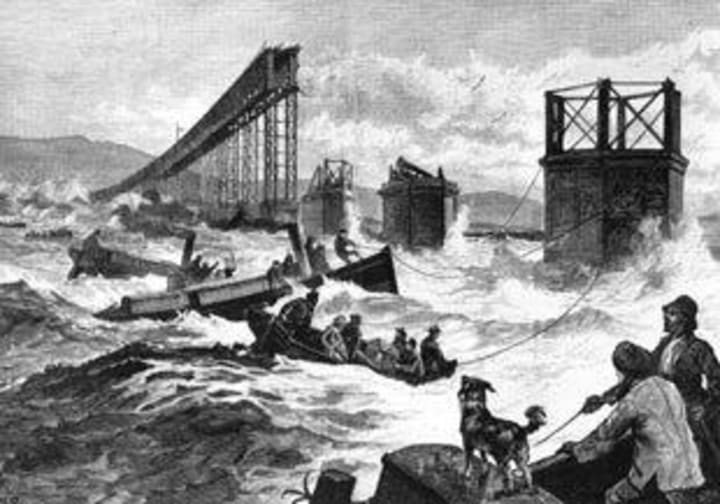
Beautiful Railway Bridge of the Silv'ry Tay!
Alas! I am very sorry to say
That ninety lives have been taken away
On the last Sabbath day of 1879,
Which will be remember'd for a very long time.
'Twas about seven o'clock at night,
And the wind it blew with all its might,
And the rain came pouring down,
And the dark clouds seemed to frown,
And the Demon of the air seem'd to say —
"I'll blow down the Bridge of Tay."
When the train left Edinburgh
The passengers' hearts were light and felt no sorrow,
But Boreas blew a terrific gale,
Which made their hearts for to quail,
And many of the passengers with fear did say —
"I hope God will send us safe across the Bridge of Tay."
Poem is unfinished here...see clickable link above to read the entire lines of the poetry, it is worth reading (especially to us bad poets).
A newspaper column written in 1888 - quotes:
" According to the Chairman, the bridge would never have fallen if this poem had not been written." (Uh, what)?
"The Tay Bridge Disaster" by William-Rees Topaz McGonagall is a ballad recounting the tragic collapse of the Tay Bridge in 1879. The poem's simple language and repetitive structure convey the horror and chaos of the event.
Compared to McGonagall's other works, this poem is more concise and focused on a specific incident. It lacks the rambling, nonsensical elements that often characterize his writing.
Be inspired!!!
About the Creator
Antoni De'Leon
Everything has its wonders, even darkness and silence, and I learn, whatever state I may be in, therein to be content. (Helen Keller).
Tiffany, Dhar, JBaz, Rommie, Grz, Paul, Mike, Sid, NA, Michelle L, Caitlin, Sarah P. List unfinished.
Keep reading
More stories from Antoni De'Leon and writers in Humor and other communities.
🍕The pizza delivery mystery👀
"There is someone at the front door". Alexa announced in her proper, preppy English voice. Now Dad had just installed a doorbell camera/Alexa informing/bell identification system so one could know when someone comes to the door as no one can hear said bell from way upstairs; thing-a-ma-jig. I don't know much about such things as you can clearly fathom here.
By Antoni De'Leonabout a year ago in Humor




Comments (5)
Inspirational - Nicely Done!!
When I saw McGonagall, I thought you were gonna talk about Minerva McGonagall from Harry Potter. Imagine my shock, lol
I love the independence of this guy, doing what he wanted and not give a flying fig what anyone thought. Very enjoyable read AD.
He is good at narrating through poetry, though. Perhaps he just didn't study it enough to understand the figurative nature of poetry--metaphors, allegory, etc.
There is inspiration in this poem for writers of all types seek ideas from others as this guy did. Good job.