
HISTORICAL DEEP DIVE: Archaeologists Conclude the Ancient Civilization That Built Stonehenge Was Just Very Bad at Jenga
The Pompous Post Presents

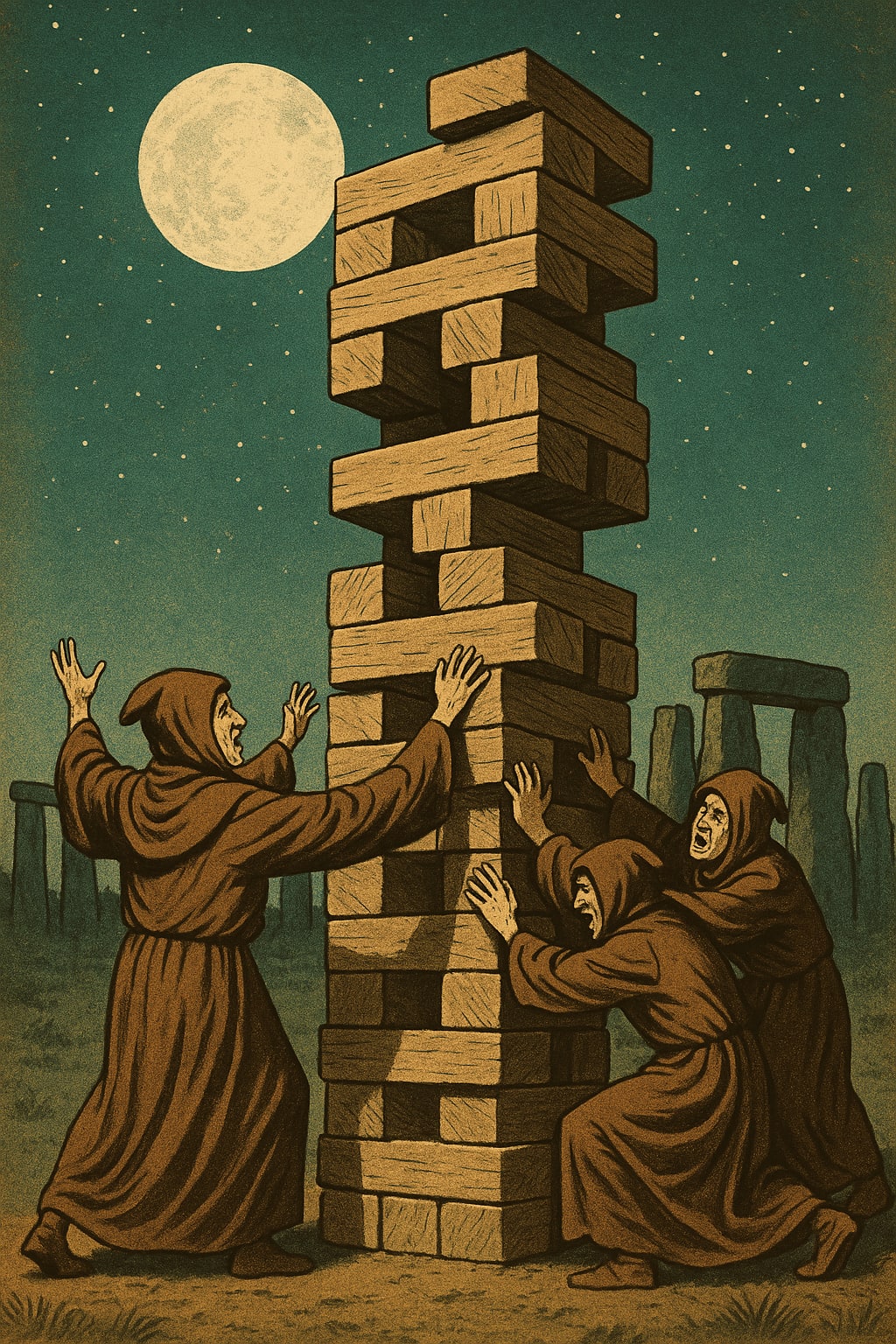
For centuries, scholars, mystics, and travel bloggers have debated the origins of Stonehenge. Was it a calendar? A sacred site? A giant rock-based IKEA project missing half the instructions?
Now, groundbreaking new research has delivered the truth we’ve all been waiting for: the ancient civilization that built Stonehenge was simply terrible at Jenga.
The Discovery
A team of archaeologists at the University of Totally Serious Science announced their findings after discovering “obvious Jenga patterns” in the stones. Lead researcher Dr. Margaret “Stacks” Hughes declared, “Once you see it, you can’t unsee it. It’s literally the world’s worst game night frozen in time.”
Her team points to the haphazard alignment, the precarious balancing, and the undeniable vibe of “This was fine until someone bumped the table.” They also note scorch marks nearby, which they claim are from villagers shouting, “Not fair! The wind blew it over!” before angrily torching the board.
Ancient Jenga League
According to this theory, Neolithic society revolved around competitive board games. Entire tribes would gather on Friday nights, paint their faces, and chant as rival families stacked enormous blocks in the moonlight.
Other monuments across Europe now make perfect sense under this framework:
- A collapsed pile of stones in Wales? Clearly the remains of Neolithic Connect Four.
- A suspicious spiral of boulders in Scotland? Obvious attempt at prehistoric Twister. (Archaeologists believe one druid broke his hip trying “left foot on moss.”)
- The Pyramids of Egypt? Okay, not Jenga. Probably Monopoly.
The Collapse
The fateful night of Stonehenge’s collapse is believed to have gone something like this:
A circle of druids, cloaked and serious, gathered around the sacred tower. A drumbeat echoed. One particularly sweaty participant; archaeologists have dubbed him Kevin the Unsteady, removed a support stone against all advice.
Eyewitness accounts carved into ancient pottery allegedly say:
- “Kevin, don’t you dare.”
- “Oh my gods, Kevin!”
- “You ruined family game night forever.”
Seconds later, the stones toppled in slow motion, crushing both egos and tribal seating arrangements. Thus ended Britain’s brief flirtation with competitive structural engineering.
Cultural Fallout
After the catastrophic game-ending collapse, records suggest the civilization abandoned oversized Jenga forever. Instead, they pivoted to safer hobbies like:
- Staring at rocks without moving them.
- Inventing soup.
- Complaining about Kevin.
Some historians argue this is why Stonehenge was left unfinished. It wasn’t a “mystical mystery,” just a society-wide case of “We’re never playing that again.”
Modern Implications
The “Stonehenge Jenga Hypothesis” has rocked the academic world. Tour guides are already adapting their scripts:
“On your left, ladies and gentlemen, is the sacred place where Kevin fumbled the block.”
Souvenir shops are selling “Mini Jenga-Henge” sets complete with historically accurate curses like “Left foot on moss” and “Kevin owes us soup.”
Meanwhile, modern Jenga players have embraced the discovery as both a warning and an inspiration. One enthusiast told reporters, “I feel connected to my ancestors every time the tower crashes and I yell profanities. It’s beautiful, really.”
Conclusion: History’s Longest Cleanup Failure
In the end, Stonehenge may not be a calendar, or a temple, or a cosmic portal. It’s something far more relatable: the aftermath of game night when no one wanted to clean up.
So next time you play Jenga and knock over the tower, don’t be embarrassed. You’re not clumsy, you’re just carrying on a tradition 5,000 years old.
And if anyone blames you, just shrug, bow deeply, and say the words that echo through history:
“Sorry for the inconvenience.”
About the Creator
The Pompous Post
Welcome to The Pompous Post.... We specialize in weaponized wit, tactful tastelessness, and unapologetic satire! Think of us as a rogue media outlet powered by caffeine, absurdism, and the relentless pursuit to make sense from nonsense.
Keep reading
More stories from The Pompous Post and writers in Humor and other communities.
How to Achieve Inner Peace by Ignoring All Your Problems (and Maybe Faking Your Own Death)
Are you tired of stress? Exhausted by the relentless grind of responsibility, bills, and that one coworker who insists on “circle-back” meetings about nothing? You’re not alone... Millions of people struggle daily with the crushing weight of reality.
By The Pompous Post4 months ago in Humor
Where's the Glory?
In breaking news, rehabilitated Republican Senator Johnnie Johnson (Pronouns: HE, HIM, HIS) called a press conference from the Men’s room of the New Orleans Louis Armstrong International Airport, Concourse B, across from the Ignatius Reilly’s Lucky Dog stand. The Senator had just returned from a sexual reorientation rehabilitation program in Memphis, TN after being publically disgraced at a Buckee’s Truckstop restroom soliciting sex from an undercover cop three months ago. He is a founding member of the Reformed Christians for Christ, a conservative, pro-family and ex-gay advocacy group. In the spirit of being reborn, Senator Johnson invited reporters to marvel at his plans for a major remodeling of airport bathrooms.
By Cathy Schieffelin4 days ago in Humor


Comments
There are no comments for this story
Be the first to respond and start the conversation.