


Be nice to me, babe or you'll regret it. You are my hostage and don't you forget it. The night is early and there's lots to be done. Lets boogy now, come on, we're gonna have some fun.
Forbidden Zone (1980)
Forbidden Zone is a film that may turn stomachs, raise hackles, outrage, or give headaches. It may even make others roll their eyes in deep regret for having spent time or money on it. Yet, despite all that, there's something undeniably infectious about this picture. The true love affair between it and those in the know doesn't start until Danny Elfman takes the screen as the Devil, channeling Cab Calloway in a bizarre, Max Fleischer-style cartoon. Boogie-woogie.
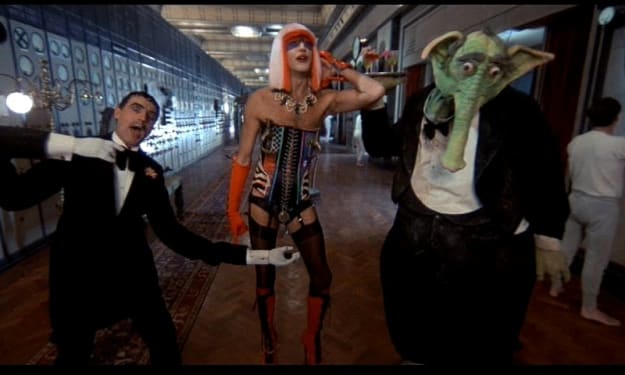
This film is a deliriously absurd, grotesque comic fantasy with Expressionist overtones. It's a partly animated romp that calls to mind Alfred Jarry's "Ubu Roi," Dr. Caligari, Betty Boop, Looney Tunes, and the wonderfully demented children’s shows of days gone by. All of this is scooped up and stir-fried (and I do mean FRIED) with a hefty serving of sexy satire and a generous helping of nudity.
However, Forbidden Zone is not without controversy. The film includes a fair amount of racial stereotyping and humor, often at the expense of Black people, gays, and Jews. It has been criticized for this reason, and it almost certainly wouldn't pass muster in the current era of Woke. But its barbs are aimed at everyone, ensuring that every group will find something here offensive.
Frenchy Hercules, (Marie-Pascale Elfman) has a nightmare family that lives in a house drawn onto the background scenery, is a bizarre group of mutants, one of whom suspiciously resembles R. Crumb. They sing and dance but are shocked to discover that Squeezeit's transsexual sister ("Toshiro Baloney" in a dual role) has been sucked into the "Sixth Dimension," also known as the titular "Forbidden Zone." Squeezeit is introduced to us in a garbage can, right before we enter a classroom where a man in drag with garish lip-gloss (Kedrick Wolfe) guns down a room full of students—modern times, indeed—that includes a gang of black pimp stereotypes. People leap through paper windows, and everything looks as though it was designed for "Pee-wee's Playhouse" after the set designer scarfed down a handful of LSD-25.
Frenchy eventually ends up in Cell 63 in the "Forbidden Zone," where King Fausto (Hervé Villechaize, in a perfect casting choice) keeps his favorite concubines. But one might wonder, shouldn't it be Cell 69? His wife, Queen Doris (Susan Tyrell), tortures everyone, including Flash and Gramps (played respectively by Phil Gordon and "Hyman Diamond"), whom she locks in a septic tank. Pa Hercules ("Ugh-Fudge Bwana") is blasted into outer space after smoking too close to flammable materials while working at La Brea Tar Pits. Most of the cast enters the Sixth Dimension after passing through the cartoonish bowels of Time and Space, only to be expelled from the heaving globules of an interdimensional orifice.
Not a single frame of this film is meant to be taken seriously. It’s a comic satire, a garbage can romp that seems to have heavily influenced later works, from Alex Winter's short student film "Squeal of Death" to the straight-to-video sleaze-o-rama dramas churned out by Troma over the decades (not to mention the filth-infused cinematic alternate realities of John Waters). The film bears a strong resemblance to Stephen Sayadin's Dr. Caligari, both in aesthetics and execution. Both films share a cheap, high-school theater production look, utilized to surrealistic ends, and both feature performances that feel like cartoon characters brought to life.
Forbidden Zone is an outgrowth of the Elfmans' (Richard, who wrote and directed, and Danny, who composed the soundtrack) experimental comedy troupe, "Mystic Knights of the Oingo Boingo." This group provided the nucleus for Danny Elfman's later New Wave band, I take it. The soundtrack is a mix of harsh, grating music alongside tubular '80s synth-pop, bebop, old-time jazz, Tin Pan Alley, and '30s tunes, plus absurd songs that seem plucked from a children’s show.
By the time Danny Elfman appears as Satan, crooning a souped-up jazz number to the hooded denizens of a live-action cartoon Hell, viewers are already convinced they're witnessing one of the most bizarrely original forgotten films ever made. Forbidden Zone is dense and weird enough to warrant repeat viewings if only to catch all the dialogue from Hervé Villechaize. It's the very definition of a "cult film." Like "The Rocky Horror Picture Show," it's not a "one-and-done" experience. It's the cinematic equivalent of a party that viewers can return to again and again—one that, if not in a "forbidden zone," is certainly in a conventionally inaccessible one.
Now, if you’ll excuse me, I have to go change a Tampax.
Forbidden Zone: Special Edition
Connect with me on Facebook
About the Creator
Tom Baker
Author of Haunted Indianapolis, Indiana Ghost Folklore, Midwest Maniacs, Midwest UFOs and Beyond, Scary Urban Legends, 50 Famous Fables and Folk Tales, and Notorious Crimes of the Upper Midwest.: http://tombakerbooks.weebly.com
From ad men to mad men
It's after 2am in the morning when a local police patrol vehicle in Northern New Jersey spots a figure costumed as Quasimodo, The Hunchback of Notre Dame, proceeding southbound on the sidewalk along Lydecker Street. Though the hunchback’s costume stuffing offers added insulation, it's January, and friggin’ freezing. Carefully, the officers slow down, gently question the subject, and offer him a ride home.
By David W. Maury7 days ago in Humor
Canada Conducts Massive Airstrikes on Minnesota to Aid Heroic Protesters Battling Authoritarian I.C.E. Regime
In an act of compassion, the Canadian Armed Forces have initiated massive airstrikes against key centers of oppression in Minneapolis, in an action dubbed "Operation De-Icing" that supports local protesters demanding an end to the brutal regime of U.S. Immigration and Customs Enforcement (I.C.E.).
By Scott Christenson🌴5 days ago in Humor


Comments (1)
I was surprised to learn that Danny Elfman was an actor at some point in his career. He is an all-around GENIUS. I can't remember if ever I saw this film but definitely intrigued.