
Five Things I'd Like to Tell Orwell About
And none of them political



Many years ago, while working as a freelance, I was given monthly commissions to write articles for a management training company. Occasionally, I would be tasked with writing about Microsoft Office applications, and for one such, I sought my material via an old TV ad campaign for a mobile phone network.
In a series of ads, famous people were asked which personage from the hereafter they would like to call for a chat if such a thing were possible. Ian Wright chose Martin Luther King, Chris Evans went for John Lennon, and Kate Moss picked Elvis.
I thought it would be fun to call George Orwell and tell him of the wonders of the word processor. Once I’d decided to go with it, the article wrote itself, as they say.
I’ve read most of Orwell’s work and much about his life, and recently re-reading that old article, I thought of several other developments I’d like to tell the great writer about.
Of course, being a political heavyweight, Orwell’s main interest would be in hearing of the many international upheavals since he died in 1950: the Cold War, the Berlin Wall, the assassination of JFK, The Falklands War, 9/11, the EU, and the UK’s subsequent exit, Donald Trump, and a host of others. Also, considering Winston Smith’s occupation in Nineteen Eighty-Four, I think Orwell would be fascinated by today's ubiquitous surveillance cameras. Then there’s the rise of social media and the spread of misinformation, all of which tie in with his nightmare vision. What he would make of TV shows that take their titles from his most famous work — Big Brother and Room 101 — is anyone’s guess. But those topics are for a weightier pen than mine; for this article, I’ve gone with light-hearted observations.
Here, then, are five things I’d like to tell Orwell about, starting with the obvious.
1: The Word Processor
In common with many writers from the typewriter era, Orwell’s manuscripts were messy and difficult to decipher. Unwanted passages were blacked out with pen strokes, and notes were scribbled into margins and between lines. See an example of his editing here:
https://orwellsociety.com/wp-content/uploads/2023/07/1984-manuscript-2.jpg
Imagine how he would react to seeing the clean, efficient editing that comes with word processing. He’d surely be delighted at such features as cut, copy, and paste, and how they can be used on single words or vast swathes of text. Automatic bold and italic text would be a novelty, and the Find and Replace function a useful tool.
“George, I love your new novel, but having your two main characters named Tom and Jerry is a bit off, as there is a cartoon show featuring cat and mouse with the same names. Don’t worry though, I’ve changed Tom to Ben throughout the text with a few keystrokes using Find and Replace.”
(Yes, I know).
Would Orwell approve?
Most certainly.
2: Goodfellas
This one is a bit of a curve ball, as I don’t recall Orwell demonstrating a particular interest in gangsters or Hollywood movies. But I’m sure he would smile in satisfaction when I told him of the 1990 film and its 300 uncensored f-bombs.
Writing on such grim subjects as the workhouse, the Paris slums, and the Spanish Civil War — all from personal experience — Orwell had his characters necessarily utter expletives to remain true to life. Imagine a pair of half-starved wretches discussing the brutality of the workhouse regime in a way that specifically avoided the censor’s blue pencil.
“I say, Clarence, that chap is little more than a tin pot tyrant.”
“Yes, Claude, he’s an absolute rotter.”
It just doesn’t ring true.
In December 1946, Orwell wrote of his frustration at having his work decimated by the censors in his As I Please column in Tribune. He observed that in the USA at the time, publishers were allowed to convey swear words by typing the first letter, followed by a long dash, so the reader knew which word had been used. In the UK, such words were replaced by only a long dash, leaving the reader to guess the expletive. This interference, say in Down and Out in Paris and London, which is peppered with swearing in some parts, interrupts the flow of the narrative terribly.
Orwell ends that article by stating:
So does progress continue — and it is genuine progress in my opinion, for if only our half-dozen ‘bad’ words could be got off the lavatory wall, and on the printed page, they would soon lose their magical quality, and the habit of swearing, degrading to our thoughts, and weakening to our language, might become less common.
Would Orwell approve?
Of the lifting of censorship, yes, but he might be disappointed with his vision that expletive emancipation would trigger a decrease in bad language. For, did bringing swearing down from the lavatory wall inspire a decline in its use?
Did it —!
3: Tea bags
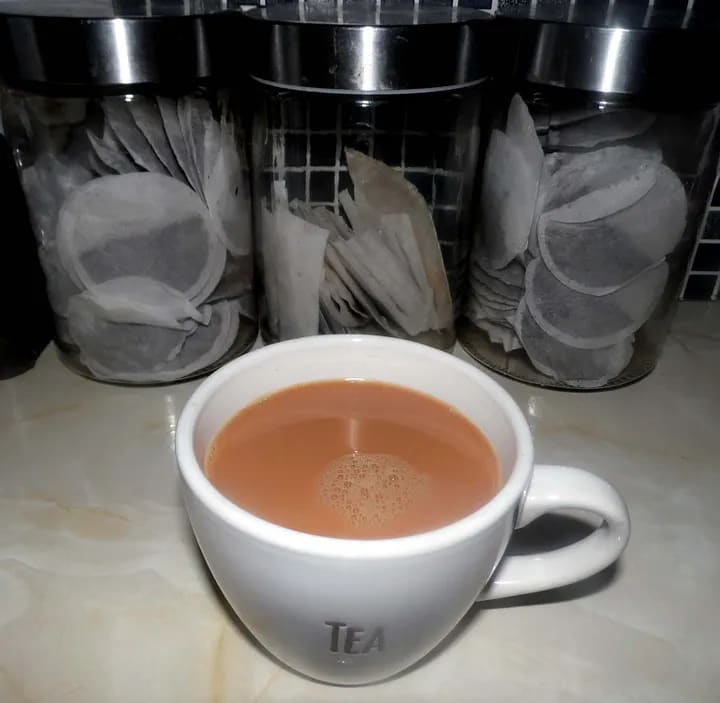
Orwell drank a lot of tea, and he liked it strong. In his essay Decline of the English Murder, he proposes washing down the Sunday lunch with a cup of mahogany-brown tea.
That Orwell was a champion of cha became even more apparent with the publication of another essay A Nice Cup of Tea in 1946. The article lists eleven rules he observes when making a cup of tea, one of which is that the leaves should be free to circulate in the hot water. He states;
No strainers, muslin bags, or other devices to imprison the tea.
In 1953, three years after Orwell’s death, the Yorkshire tea company Tetley began pushing the teabag in earnest. Before that, bags had been little more than a novelty, but the convenience of banishing tea leaves made their development imperative. I’m no expert on the subject, but, I believe the breakthrough came when it was discovered that grinding tea to a powder before putting it into bags allowed the brew to infuse adequately.
Would Orwell approve?
It might take three tea bags to get the brew up to his desired strength (I use the term Orwellian tea for a very strong cuppa), but I think he would.
4: Plant Milks
You may be wondering why I would include plant milk in this list. After all, Orwell was quite critical of vegetarianism (I refer the reader to the te-heeing twit in the pince-nez from the vegetarian colony in Upper Binfield in Coming Up for Air). I suspect vegans would be even less to his taste. But hear me out.
Orwell was terrified that his adopted son Richard would contract TB via milk from an infected cow. In letters to friends, he told of his search for a ‘TB Tested’ cow so they could drink milk safely. In a letter to T R Fyvel, Orwell said,
“We have been boiling his (Richard’s) milk, but of course, one can forget sometimes.”
But, would Orwell accept the alien concept of ‘milk’ made from plants?
He may not have been keen to give up dairy, and a splash of soya milk in his renowned mahogany-brown brew might be unthinkable at first, but tastes can be acquired, and peace of mind is a strong bargaining chip.
Would Orwell approve?
On safety grounds, I think yes, if only temporarily.
5: ‘Out-at-the-knee’ Jeans
I once invited friends on social media to imagine that my grandfather, who died in 1972, was allowed one day back with us to see how much had changed since his demise. I said that, while I could probably make a decent fist of explaining the rudiments of mobile phone technology and how Alexa knows so much, I would never, but never be able to get him to understand why people wear jeans that are out at the knee as a matter of choice.
It would be interesting to show this fashion quirk to Orwell too, as the out-at-elbow sleeve pops up in several of his works, always as an indicator of hardship, and the wearer is always painfully aware of his shabbiness. For example, in Down and Out in Paris and London, he says;
Here was a splendid chance, and I could not take it, for it was impossible to go to the agency with my coat out at the elbow.
And again;
I had now no clothes except what I stood up in — the coat badly out at the elbow — an overcoat, moderately pawnable, and one spare shirt.
In Keep the Aspidistra Flying, he describes Gordon Comstock thus:
His coat was out at the elbow in the right sleeve and its middle button was missing; his ready-made flannel trousers were stained and shapeless.
So, how would the great writer react to the trend of today’s bright young things to go about with holes in their jeans and their knees peeping through like Waldorf and Statler?
My guess would be astonishment (I blame The Ramones).
Would Orwell approve?
I don’t think he would.
About the Creator
Joe Young
Blogger and freelance writer from the north-east coast of England
Reader insights
Outstanding
Excellent work. Looking forward to reading more!
Top insight
Compelling and original writing
Creative use of language & vocab
Mally and the Media JUNKIEZ A
I always wanted to a comic strip and get it published and I did that with Mally and Media Junkiez This was inspired by the time when I was a vegetarian my uncle and I ordered a pizza with eggplant and I thought it was meat and began taking off the eggplant and my uncle says that’s not meat
By Revista Miko:XCI 6 days ago in Humor


Comments (7)
Congrats 🍾🎈🎊🎉 on top Story!!!!!
The idea of telling Orwell about the word processor is fascinating. How did you come up with the concept of blending historical figures with modern technology? Your creativity in imagining Orwell's reactions is truly engaging. Well done!
Very enjoyable read. Congrats on Top Story. Orwell is an awesome subject. Such a prophetic writer.
I love this concept and agree on most from what little I know of Orwell. The plant milk - I get from the perspective of his son's issue. I think he wouldn't like Alexa or Siri - someone always listening - I don't think that would be his thing, though.
I enjoyed your article I love 1984 and though I feel Animal Farm Was more derivative and less imaginative, I enjoyed it
Not a bad list, but I think I have to call you out on "Goodfellas". I have the complete set of essays, articles and letters, and I know that he really did not care for American culture. But the others? I think you're spot on! 👖
Id like to tell Orwell too!