
Amish Leader Declares “We Were Right All Along”
After Trump’s tariffs spark collapse of modern society

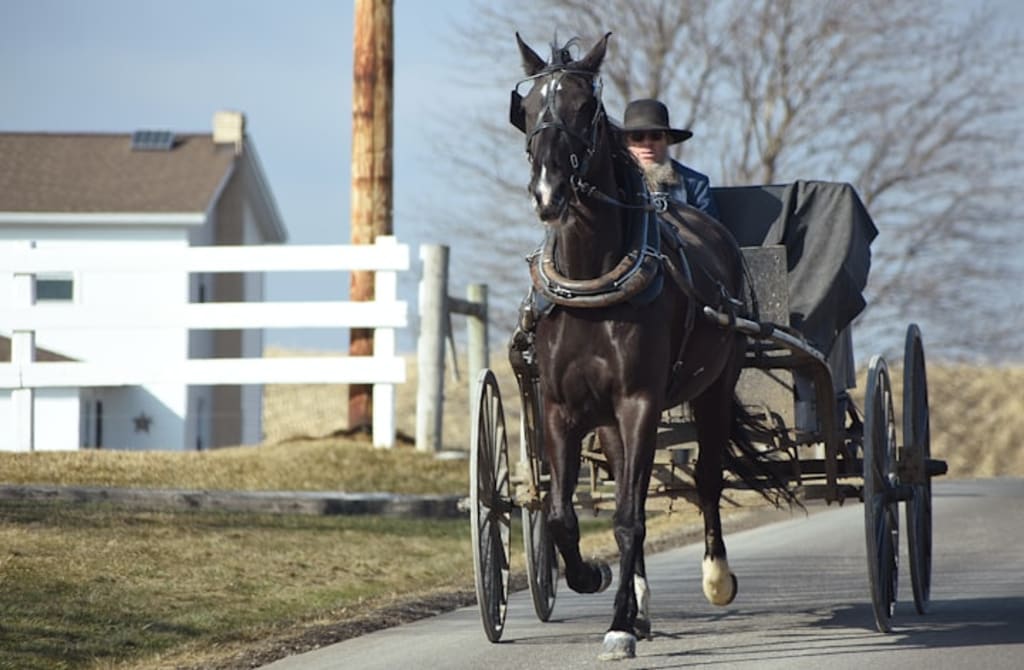
By Jebediah Smith, Columnist for The Budget Buggy Gazette
LANCASTER COUNTY, PA — In a stunning turn of events, the Amish community — long mocked for their rejection of modern technology and their self-sufficient lifestyle — is having the last laugh.
Following President Donald Trump’s announcement of steep tariffs on foreign goods, which plunged America into a pre-industrial crisis, Amish elders have officially declared: “We told you so.”
The Great Tariff Meltdown
As Walmart shelves empty, Amazon deliveries vanish, and Americans suddenly realize they don’t know how to make their own soap, the Amish are thriving.
Bishop Ezekiel Stoltzfus, leader of a prominent Pennsylvania settlement, held a rare press conference (announced via a handwritten letter nailed to a barn door) to address the nation’s newfound struggles.
“For years, you called us backward. You laughed at our horse-drawn buggies, our hand-stitched clothes, our butter churns,”
Stoltzfus said, stroking his beard with quiet satisfaction.
“Now look at you. No iPhones. No cheap Chinese toasters. No fast fashion. Just… silence. And the sweet, sweet sound of regret.”
Modern Problems Meet Amish Solutions
As panicked Americans scramble to adapt, the Amish are offering workshops on “How to Survive Without Everything You Thought You Needed.”
Enrollment has skyrocketed. Key lessons include:
- Electricity-Free Cooking: “You call it ‘living like a peasant,’ we call it ‘Tuesday.’”
- Clothing Repair: “If your pants rip, sew them. If they rip again, pray harder.”
- Entertainment: “We’ve been doing ‘analog TikTok’ for 300 years. It’s called ‘whittling.’”
Meanwhile, formerly tech-addicted urbanites are experiencing withdrawal. Brooklyn hipsters, deprived of their meditation apps, have resorted to staring blankly at trees, whispering, “Is this…nature? The UX is trash.”
Trump’s Response: “All Part of the Plan”
When reached for comment, Trump praised the Amish in a late-night Truth Social post:
“The Amish are tremendous people, just tremendous. Very low crime. No electric bills. And they don’t complain — because they don’t read the media! Maybe we should all be more like them. #MakeAmericaAmishAgain”
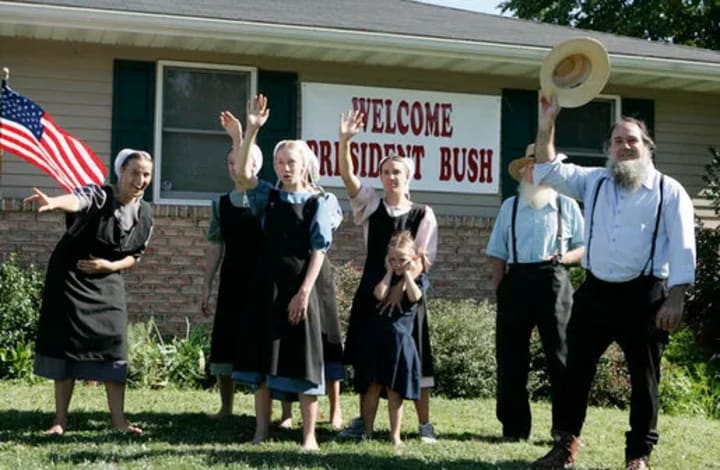
America’s Awkward Transition
As the nation stumbles into its new, off-grid reality, signs of cultural adaptation are emerging:
- Hipsters now brag about their hand-cranked coffee grinders.
- Survivalists beg Amish farmers for apprenticeship opportunities.
- Congressional lobbyists debate replacing Super PAC donations with a barter system (1 cow = 10 Congressional votes).
The Final Irony
The biggest twist? The Amish are now the most sought-after trade partners in the Western world. Their handcrafted furniture, organic produce, and tariff-proof lifestyles have made them the new economic elite.
“We don’t need tariffs,” Bishop Stoltzfus concluded. “We never needed China. We just needed common sense — and a really good plow.”
As the rest of America learns the hard way, the Amish motto rings truer than ever: “Live simply. Laugh at the English. And always keep an extra jar of pickled beets.”
Final Thought: The next time you see an Amish farmer, tip your hat. He’s been prepping for this moment since 1693.

***
Appendum:
Background on Amish Movement in America:
Origins: Europe’s Radical Pacifists
The Amish trace their roots to the Anabaptist movement in 16th-century Switzerland, where they broke away from mainstream Protestantism over issues like infant baptism and military service. Persecuted for their beliefs, they fled to Germany and later Pennsylvania in the early 1700s, drawn by William Penn’s promise of religious freedom.
Settlement in America: “We’ll Take the Woods”
The first Amish arrived in Lancaster County, Pennsylvania, in the 1730s. Unlike other colonists rushing toward cities, the Amish preferred rural isolation, where they could farm and practice their faith without interference. Their motto? “No government, no war, no buttons.” (Okay, the button thing came later.)
The Great Schism: Old Order vs. Progress
In the late 1800s, tensions grew between traditionalists (Old Order Amish) and those open to modernization (Mennonites). The Old Order rejected railroads, telephones, and electricity, fearing they would corrupt their tight-knit communities. This split defined the Amish as we know them today.
Why No Technology? It’s Not Just About the Past
Contrary to popular belief, the Amish don’t reject all technology—just anything that threatens their core values:
- Community Over Convenience – Cars isolate people; buggies keep travel local.
- Humility Over Hype – Fancy clothes and smartphones breed pride.
- Manual Labor as Worship – Hard work is holy; tractors (sometimes allowed) must not replace horse plows.
They evaluate each invention (like solar panels or gas-powered tools) based on whether it strengthens or weakens family and faith.
Amish Today: Thriving in the 21st Century
Despite their old-world ways, the Amish are growing faster than ever (doubling every 20 years thanks to large families). They’ve expanded beyond Pennsylvania to Ohio, Indiana, and even Canada, running successful businesses—without Wi-Fi.
About the Creator
Scott Christenson🌴
Born and raised in Milwaukee WI, living in Hong Kong. Hoping to share some of my experiences w short story & non-fiction writing. Have a few shortlisted on Reedsy:
https://blog.reedsy.com/creative-writing-prompts/author/scott-christenson/
Keep reading
More stories from Scott Christenson🌴 and writers in Humor and other communities.
Kim.K.exe Goes Platinum: The AI Clone Who Dropped Reality for the Virtual Spotlight
Kim Kardashian just pulled off one of the most dazzling digital upgrades we’ve seen—not with a simple filter, but by spawning a full-blown AI replica. Now shining in platinum-blonde perfection, Kim.K.exe is smoothly integrated into the Metaverse, redefining what it means to be a celebrity in 2025.
By Angel Solora4 days ago in Humor




Comments (4)
Hahaha 😂 Good stuff!
Guy feels he did America a favor and now they running out of goods...
Gosh, even I don't know how to make my own soap. Lol. The Amish deserves to be envied. 'Workshops on how to survive without everything you thought you needed' 🤣🤣 clever bunch. Pray harder for sure! Prepping since 1693. All they needed was patience, waiting for the moment to say I told you so lol. And they seemed to have had a lot of it. I see everyone going by to beg for those pickled beets soon. No buttons 🤣 I love the inclusion of the history related to the Amish. Some of their reasons for avoiding most technology is kind of hard to fight. Evaluating each invention, measuring whether it strengthens or weaken family and faith is rather admirable. Thank you for the laugh and the information, I enjoyed reading and have learnt a lot👌🏾🙏🏾
I really didn't know that we're running out of goods.. I don't go to Walmart though, so maybe that's why. We have been conditioned to think of substandard Chinese goods as the only option, and that's the real problem. We should be manufacturing here !