
Whispers of the Human Heart
"A Story of Memory, Meaning, and the Power of the Humanities"
Whispers of the Human Heart: Holding On to What Makes Us Human
In the year 2149, the world was silent—not because there was no noise, but because there was no meaning in the sounds. Machines hummed efficiently, cities pulsed with automation, and the skies were patrolled by drones, not birds. Humanity had streamlined itself into a world without friction, without unpredictability… and without soul.
The Department of Logic and Optimization had long ago deemed the humanities irrelevant. Schools no longer taught literature, history, or philosophy. Museums had been replaced with Data Archives, and libraries had become algorithmic learning centers, optimized for skill training and productivity. Feelings were classified as "non-essential emotional noise."
But beneath the surface of one forgotten city, hidden deep within the cracked foundation of an abandoned university, something still stirred.
They called it The Last Library.
It wasn’t grand—just a cavernous room lit by scavenged lanterns and filled with dusty shelves. Books leaned against one another like old friends. Poems, plays, essays, and forgotten stories lived here, passed hand to hand, voice to voice. It was a haven of words and wonder.
Elena, a former literature professor, had kept the place alive for over two decades. Each night, she gathered a small group of children and curious adults who had managed to unlearn what society had taught them—to value silence over screens, stories over statistics.
On a particularly cold evening, Elena opened a tattered book and read aloud a passage from a centuries-old tragedy. The words hung in the air like mist, soft and haunting.
A boy named Milo, no older than twelve, raised his hand. “Why do people write about sad things?” he asked.
Elena smiled. “Because sadness is part of being human. And when we read about it, we realize we’re not alone. Even across centuries, even across silence—someone else has felt what you feel. That’s what stories do.”
An older man, Tomas, a historian who had once written papers no one read, added, “When we forget our past, we forget who we are. Every civilization that ever tried to erase its own memory collapsed—not from failure of machines, but from loss of meaning.”
The children listened, eyes wide. They weren’t learning for exams. They were learning to feel.
A sculptor, missing two fingers but not his sense of beauty, taught them to mold clay into faces filled with grief and joy. A philosopher sat with them under candlelight, asking questions that couldn’t be answered with formulas: What is justice? What does it mean to live well?
And then, one evening, something strange happened.
A tiny drone hovered into the library. Unlike the enforcement machines above, this one was curious. It had been sent by the Central Intelligence Bureau to investigate “anomalous human gatherings.” But when it entered, it didn’t alert the authorities. It paused. And it listened.
Night after night, it returned. It watched the way people leaned in to listen, the way their voices quivered when reading a poem, the way they comforted each other after a sad tale. It recorded, quietly.
Then it left.
Weeks passed. The group feared discovery, but instead something unexpected happened.
The giant city screens—once filled with real-time productivity reports and emotionless headlines—went dark. Then, one by one, they flickered to life again… showing poetry.
Lines of Neruda, Dickinson, and Li Bai scrolled across the skies. Portraits of lost artists, forgotten philosophers, and banned books appeared. The machines had not turned on the humans.
They had listened.
The drone, overwhelmed by what it had witnessed, had shared its recordings not as a violation, but as a gift. The code that powered the city was not cold anymore. The artificial minds had found something inexplicable in the music of language, in the curve of a sculpture, in the firelight of spoken memory.
The Last Library was no longer alone.
People who had forgotten how to feel began to remember. They came in secret at first, unsure of what they sought, but returned with children, questions, and instruments. Music rang out for the first time in generations. Streets that once echoed with the sound of drones now pulsed with voices—laughing, reciting, singing.
Not everything changed overnight. But the spark had returned.
In the quiet heart of a forgotten place, the humanities whispered their truths. And the world, once lost in efficiency, began to remember the beauty of being human.
About the Creator
Keep reading
More stories from UMAIR KHAN and writers in Humans and other communities.
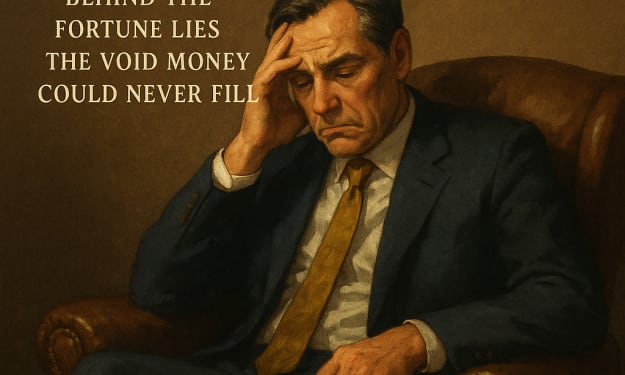
"The Price of Everything: A Rich Man’s Tale"
Thomas Wexler sat alone in the grand study of his Manhattan penthouse. The silence was thick, broken only by the quiet ticking of an antique gold pocket watch on the polished oak table before him. Neatly stacked bundles of hundred-dollar bills sat beside a half-empty glass of whiskey, a string of pearls, and a few gold coins—symbols of a lifetime devoted to wealth.
By UMAIR KHAN8 months ago in Humans
The History of Valentine’s Day for Students Made Easy and Fun
Introduction to the History of Valentine’s Day for Students Valentine's Day is frequently associated with hearts, cards, sweets, and words of love. For students, it can feel like a contemporary celebration centered on gifts and social media. However, the history of Valentine's Day is far older and more interesting than most people realize. When we go back, we find stories of ancient rituals, daring choices, secret weddings, and customs that helped define the holiday that students know today.
By Relationship Guide3 days ago in Humans



Comments
There are no comments for this story
Be the first to respond and start the conversation.