
Juneteenth: The Liberty We Celebrate, The Chains We Keep
From Emancipation to Emotion: The Hidden Price of Being “Free”

I.
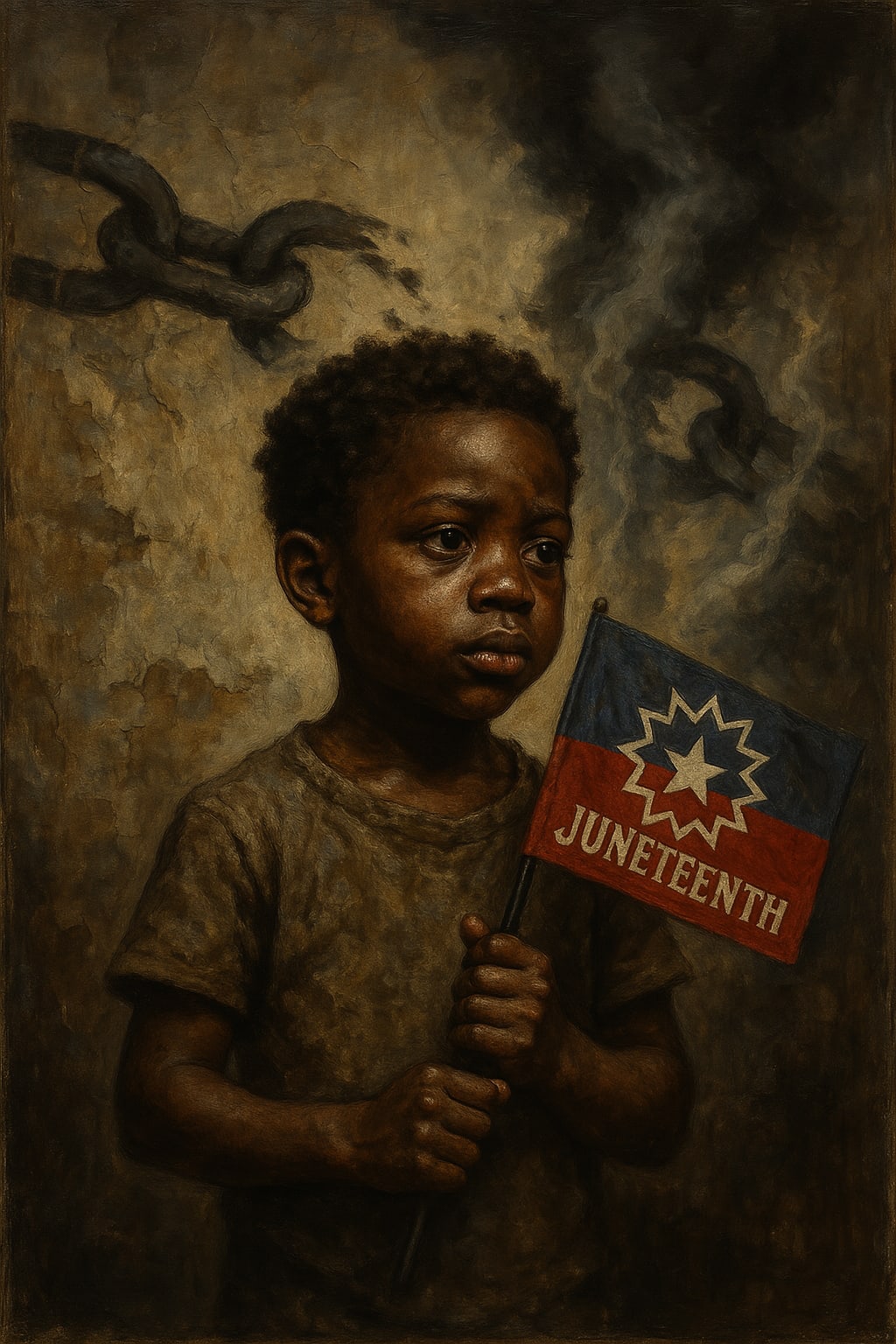
They say freedom rang on June 19, 1865.
Two and a half years late, but freedom—like most things in America—took the scenic route through oppression, confusion, and polite delay. General Granger arrived in Galveston, Texas, with news that the enslaved were—imagine this—already free. The chains had been outlawed. And so the broken were told they were no longer broken, the owned were told they had never truly been owned, and the dying were told to get up and live.
Juneteenth, they call it.
A word swollen with both celebration and sarcasm. A word that holds a question in its syllables: Can freedom ever be late? Or does the delay define its truth?
II.
We commemorate with cookouts now. With flags and colors and drums and dance. It’s beautiful, truly. Barbecue smoke curls into the sky like incense to the ancestors. Children laugh in parks where they once would’ve been chased, chained, or told to leave. Corporations release limited-edition ice cream flavors and post stylized tweets. America claps.
But freedom, real freedom—it doesn’t come with a coupon code.
Irony sits heavy at these parties. Under the rainbow of paper lanterns, it leans back in a folding chair and sips something cold, watching history circle itself like a dog chasing its own tail. Juneteenth is now a federal holiday. What a marvelous achievement. We’ve federally recognized a freedom we still debate in courts, schools, and on highways lined with billboards asking for justice.
III.
Freedom, you see, is a peculiar perfume. Sold in different bottles. Smells different depending on whose neck it's sprayed on.
Ask the children in underfunded schools in Chicago, Detroit, Atlanta—ask if they’ve been emancipated from ignorance.
Ask the man pulled over in Mississippi at 2 AM for being “suspiciously Black”—ask if liberty rode in the passenger seat with him.
Ask the woman whose résumé gets tossed aside because her name sings with the music of her ancestors.
And yet, we celebrate.
IV.
Celebration is a human necessity. It’s how we hold on to sanity. How we dance in defiance of despair.
We are not mocking joy when we question it. We are sharpening it.
Because Juneteenth is not a holiday for the comfortable. It is a mirror, smudged with time, handed from one generation to the next, asking: Have you done enough? Have you paid your dues to justice?
Not just in grand speeches but in small kindnesses. Not just in statues torn down but systems rebuilt.
V.
Slavery didn’t end in a day. It reincarnated.
It put on new clothes. It became “mass incarceration.” It became “war on drugs.” It became redlining, minimum wage, underemployment, and voter suppression. It traded whips for paperwork and chains for policy.
Now it smiles from behind glass offices, offers you a loan with a 28% interest rate, and says, “We’re all free here.”
VI.
Human nature, for all its glory, has an exceptional talent for forgetting.
We forget what we are not forced to remember. We remember what flatters us.
Juneteenth, if remembered rightly, is not just about slavery. It is about how humans treat other humans. It is about the silent contracts we sign every day—between fear and power, between survival and dignity.
It is about the lies we tell in classrooms and the truths we whisper at funerals.
VII.
Some truths live in textbooks, polished and precise. Others grow like weeds in the cracks of our cities.
One truth: Black people in America were not given freedom; they were told they had always had it, while being whipped for disagreeing.
Another: Justice delayed is not justice at all—it’s performance.
And a third: You can be free and still not be equal.
VIII.
But we are hopeful creatures, aren’t we?
That’s our tragic beauty. We believe in change the way lovers believe in reconciliation—against logic, against history, against odds.
Juneteenth, at its best, is a hopeful candle. It lights up a dark past not to romanticize it, but to warn us: Don’t trip over the same stones your ancestors bled on.
It says, “Celebrate, yes. But also rebuild. Rethink. Reimagine.”
IX.
So what is freedom, really?
Is it voting without fear? Breathing without begging? Speaking without shrinking?
Is it economic power? Is it emotional rest? Is it knowing your children will not die for wearing hoodies or having loud music?
Is it dancing at Juneteenth parades and not worrying if the bank down the street will still deny your mortgage?
Freedom is more than laws. It’s the absence of invisible fences.
X.
In churches and mosques, synagogues and temples, humans have placed their noblest desires in the divine: peace, love, unity, justice.
And yet, our religions have been used to justify everything from bondage to bombs.
Even now, pulpits echo with prayers that skip over the Black boy lying dead on concrete because his skin was a threat.
What does salvation mean if your heaven has a dress code?
What is righteousness if it recoils at revolution?
Juneteenth is not a hymn—it is a drumbeat. Deep. Loud. Insistent.
XI.
We deceive ourselves often.
We believe we are better than those who came before. We wear different clothes and own newer gadgets. But moral progress is not an app update.
Slavery wore chains. Racism wears a smile and a slogan.
Oppression has evolved; it’s learned to wear makeup and manners. But don’t let it fool you. It’s still in the room.
XII.
Yet, we love.
Despite everything. Black mothers still cradle their babies with a tenderness that defies centuries. Fathers still stand. Communities still feed, laugh, create, teach.
Black love is resistance. Black joy is revolution.
Juneteenth is a love letter to survival. A song for the still-breathing. A kiss on the bruises of time.
XIII.
Here lies the great paradox of humanity:
We are capable of slavery and of singing. Of chains and chapels. Of bullets and baptisms.
We burn and rebuild. We curse and pray. We forget, then remember, too late.
But if Juneteenth teaches anything, it is this:
Even delayed freedom is worth the wait, if you’re brave enough to fight for it again and again.
XIV.
So yes, let the grills sizzle. Let the kids play. Let the bands march and the elders speak.
But do not let the smoke cloud your vision.
Freedom is not fireworks—it is a responsibility.
And it is still arriving.
One generation at a time.
About the Creator
Muhammad Abdullah
Crafting stories that ignite minds, stir souls, and challenge the ordinary. From timeless morals to chilling horror—every word has a purpose. Follow for tales that stay with you long after the last line.
Keep reading
More stories from Muhammad Abdullah and writers in Humans and other communities.
The Beautiful Lies We Breathe
I was born human. I am told this every day—not by fact, but by function. By the way I’m asked to smile when I don’t feel like smiling. To believe when doubt lingers. To love while my heart is tired. To chase when I’ve forgotten why I run. This is not a complaint. It’s a confession. And like every good confession, it is human.
By Muhammad Abdullah7 months ago in Humans



Comments
There are no comments for this story
Be the first to respond and start the conversation.