
When literature and art meet under the tree of life
An artist and a writer meet under the shade of a fig tree

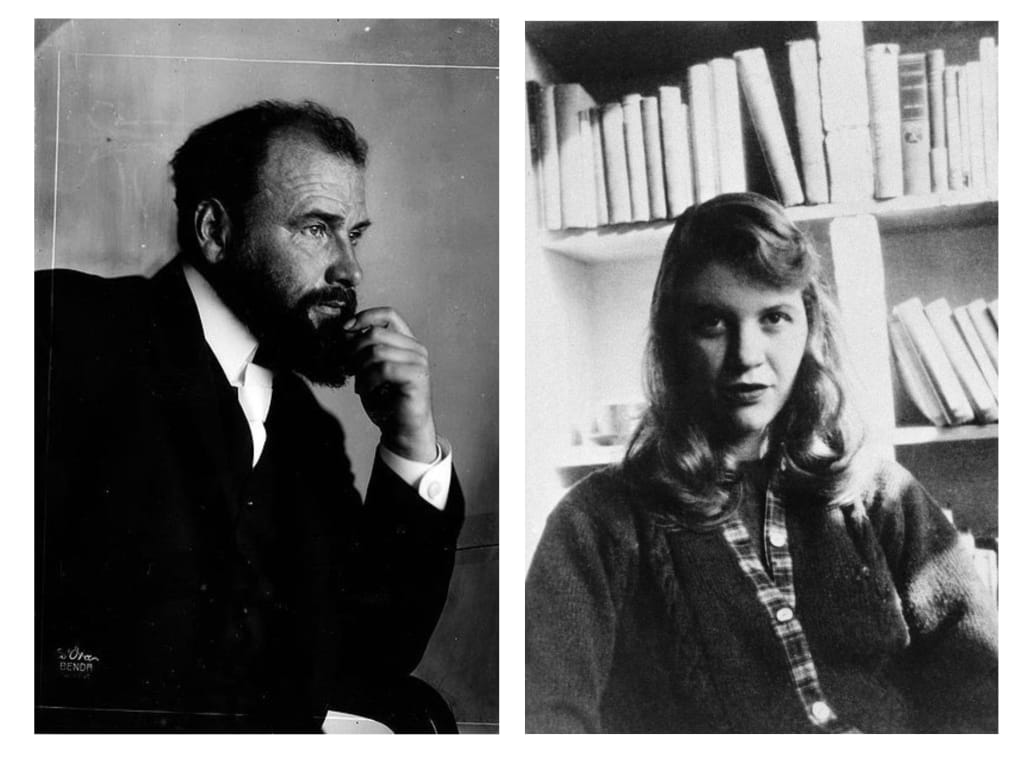
Some writers passed through our lives like a gentle breeze. They gently touch our souls and then leave without a trace, but others come like a raging storm, shake our depths, and uproot the structures of reassurance we have built around ourselves, not to destroy us in vain, but to reveal the fragility of what we thought was constant.
They understand us like no one ever has, as if they have inhabited our minds and roamed the corridors of our souls. They lay their hands on wounds we have long hidden and strip them naked in an inevitable light. These writers do not pass peacefully, but leave an indelible mark. They reshape you by revealing what you missed in yourself and what you feared to the point of denial. Their words seep in silently and settle where no one else could reach.
For me, Sylvia Plath was that hurricane.
No one has approached my soul as she has. I read her and feel that she sees my turmoil and anxiety without eyes. She touches, with my delicate detail, the fluctuations, the chaos, and the vague sadness. As if there is an inexplicable bond between us that transcends language and time. A rare feeling, to find one’s counterpart without meeting.
Amid the symbolism of The Bell Jar, under the shade of the fig tree, and between the lines of her poems, I found myself. And whenever my eyes fell upon Gustav Klimt’s painting “The Tree of Life,” I felt that wondrous intersection between literature and art; two different cries, throbbing with the same fear.
Something united the writer and the artist: a girl watching the fruits of her life rot before her due to her hesitation, and a golden tree pulsing with possibilities above a land full of symbols. Each of them, in their own language, depicted the person standing on the edge of what is possible, and threatened with loss.
When literature understands you:
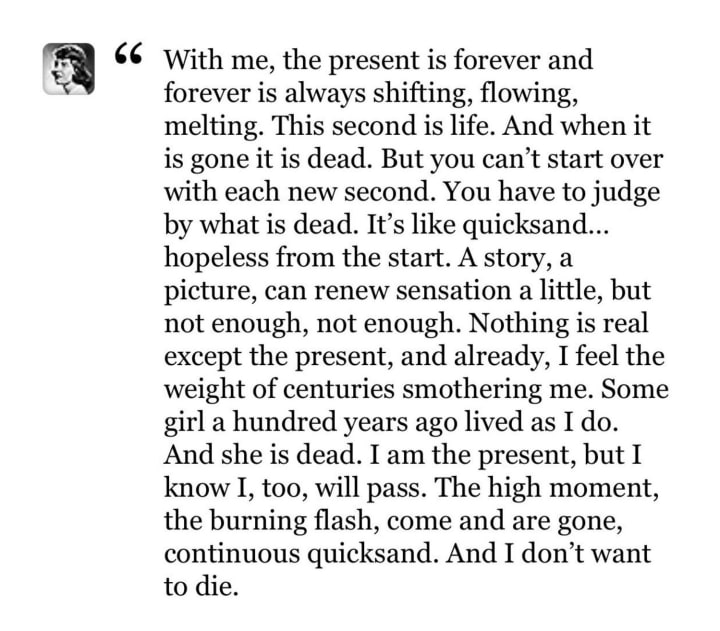
Sylvia Plath, an American poet and novelist, is considered one of the most honest and courageous literary voices in expressing troubled human emotions, especially with regard to anxiety, depression, and inner alienation. In 1963, Plath published her only novel, “The Bell Jar”, just weeks before her tragic suicide, and the novel later became a classic read as a hidden autobiography.
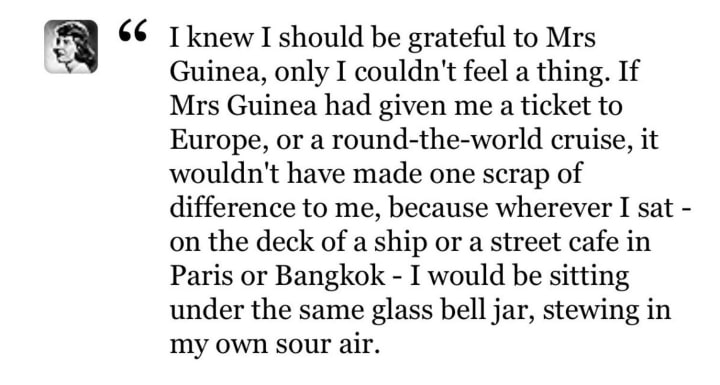
In the novel, Plath tells the story of “Esther Greenwood,” a talented young woman who faces an internal struggle under the weight of social expectations and stereotypes imposed on women: to be polite, moderately ambitious, and successful without exceeding the boundaries of traditional femininity. Esther sees the world from behind a suffocating glass bell jar that envelops her existence in isolation, blocking fresh air and distorting her vision. The bell jar is not just a symbol of depression, but a complete embodiment of suffocating isolation and a psychological space filled with fear, stagnation, and futility.
Although the ending suggests the beginning of Esther’s journey to recovery, the bell does not completely abandon her; rather, it merely rises a little, ready to descend at any moment. For depression, as Plath sees it, does not disappear entirely, but rather hides and bides its time, remaining a constant shadow.
This ending was not what Plath wanted. After her suicide, her husband, the poet Ted Hughes, modified the novel to soften its bleakness. The original ending was harsher and more realistic, reflecting her conviction that recovery is not a happy ending, but rather the beginning of a long and difficult road full of challenges and setbacks. Had it not been for Hughes’s intervention, the novel might have ended on a note more truthful to her personal suffering.
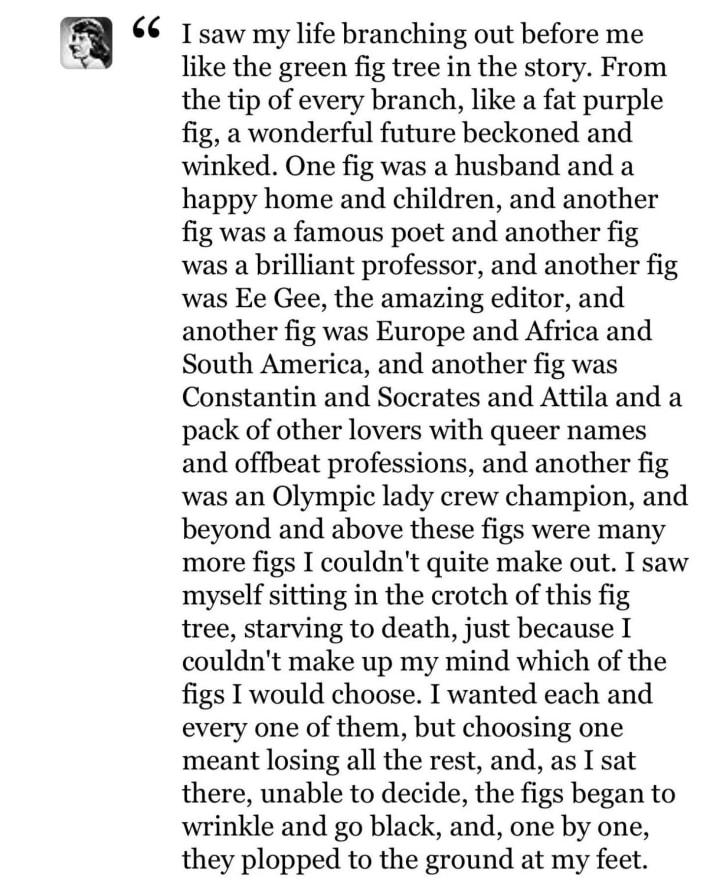
In the novel, a profound symbolism emerges when Esther sees her life branching out before her like a fig tree laden with ripe fruit, where each fruit represents a life choice: a career, marriage, motherhood, travel, independence… But she sat hesitant under the tree, unable to choose and paralyzed by the fear of picking one fruit and losing the rest; so she remained still in her place until the fruits rotted and fell one after the other. Thus, Plath summarizes the dilemma of modern man: the abundance of choices that turns into a burden, and the freedom that paralyzes instead of liberating.
When arts embrace you:
The Austrian painter Gustav Klimt reached the peak of his “Golden Period” and during it he completed a single painting classified as a landscape entitled “The Tree of Life” (1909). At first glance, the painting appears to be merely a decorative celebration of patterns and shimmering gold, but like the literature of Sylvia Plath, it conceals a deeper narrative about life, death, and the eternal cycle of existence.
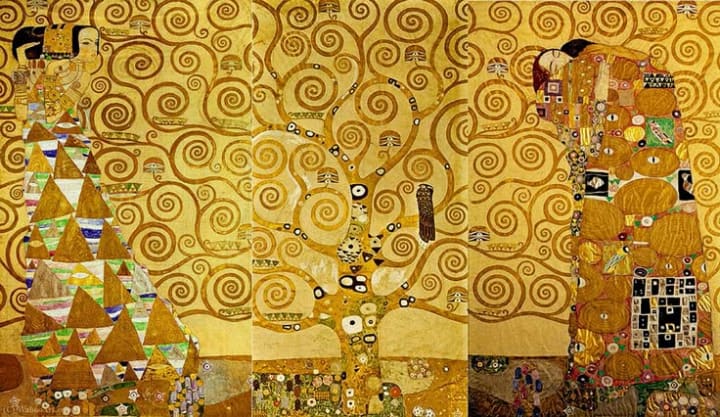
The twisting of ascending branches in a spiral path towards the sky symbolizes the continuity of life and its perpetuation. Their twisting is not merely an ornament, but a reflection of the soul’s fluctuations, its struggles, and its constant aspiration for salvation and meaning. Meanwhile, the roots embedded in the soil indicate the body’s constraint and its forced belonging to the earth.
In the painting, a woman appears in a modest dress of triangles — a symbol of stability and harmony — in stark contrast to the complexity and chaos of the branches twisting around her. Does she embody a desperate aspiration amidst the absurdity of existence, or a surrender to an inevitable fate?
Gold leaf envelops the tree in an aura of sanctity and splendor, while geometric ornaments whisper that behind the chaos of the world lies a hidden, unseen order. Here, the tree of life meets Plath’s fig tree, placing humanity before the mirror of its existential bewilderment; Klimt glitters with gold, and Plath bleeds ink.
The message is one, and the questions are endless: life is an infinite web of possibilities; so how do we live while burdened by futility? And how do we choose without being weighed down by regret for what we left behind?
Something brought them together:
The visions of artists who have never met intersect in a shared space that brings together words and colors, imagination and symbols, fig trees and golden branches. At this intersection, I find a single spiritual echo of the breadth of choices and the narrowness of time, and of the relentless cycles of existence. While Esther hesitates under the fig tree, weighed down by the burden of choice, Klimt’s tree branches writhe in a visual embodiment of the complexity of freedom and the dilemma of decision-making.
Ultimately, through literature and art, Sylvia Plath and Gustav Klimt offered profound reflections on the existential tension experienced by humans, and on the soul’s constant struggle with the chaos of life and the meaning of existence.
......
About the Creator
Manal
I write to breath


Comments
There are no comments for this story
Be the first to respond and start the conversation.