
What Makes an Expert Witness Credible in Construction Court Cases?
Construction Expert Witness
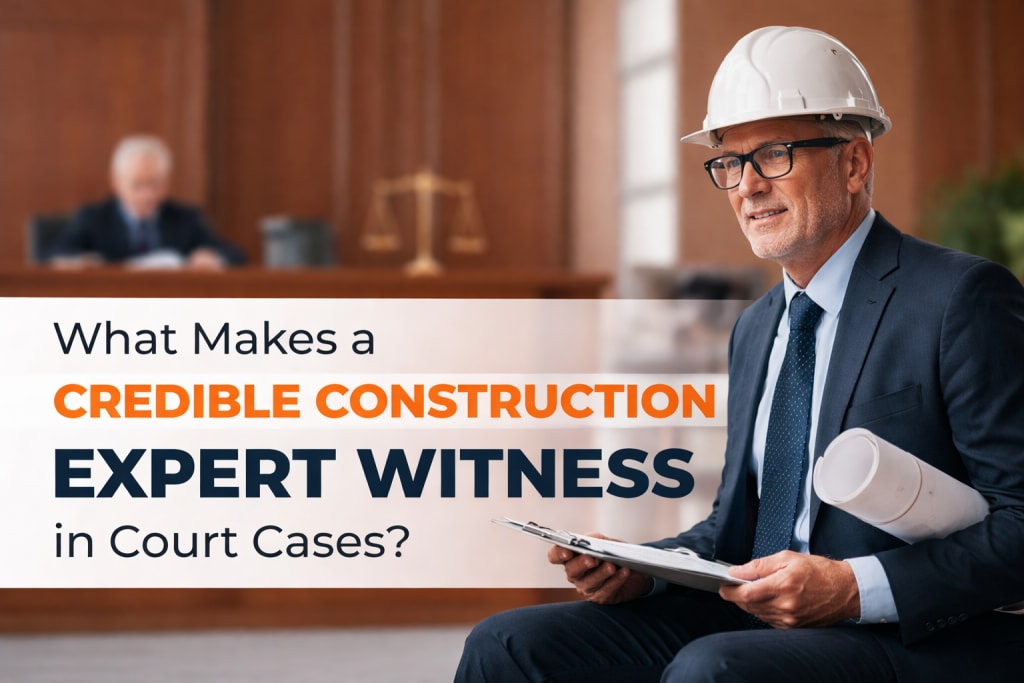
Construction disputes often involve large sums of money, tight contractual obligations and technical detail that courts need help to understand. A credible construction expert witness can strongly influence the outcome of a case. However, not every experienced builder or engineer qualifies as a reliable expert in court.
This article explains what courts in Australia look for when assessing the credibility of a construction expert witness.
A credible construction expert witness must:
- Have proven qualifications and relevant industry experience
- Remain independent and unbiased
- Follow the court’s expert witness code of conduct
- Base opinions on verifiable evidence and recognised methods
- Present clear, logical and consistent reports
- Perform well under cross examination
Credibility depends not only on expertise, but also on integrity and clarity.
1. Relevant Qualifications and Practical Experience
Courts assess whether the expert has direct experience in the specific area in dispute.
For example:
- A delay claim requires experience in programming and time impact analysis
- A structural defect case may require a chartered structural engineer
- A cost dispute requires expertise in quantity surveying
Membership with recognised bodies such as:
- Engineers Australia
- Australian Institute of Building
- Royal Institution of Chartered Surveyors
adds weight, but practical project experience is equally important.
An expert must demonstrate deep involvement in similar projects, not just general industry knowledge.
2. Independence and Impartiality
Under Australian court rules, an expert witness owes their primary duty to the court, not to the party who engages them.
Credibility drops quickly if the expert appears to advocate for the client rather than provide objective opinion.
A credible expert:
- Acknowledges facts that do not support their client
- Identifies limitations in their analysis
- Avoids exaggerated claim
- Discloses assumptions clearly
Courts are quick to dismiss experts who act as hired advocates.
3. Compliance with Expert Witness Codes of Conduct
In Australia, expert witnesses must comply with the relevant court rules, such as:
- Federal Court of Australia Expert Evidence Practice Note
- Supreme Court expert witness codes in each state
Reports usually require a declaration confirming that the expert understands their duty to the court.
Failure to follow these procedural requirements can reduce reliability, even if the technical opinion is sound.
4. Evidence Based and Methodical Analysis
Credibility relies on how conclusions are formed.
A strong expert report will:
- Reference contract documents
- Analyse drawings, variations and site records
- Use recognised delay analysis methods
- Provide clear calculations for quantum assessments
- Explain reasoning step by step
Unsupported opinion carries little weight. Courts prefer structured reasoning backed by documents, data and accepted industry standards.
5. Clear and Logical Reporting
Judges and barristers may not have technical construction backgrounds. An expert who cannot explain complex issues clearly risks losing influence.
A credible expert:
- Uses plain language
- Defines technical terms
- Structures reports logically
- Links conclusions directly to evidence
- Avoids unnecessary jargon
Clarity strengthens authority.
6. Consistency Under Cross Examination
Courtroom performance matters.
During cross examination, barristers test:
- The expert’s assumptions
- Any inconsistencies
- Methodology
- Independence
A credible expert remains calm, answers directly and does not become defensive.
If contradictions emerge between the written report and oral evidence, credibility suffers.
7. Direct Experience With Litigation
Construction litigation differs from project management.
An expert with prior court or arbitration experience understands:
- Joint expert conferences
- Concurrent evidence sessions
- Courtroom protocol
- Report formatting requirements
This experience improves reliability and presentation.
8. Transparency About Limitations
No expert can know everything. Credible witnesses openly state:
- Information gaps
- Assumptions made
- Areas outside their expertise
Courts respect measured opinions more than overconfident claims.
Why Credibility Matters in Construction Disputes?
In construction cases involving defects, delays or cost overruns, the judge often relies heavily on expert opinion to determine:
- Whether work met Australian Standards
- Whether delays were excusable
- Whether variations were valid
- The value of damages
If the expert lacks credibility, their entire analysis may be given little weight.
Conclusion
A credible construction expert witness combines technical depth with independence, discipline and clear communication.
Experience alone is not enough. Courts look for:
- Relevant qualifications
- Objective reasoning
- Procedural compliance
- Strong documentation
- Composure in court
When these elements align, expert evidence becomes persuasive and reliable.
About the Creator
Keep reading
More stories from wizard renovation and writers in Humans and other communities.
When Should You Appoint a Construction Expert Witness in a Dispute?
Construction disputes often involve technical details that courts, arbitrators, and lawyers are not trained to interpret on their own. This is where a construction expert witness becomes critical. Appointing the expert at the right time can directly influence the strength, cost, and outcome of a dispute.
By wizard renovationabout a month ago in Humans




Comments
There are no comments for this story
Be the first to respond and start the conversation.