
What It Means To Be Co-dependent
A personal journey

Co-dependent.
A word that was foreign to me until I heard it for the first time 6 years ago.
Discovering the significance of Mental Health Disorders as they become better researched, known, and understood has been a topic I find myself drawn to. I am fascinated by human beings, their thought processes, and how some manage day-to-day life as a result. I find myself drawn to instances where I can connect an explanation with a situation. As my husband likes to point out, “not everything has to have an answer!”
I disagree.
There is a reason for most everything and I am the purveyor of collecting information about human behavior and thought patterns. Humans are a most fascinating species for me and I truly want to understand the many facets of the human mind. Starting with myself seemed to be the best place to begin.
The definition of a co-dependent comes from a quick Google search:
“Characterized by excessive emotional or psychological reliance on a partner, typically one who requires support on account of an illness or addiction.”
When I first read that definition, I was confused. How did someone, such as myself, become co-dependent when neither of my parents had ever been drug addicts or alcoholics? It took me some time to discover and connect those dots. It wasn’t until I understood myself as a co-dependent better that I was finally able to pinpoint the possible reasons for my behavior.
A Brief History
My father was raised in a home where his parents drank socially, but also excessively. Both my grandparents had served in the Military during Wartime. It is possible that their service is what led to the drinking. It was also during a period of time when drinking alcohol during that era, was seen in a different light. Drinking is a coping mechanism for many individuals and without really knowing or understanding the horrors my grandparents faced during their service leads me to believe that it stayed with them. I also don’t quite know the type of upbringing they had either.
My father was the only son of 4 children. It is possible that the pressures of this role, in combination with the alcoholism, led to the co-dependent behaviors of my father.
My mother was adopted by her Aunt and Uncle after being discovered in a state of neglect as an infant. She was younger than her adoptive siblings so was essentially raised as an only child. Her adoptive mother suffered an emotional break when her husband left her for another woman. Her adoptive mother eventually married the estranged husband’s brother. Her upbringing was not unpleasant but I also get the impression there was a stern religious presence that prevented her from being allowed to do many age-appropriate activities as a child and young adult. She seemed isolated at times.
Both of my parents likely developed co-dependent behavior due to their home life situations.
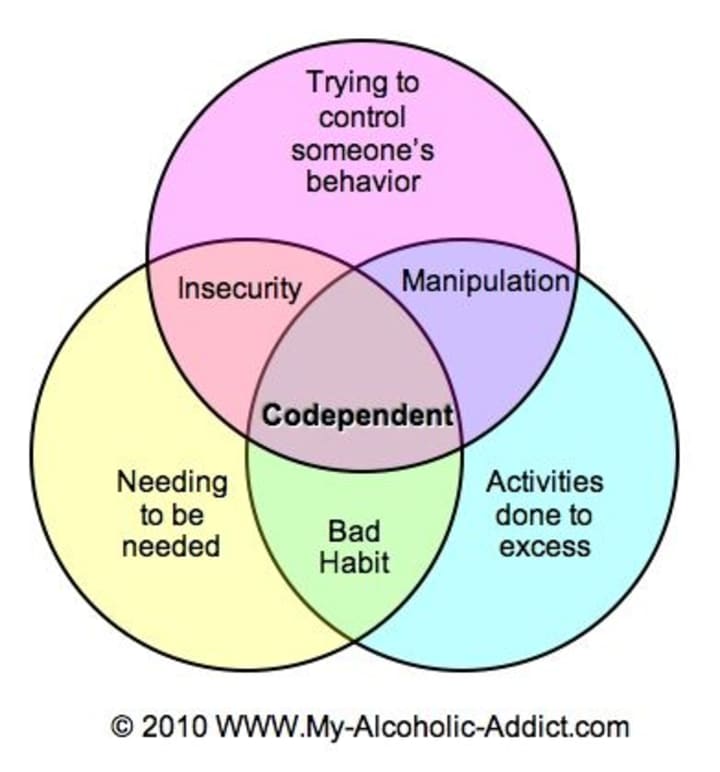
So what are some of those behaviors that make a person co-dependent? Anyone who researches this topic on the internet can receive a long list of behaviors known to those who are co-dependent. I feel that ANYONE can have any number of these behaviors, varying from slight to extreme. I believe anymore that most of us are co-dependent in some form simply because of how societal pressures cause this.
With that, they modeled those behaviors with my brother and me. With there being no real understanding of this type of behavior, no one had a name for it. Even then, while co-dependency was in its infancy, it was attributed to drug addicts and alcoholics and those that enabled that behavior. With the absence of this destructive usage in my own upbringing, I can only attribute the behavior to my parents modeling a similar behavior to each other and those they socially interacted with.
My father was also, for a lack of a better word, abusive to my brother and me. Being spanked for typical child behavior usually occurred and oftentimes, included implements such as wooden spoons and belts. Phrases such as, “stop crying or I’ll give you something to cry about” or “if you tell the truth your punishment won’t be as bad as if I catch you in a lie” were phrases I learned to be wary of. The punishments were often awful no matter if I lied or told the truth. I learned quickly to find ways to defend myself to avoid severe punishment.
I would like to take a moment to say that I am not angry or bitter in any way towards my parents. I have grown up, had children of my own, and forgiven them a very long time ago. I have a healthy relationship with my parents where I have set boundaries for myself. I could educate my parents on codependency, however, they are at a point in their lives where they won’t understand and would likely be dismissive of some behaviors as “just part of parenting and growing up”.

The Awakening
So how did I come to come to the conclusion I was a co-dependent? Not long after my second husband left me for another woman, I was speaking to a friend of mine who was going through some similar situations. His wife had cheated on him and he found out about it and was coping with some of his own feelings on the topic. As we were talking one afternoon, he would describe the actions of his wife and then correlate that with the term co-dependent. After hearing him mention this several times, I finally asked what that was because many of her mannerisms seemed very normal to me.
Once he explained what a co-dependent was, it was as if my mind went full-on Fourth of July. Every synapse in my head was sparked and going off like a million little powder kegs at that moment. My thirst for knowledge and understanding went into overdrive. I went to the internet to search for more answers.
The Connection
I was introduced to Dave Ramsey by my first ex-husband sometime in 2008. If you are not aware of who Dave Ramsey is, he is someone who specializes in finance and debt. If you have not ever heard about him, I highly encourage you to research him and listen to some of his podcasts.
I know what you are thinking, “How does a financial advisor fit in with co-dependency?” Hear me out.
Dave Ramsey gave a lecture about debt and I was fortunate enough to have a copy on CD. I listened to it a few times and learned something new with every listening.
Dave covers a topic about lending money. Essentially Dave encourages people to not loan money they don’t have. He tells of how people who borrow money in the first place, are usually in a position where they will never be able to repay the loan; thus why they are borrowing money in the first place. He speaks about how loaning money to someone changes the relationship. It is no longer a friend/friend relationship, parent/child relationship, etc. It changes to a lender/debtor relationship. He concludes that if you don’t have money to lend, not to lend it. However, if you do, give it to the person. This prevents the change of a relationship. Especially close coveted relationships such as family.
OK. So how did my mind take this information and connect the dots to co-dependency? As a co-dependent, I would bend over backward to please people. I was a “Yes, ma’am”! (A play on words was intentional). You would hardly ever hear me say no to anyone for anything for any reason. For those who may not know, this is exhausting. You find yourself overbooked, overtasked, and above all, miserable.
Then you become resentful. But you still don’t say no.
My thoughts were that if I do all these things for others, well then one day they will return the favor.
This was NOT the case.
You see, I was “lending” out parts of myself, in hopes I would be “paid back” eventually. But I never made those people aware of the exchange. They simply took it as I was doing them a favor because I could. They weren’t aware I was expecting to be paid back over time. I had ultimately “changed the relationship” with those individuals.
Learning To Say No
One of the most challenging and difficult areas for a co-dependent is saying “No”. After you have said yes so often, making this change is like being kicked in the stomach. It was the most difficult journey I have to say I experienced.
When you hear that someone has set boundaries, you often think they are setting boundaries for others. Not true. Setting boundaries for oneself is a HEALTHY thing to do. These boundaries can be adjusted over time, but essentially it is protecting oneself.
The first three months I was miserable. I felt like I was detoxing after a lengthy bender. I physically felt ill, emotionally I was tapped. I loathed and hated myself beyond words. However, I started to feel the change within me.
I was no longer overwhelmed. I had stopped taking on everyone else’s burdens to make my own and I could genuinely feel the weight lifting from my shoulders. I felt lighter, freer, almost my old self.
I found that saying no was empowering and I found myself doing it more often. I no longer gave what I didn’t have. I found I had more energy for myself and for my children and family. I was relishing my free time.
Don't get me wrong, I still said yes to people and helped and supported them when I had the means to do so. However, I felt better about saying no when I was not able to offer my assistance.
I also found myself going through a grieving process as well. As I grew stronger, I found that some people stepped out of my life. I would like to think the best in people and that they were setting boundaries for themselves. However, people are much like the seasons; they come and they go.
It's been a little over 6 years since that moment in time. The journey still continues and I am still learning to change many co-dependent behaviors, though none have been quite as eye-opening as that day.
Next Steps
I am still slowly learning to shed myself of some of the co-dependent behaviors. Some of those changes came too late and I am now having to try to figure out another way to manage them.
One such behavior was always believing no one else could do things the right way so I did everything. Now I have children who are struggling with what to do in their life and always looking to me for answers on every basic level. It is a process and one I am working to get through with love and patience. It is just another bump in the road.
One doesn’t unlearn things overnight. Sometimes I lose patience and have to remember to have grace with myself. Forgiving myself was a difficult area, but being human and flawed is such a magical thing to embrace. It is how we learn. We have to make mistakes to learn. We started off as newborns, making mistakes and learning as we grew. Somehow as adults, we forget that mistakes continue to happen and we have to move through them in order to grow.
I hope you read this and found something to hold on to, to grow from.
We are perfectly imperfect.
And I love this!
About the Creator
Keep reading
More stories from Jennifer Ann Tipton and writers in Humans and other communities.
Autonomy Is The Real Privilege
Good morning, freedom-seekers! Today we’re gonna be looking at autonomy. A strange word, I know; one many would probably look at blankly and run away from on sight. We’re gonna figure out what it actually means, consider how it’s achieved, and decipher just how deeply most of us are tangled up in dependence without realising it.
By That ‘Freedom’ Guy3 days ago in Humans
The Unexpected Guardian
A Fragmented Life in a Foreign Land The city was a blur of unfamiliar sights and sounds for the young Chinese student. He had arrived in Germany, like countless others, with dreams of education and a brighter future, yet found himself navigating the universal challenges of an international student: language barriers, cultural shocks, and the quiet ache of loneliness. His initial lodging was modest, a room in an old, somewhat dilapidated house owned by an elderly German man.
By Linda Yule7 days ago in Humans
Smart phones, Humans and Aliens.
WARNING. I will be tapping into one of your favorite creative tensions: The absurdity of humans worshipping their glowing rectangles as if they were tiny oracles. There’s something deliciously poetic about that contradiction, and it lends itself beautifully to an instructive proviso.
By Novel Allen7 days ago in Poets



Comments
There are no comments for this story
Be the first to respond and start the conversation.