

The Dove and the Broken Cage
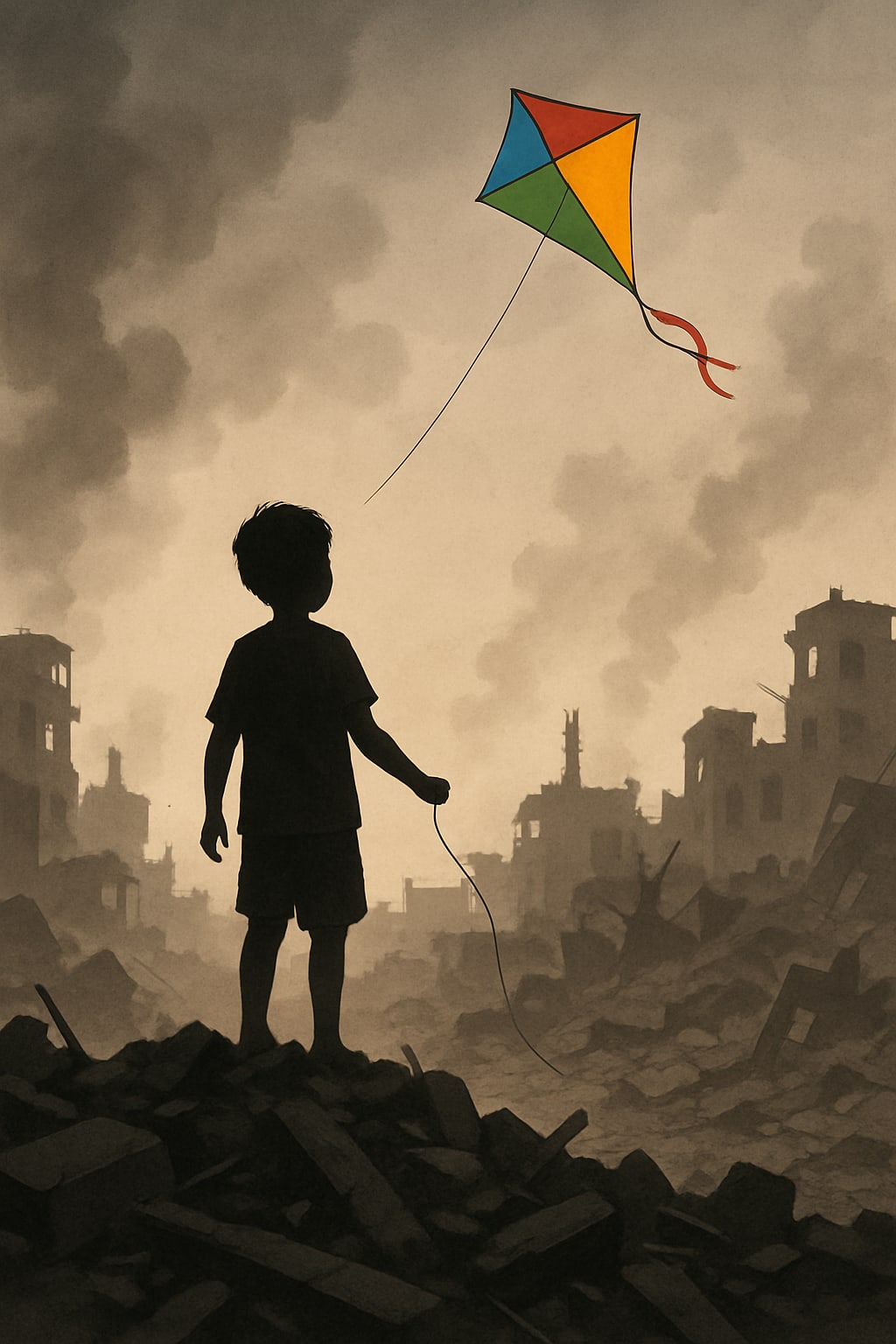
In a city whose name the wind had long forgotten, smoke rose like ghostly fingers toward a sky bruised by war. The buildings, once proud, now leaned like old men whispering their regrets. Rubble covered streets where children once played, and silence had taken the place of music.
But even silence cannot kill the heartbeat of a people.
In the heart of this broken land lived a boy named Yousef, no older than ten. His eyes were wide not with fear but with something far more stubborn: hope. He had lived all his life in this fractured world—his lullabies were sirens, his toys were rusted nails and broken wood, and his school was a charred skeleton of concrete. Still, he dreamed.
Yousef spent most of his days exploring the ruins near his home, once a library, now just a graveyard of burnt books and splintered shelves. It was in this place, one windless morning, that he found the cage.
It was half-buried in dust, a small iron thing with elegant bars twisted like vines. One entire side had cracked wide open, as though something inside had burst free. It looked ancient, yet strong. Strange that it would still be here, untouched, in a place where even bread didn’t last a day. Yousef pulled it out, brushed off the sand, and turned it over in his small hands.
Something about the broken cage stirred him. It reminded him of his uncle, who had once said, “Cages aren’t always made of metal, habibi. Sometimes they’re made of silence.” That was the last thing his uncle said before he disappeared one night, taken by men who never returned.
Yousef took the cage home, setting it gently near the window that no longer had glass. Every morning he would look at it, then at the sky. And every morning, he would sketch. He had a stub of charcoal and a few torn pieces of cardboard — his canvases. On them, he drew wings, birds, skies with no smoke, oceans he’d never seen, and faces of people laughing in colors he could only imagine.
One afternoon, while sketching, he heard a soft flutter — a sound so foreign that at first he thought it was the ghost of a bird. He looked up and saw it: a dove, white as untouched snow, perching carefully on the windowsill, just beside the broken cage.
Yousef’s breath caught. He had never seen a bird here. Not anymore.
He froze, fearing the slightest movement would send it away. But the dove did not flee. It peered at him with its obsidian eyes, as if studying his soul. Slowly, Yousef reached out, setting a small crust of bread — his only meal for the day — on the window frame. The bird tilted its head, then stepped forward to eat.
It became a ritual. Each day, the dove returned. Yousef would feed it, draw it, talk to it. He named it Hurriya — Freedom. He imagined that it had come from beyond the wall that enclosed their city, beyond the blockade, beyond the darkness. He imagined it had flown over mountains, through bullet-riddled skies, carrying news of spring.
Then came the day the soldiers returned.
They came without warning, their boots crushing what little remained of the neighborhood’s soul. A blast shattered what was left of the roof. Dust choked the sky. Yousef hid in the hollow of a wall, clutching the cage and his drawings. He couldn’t cry. Not because he didn’t want to — but because his tears had long since run dry.
When the dust settled, his home was no longer a home. Just rocks and ash.
But Hurriya returned. Through the smoke, she flew — not away, but toward him. She circled once, twice, then landed beside the cage. And for the first time, Yousef didn’t feel afraid. He didn’t feel alone.
With trembling fingers, he opened what remained of the cage door, though there was no need. It was already broken — but the gesture felt sacred.
He placed the bird inside, just for a moment. Then, gently, he lifted it again, whispering, “Go. Fly for me. Fly for all of us.”
And Hurriya did.
She soared into the darkening sky, a white flame against the soot and sorrow. Higher and higher, until she was just a shimmer of light. And for a moment, Yousef felt as though a piece of him had gone with her — the part that still dared to believe.
He stood alone, barefoot among ruins, holding a shattered cage. But in his heart, something had changed. He no longer drew wings — he felt them. He no longer imagined freedom — he had seen it take flight.
⸻
Years later, people would tell a story — whispered among rubble, carried in songs hummed by mothers to their children:
“Once, a boy gave his only bread to a dove. And the dove flew high enough for the world to remember us.”
And in a quiet corner of the city, still watched by drones and fear, someone had painted on a surviving wall:
A cracked cage. A white dove. And the word: “Hurriya.”
About the Creator
Abdul Rauf
love you all 💕❤️
Keep reading
More stories from Abdul Rauf and writers in Humans and other communities.


Comments
There are no comments for this story
Be the first to respond and start the conversation.