

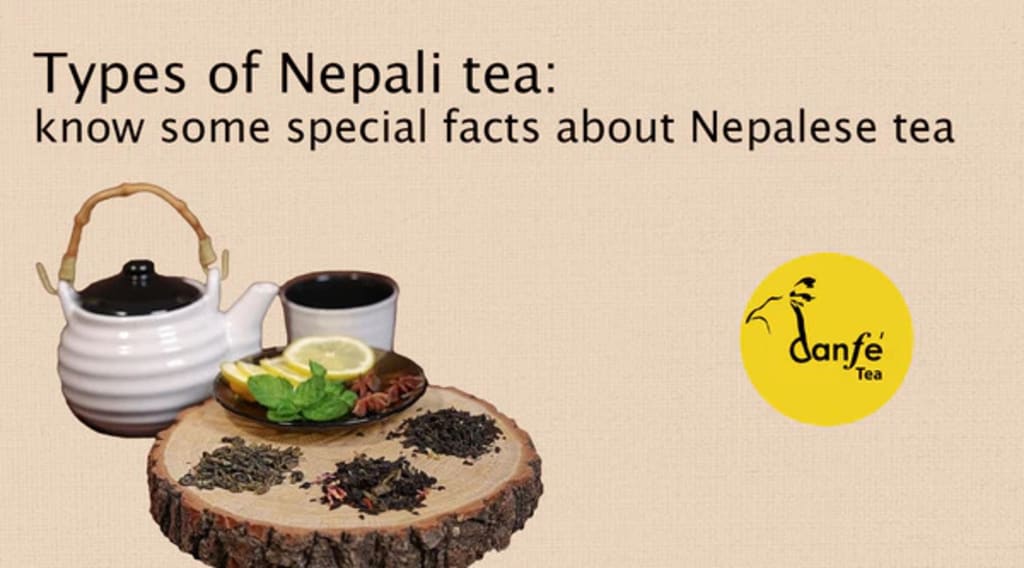
Since millennia, tea has been grown in Nepal, and over time, the country has built a reputation as a producer of high-quality teas. Tea is quite popular in Nepal. If you ever get the chance to travel to Nepal, you will see groups of people conversing in squares and tiny tea shops while savoring each drink of delectable Nepali tea. Despite the fact that tea is widely consumed, few people are aware of the variety of Nepali teas available. This information is intended for individuals who are unfamiliar with Nepali tea and don't know the varieties that are sold there. Scroll forward.
History of Nepali Tea
A portion of the famous Tea Horse Road, which was used by tea dealers from Yunnan China to convey their goods in the late sixth century, passed via Tibet, Myanmar, and Bhutan on its way to Nepal, India, and other destinations. Nepal, an old country at the time, contributed to the growth of the tea trade by buying and selling Chinese teas.
Despite being a relatively tiny nation, Nepal has a long tradition of tea production. Throughout history, mountain tribes in Nepal's eastern slopes, including the Limbu, Rai, and others, have grown tea for domestic consumption.
However, the Ilam Tea Estate was founded in the Hills of Ilam District in 1863, marking the beginning of the modern organized plantation. The first official tea plants were produced in Nepal from seedlings sent by the Chinese Emperor to Jung Bahadur Rana, who was the country's prime minister at the time. Currently, Nepal is home to more than 85 farms where high-quality, fragrant tea is mass-produced.
Nepali teas were first used to make up for the inferior quality of Darjeeling tea. However, Ilam established its own factory for the production of tea in 1978, reviving a dormant sector. In 1982, Nepal began making its own premium tea. At that time, the five districts of Ilam, Jhapa, Panchthar, Dhankuta, and Terhathum were designated as the "Nepal Tea Zones" by the then-King of Nepal, His Majesty Birendra Bir Bikram Shah Dev. All other districts in Nepal are located in the hilly area, with the exception of Jhapa.
Modern Nepali Tea Industry
Independent groups made efforts to increase the quality and refinement of Nepali tea around the turn of the 20th century, which led to the development of a successful tea industry in Nepal. Although Nepali tea was brought to the globe much later than Darjeeling tea, it is now regarded as the best in the world because of its color, fusion, flavor, and scent. Nepal's high mountain areas occupy more than 16,000 hectares with tea gardens.
Types of Nepali Tea
While all Nepali teas are manufactured from the Camellia sinensis plant, there are many different varieties produced there due to processing differences. Although there are several types of Nepali tea, we have included the most well-liked ones below.
A unique oxidation technique is used to create oolong tea, a historic and traditional Nepali tea. The enzymes in the tea leaves interact with oxygen during the oxidation process, darkening the color of the leaves. The process is comparable to how an apple browns after being sliced open and left outside. Its amount of oxidation increases with the duration of the oxygen reaction.
Tea leaves are meticulously selected, hand-rolled, and allowed to oxidize to give the beverage its distinctive flavor. The leaves are left outside until their level of oxidation reaches between 50 and 70%. Take a sip of brewed oolong tea to experience its fruity and earthy flavor. Oolong tea leaves are rather brownish.
The strong Nepali black tea known as Ilam is abundantly cultivated in Nepal's Eastern Himalayas. The main usage for it is as a morning tea. It can be served with milk or on its own. Black tea has undergone complete oxidation. Its degree of oxidation ranges from 80 to 100%. One of the most popular Nepali teas, alongside Darjeeling Black Tea, is Ilam Black Tea. It produces a reddish-golden hue when brewed, yielding a cup of tea that is tasty and well-balanced.
Tea that has not undergone oxidation is called green tea. It has a fragrant flavor since its leaves are delicately steam-infused. Less processing is applied to green tea than to black and oolong tea. In contrast to black tea and oolong tea, green tea is shielded from oxidation and doesn't require a withering process to make it.
The majority of people drink green tea because it is beneficial. Green tea is very beneficial for weight loss and bodily detoxification.
- Golden Tips Tea
The finest grade Black tea, known as Golden Tips, is produced in high altitude (between 7000 and 7500 feet) in Nepal's Mid-Eastern Himalayas. Due to the early harvesting of immature tea buds, it is known as "Golden tips tea." The gold-colored tips yield a golden amber tint with a smooth, velvety texture when steeped. Golden tips tea has a nutty flavor resembling roasted peanuts and popcorn.
- Silver Tips Tea
Unlike black, green, or oolong tea, which is made from tea leaves, Silver tips tea is made from single-origin unopened tea buds. They are handpicked and processed into the highest-grade Tea. Best known for its long and velvety silvery buds, Silver tips tea are processed into the highest-grade White tea.
After a long winter dormancy in the tea mountains of Nepal, as soon as spring blooms, tender tea buds with a pointed needle appear on the tea plants, which are plucked and then immediately dried out into white tea, to make Silver tips tea. This tea is one of the rarest Nepali tea because it can only be harvested once in a year.
About the Creator
Danfe Tea
By adopting us, you can not only experience some of the rarest Nepalese Himalayan mountain teas, but you can also help the struggling tea industry get recognition by introducing its goods to a market that recognizes their inherent worth.
Keep reading
More stories from writers in Humans and other communities.
The Angry Man in Your House
"If you grow up with an angry man in your house, there will always be an angry man in your house" This statement has caused plenty of controversy online, people say its a statement that blames victims while also undermining those who break traumatic cycles to form health relationships... but if I'm honest now that I'm in my 30s it makes more sense to me than ever, and I'd argue that its not just about fathers and uncles.
By S. A. Crawforda day ago in Humans
The Weight of Small Acts
Mariam had always believed that big actions changed the world. She thought that unless someone did something extraordinary, like saving lives or leading movements, their efforts didn’t matter. She had watched the news for years, filled with stories of disasters, wars, and crises, and it made her feel small. She wondered if one person could ever make a difference in such a large, complicated world.
By Sudais Zakwanabout 4 hours ago in Humans




Comments
There are no comments for this story
Be the first to respond and start the conversation.