
Trust, Betrayed
Beyond the Vows: Why People Cheat, and How to Decide if You Should Forgive


Infidelity is a painful reality that many couples face in modern marriage.
Adultery is not a new topic; it has shadowed the institution of marriage since its very beginning. Monogamy is a creation of human culture, designed to maintain social stability, but it can never completely suppress primal human drives.
A set of surprising statistics reveals the scale of the issue:
41% of married partners admit to at least one instance of physical or emotional cheating.
22% of married men report having cheated at least once since their wedding.
14% of married women report having cheated at least once since their wedding.
When faced with a partner’s betrayal, many attempt to forgive and move on. Especially in long-term marriages, forgiveness becomes a common choice. However, the damage caused by infidelity is not something that simply disappears.
Why Do Happy Spouses Cheat?
American relationship therapist, Esther Perel, has studied countless couples dealing with infidelity worldwide. She discovered that most people who cheat are not serial philanderers, but rather ordinary individuals who firmly believe in monogamy and have been loyal for decades.
Contrary to popular belief, Perel found that the core reason for infidelity is often not about better sex. Instead, people use affairs to find emotional communication and satisfy deep inner cravings for:
Novelty
Freedom
A feeling of being important and seen
Ultimately, cheating is a way to fill unmet needs that a person isn't getting at home.
The Thrill of the Secret Self
Furthermore, infidelity can stem from a desire for self-exploration. It can be a way to seek a new identity, experience a different version of life, or challenge personal possibilities.
As many of us remember from childhood, the act of hiding, sneaking, rebelling, fearing discovery, and successfully escaping detection is inherently thrilling.
American psychologist Maureen Scanlan proposed a "Sexual Equation": Attraction + Obstacle = Excitement.
People feel most alive and excited when they are in an unbalanced, uncertain state—teetering on the dangerous edge between ecstasy and catastrophe. Ironically, the happier the marriage, the more shocking the infidelity often seems, simply because the contrast is so great. An affair, if undetected, can even become addictive.
No Reason Justifies Betrayal
It’s normal for humans to have desires. However, no reason or internal drive ever justifies cheating.
The essence of marriage is constraint, commitment, and responsibility. Trying to solve your own internal issues by seeking answers in a third party is fundamentally wrong.
We can, and should, make choices about our own lives. The promise to "grow old together" is not just a romantic gesture; it is a steadfast commitment. When we choose to join hands in marriage, we must be prepared to restrain the greedy impulses of human nature and forego certain possible life encounters for the sake of that intimate bond and warmth.
The encounters we forgo might have been exciting or romantic, but what we gain in commitment is far more priceless.
Should You Forgive Your Cheating Spouse?
When deciding whether to forgive a spouse's infidelity, I believe there are two crucial standards to measure:
1. Can you truly rebuild trust with them?
2. How genuine and strong is their desire for repentance and reconciliation?
Regarding the issue of trust, you need to ask yourself honestly:
Can you eventually let this incident go?
Can you truly forgive this in the long run?
If you simply cannot, from the bottom of your heart, accept or forgive this breach, then whether they completely reform their behavior or not, the rebuilding of trust will be impossible. In that case, it might be better to walk away.
However, if you are willing to rebuild the trust, and if your partner is genuinely committed to returning to the family, acknowledges the profound damage they caused, and is making sincere, continuous efforts to heal your pain, then forgiveness is something you can seriously consider.
About the Creator
Water&Well&Page
I think to write, I write to think
Keep reading
More stories from Water&Well&Page and writers in Humans and other communities.
Affair Goes Public
My buddy was dating his girlfriend for over two years. They seemed genuinely in love—the kind of couple everyone wants to hang out with. Things were serious; they had met each other’s parents and were actively planning their wedding date. They were literally discussing when to get their marriage license.
By Water&Well&Page3 months ago in Humans
Staying sane in the insane world.
”It is no measure of health to be well adjusted to a profoundly sick society.” Jiddu Krishnamurti This quote has been one of my favourites since the moment I first laid my eyes on it. To me, it cuts right through the fog of the illusion of normality that permeates our lives. And since I am someone who has never felt (well) adjusted to this society, Krishnamurti’s words gifted me with the realisation that there isn’t anything inherently wrong with me.
By Eva Smitte4 days ago in Humans
Please Stay on the Line
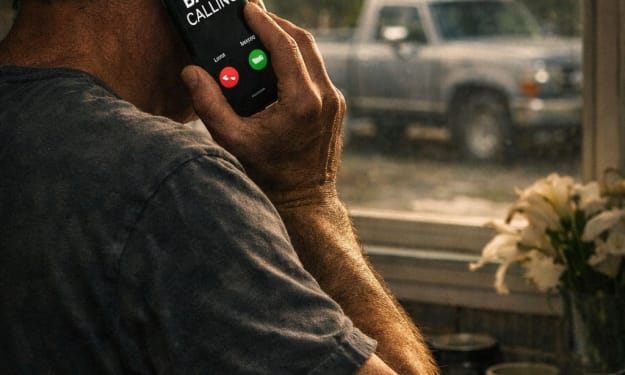
The phone rang on a Tuesday. I knew who it was before I looked at the screen. The bank. It had been ringing for three days. Same time. Same number. I let it go to voicemail the first two times. On the third day, I answered.
By Edward Smith3 days ago in Humans



Comments
There are no comments for this story
Be the first to respond and start the conversation.