
The Weight of Being "Too Much": How I Learned My Sensitivity Was Never the Problem
For thirty years, I apologized for feeling too deeply. I dimmed my light to make others comfortable. I learned to be smaller, quieter, less. And in the process, I nearly lost myself completely.

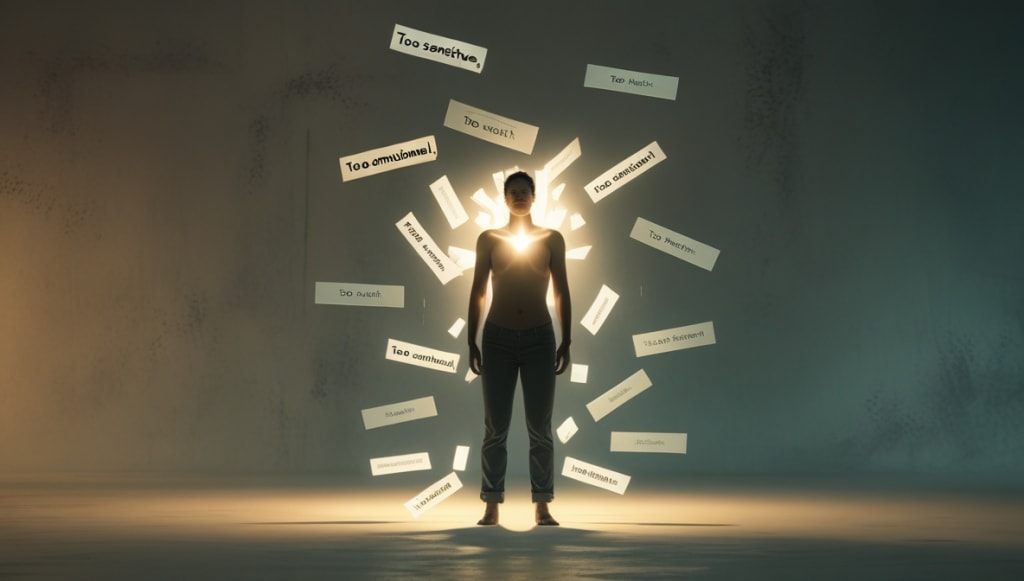
I was seven years old the first time someone told me I was too sensitive.
I'd come home from school crying because my best friend said she didn't want to play with me anymore. My father looked up from his newspaper, irritation flickering across his face. "You're being too sensitive," he said, turning the page. "Kids say things. You need to toughen up."
So I tried. I swallowed my hurt. I forced a smile. I pretended it didn't matter.
That moment became a blueprint for the next three decades of my life.
By the time I was thirty-seven, married with two kids and a successful career, I'd perfected the art of not feeling too much. I'd learned to laugh off insults, minimize my pain, and apologize for my emotions before anyone else could criticize them.
But the cost of all that toughening up? I'd become a stranger to myself.
The Education of Emotional Suppression
The messages came from everywhere, each one teaching me that my natural way of being was somehow wrong.
When I cried during a sad movie: "It's just a movie. Why are you so emotional?"
When a friend's thoughtless comment hurt my feelings: "You're overreacting. I was just joking."
When I needed time to process conflict: "You're being too dramatic. Just get over it."
When I was moved to tears by beauty—a sunset, a piece of music, an act of kindness: "You cry at everything. What's wrong with you?"
Each time, the same lesson: Your feelings are excessive. Your responses are inappropriate. You are too much.
I learned to preface every emotional expression with an apology. "I know I'm being ridiculous, but..." "I'm probably overreacting, but..." "Sorry, I'm just too sensitive..."
I became an expert at minimizing my own experience, at gaslight myself before anyone else could do it for me.
The Slow Erosion of Self
What happens when you spend decades being told your emotions are wrong? You start to believe it.
I stopped trusting my own reactions. When something hurt me, my first thought wasn't "that was hurtful," but "I'm being too sensitive." When I felt uncomfortable in a situation, I'd override my instincts and force myself to stay, convinced my discomfort was a character flaw rather than valuable information.
I became everyone's emotional support system while denying myself the same care. Friends would call me for hours when they were upset, and I'd listen with endless patience and compassion. But when I was hurting? I'd minimize it, laugh it off, handle it alone.
In my marriage, I'd absorb my husband's bad moods without comment, adjust my behavior to keep the peace, and swallow my hurt when he was dismissive or short with me. "You're too sensitive" became his go-to response whenever I expressed that something bothered me. Eventually, I stopped expressing it at all.
I taught my children to share their feelings, while simultaneously teaching them through my example that their mother's feelings didn't matter. I'd hide in the bathroom to cry, ashamed that I couldn't be stronger.

The Breaking Point
The collapse came during what should have been a casual dinner with friends.
Someone made a joke at my expense—a cutting comment disguised as humor. The table laughed. I felt the familiar sting, the heat rising to my cheeks, the tightness in my throat.
And then I did what I'd been trained to do: I laughed too. I made a self-deprecating comment that invited more laughter. I performed the role of good sport, of someone who could take a joke, of someone who wasn't too sensitive.
But driving home that night, something inside me fractured. I pulled over on a dark side street and sobbed—deep, wrenching sobs that came from a place I'd been keeping locked for thirty years.
I was so tired. Tired of shrinking. Tired of apologizing for existing. Tired of treating my own heart like an inconvenience.
"What's wrong with me?" I whispered into the darkness.
And for the first time, a different voice answered back: "Nothing. There's nothing wrong with you."
The Awakening
Therapy gave me language for what I'd experienced. My therapist introduced me to the term "highly sensitive person"—someone with a more finely tuned nervous system, who processes information and emotions more deeply.
"About twenty percent of people are born this way," she explained. "It's not a flaw. It's a trait. Like being tall or left-handed."
I stared at her, this information rearranging everything I'd believed about myself.
"But I've always been told—"
"That you're too sensitive," she finished. "Because we live in a culture that values emotional toughness over emotional depth. But sensitivity isn't weakness. It's actually a sophisticated form of processing. You notice things others miss. You feel things others don't. That's not too much. That's a gift—one that our world desperately needs."
A gift. I'd spent my entire life treating my sensitivity like a defect, and she was calling it a gift.
The Silent Damage Revealed
As I began unpacking decades of emotional suppression, the damage became clear.
I'd developed chronic anxiety from constantly second-guessing my own responses. My body had learned that my feelings were dangerous, something to be controlled and contained at all costs.
I'd attracted relationships where my emotional needs were minimized because I'd been trained to believe they weren't valid. I'd married someone who used "you're too sensitive" as a weapon to avoid accountability for hurtful behavior.
I'd lost touch with my intuition. That inner voice that says "something's wrong here" or "this doesn't feel right" had been silenced by years of being told I was overreacting.
I'd become a people-pleaser, contorting myself to fit others' comfort zones, terrified that my authentic self was too intense, too emotional, too much.
Most devastatingly, I'd taught my daughter the same lessons I'd learned. I watched her starting to apologize for crying, starting to minimize her hurts. I was passing down the same toxic inheritance I'd received.
That's when I knew something had to change.
The Rebellion of Reclaiming
Learning to honor my sensitivity felt like learning to walk again. Every step was unfamiliar and frightening.
I started small. When someone made a joke at my expense, instead of laughing along, I'd pause and say calmly, "That hurt my feelings." The first few times, my voice shook. My heart raced. But I said it anyway.
When my husband dismissed my concerns with "you're being too sensitive," I stopped accepting it. "No," I'd say. "I'm expressing how I feel. If you're uncomfortable with that, we need to talk about why."
I stopped apologizing for crying. When tears came, I let them fall without the usual cascade of "I'm sorry, I'm sorry."
I set boundaries. When friends dumped their emotional baggage on me but had no capacity for mine, I started saying, "I don't have the bandwidth for this right now." Some friendships ended. The ones that remained became deeper and more reciprocal.
I gave myself permission to feel things fully—the joy, the grief, the anger, the love. All of it, without judgment, without apology.
The Unexpected Strength
Here's what I discovered: sensitivity isn't the opposite of strength. It's a different kind of strength.
It takes strength to feel deeply in a world that encourages numbness. It takes courage to stay open-hearted when you've been hurt. It takes power to refuse to dim your light just because it makes others uncomfortable.
My sensitivity, which I'd been taught was my greatest weakness, turned out to be my superpower. I could read rooms and pick up on unspoken emotions. I could connect with people on a deep level. I could create art and writing that moved people because I wasn't afraid to feel it all first.
The empathy I'd been shamed for became my greatest asset as a mother, allowing me to attune to my children's needs with precision and care. The emotional depth I'd been told to suppress became the foundation of my most meaningful relationships.
I wasn't too sensitive. The world had just been asking me to be less than I was.
The Ripple Effect
The most beautiful part of reclaiming my sensitivity? Watching how it gave others permission to do the same.
My daughter stopped apologizing for her tears. My son started expressing his feelings instead of bottling them up. Friends began sharing more vulnerably, knowing I wouldn't judge their emotions as excessive.
Even my marriage transformed. When I stopped accepting "you're too sensitive" as a conversation-ender, my husband had to learn a new language—one of accountability, of recognizing impact over intent, of meeting me with curiosity instead of dismissal.
Not everyone could handle the change. Some people had been comfortable with the version of me that required no emotional reciprocity, that absorbed their moods without complaint. When I stopped being that person, they left.
And I let them go. Because I'd finally learned: people who tell you you're "too sensitive" are really saying, "Your feelings are inconvenient to me." And that says everything about them and nothing about you.
The Truth I Wish I'd Known
If I could go back and tell that seven-year-old girl crying over her lost friendship anything, it would be this:
Your sensitivity is not a flaw to be fixed. It's a feature to be honored. In a world that's increasingly disconnected, your ability to feel deeply is revolutionary. Your tears are not weakness—they're proof you haven't let life harden you. Your emotional awareness isn't excessive—it's exactly what this world needs more of.
The people who tell you you're "too sensitive" are often the ones who've learned to feel too little. Their numbness isn't strength; it's armor. And they resent you for living without it because you remind them of everything they've had to bury to survive.
You're not too much. You've just been surrounded by people who are too little.
Being told you're "too sensitive" is a form of gaslighting that teaches you to doubt your own emotional reality. It's a request that you make yourself smaller so others can stay comfortable. But your sensitivity isn't a burden—it's your birthright. The world doesn't need you to feel less. It needs you to stop apologizing for feeling at all. Your depth isn't damage. Your emotions aren't excessive. You're not broken. You're awake in a world that's chosen to sleepwalk, and that makes some people uncomfortable. Let them be uncomfortable. You keep feeling.
About the Creator
Keep reading
More stories from Ameer Moavia and writers in Humans and other communities.
When Home Becomes a Memory: Learning to Let Go of the Person You Thought Was Forever
I still remember the exact moment I realized I had to let her go. We were sitting on opposite ends of the couch—the same couch where we'd spent countless nights talking until sunrise, dreaming about our future, planning adventures we'd never take. But that night, the silence between us felt heavier than any words we'd ever shared. The distance wasn't measured in inches. It was measured in all the things we'd stopped saying, all the dreams that had quietly died, all the versions of ourselves we'd outgrown. She still felt like home. That was the cruelest part. The Comfort That Becomes a Cage There's something uniquely painful about loving someone who feels like home but no longer helps you grow. For three years, she'd been my safe place—the person I ran to when the world felt too heavy, the voice that calmed my anxious thoughts, the presence that made everything feel right. But somewhere along the way, comfort had turned into complacency. We'd stopped challenging each other. We'd stopped dreaming together. We'd become so focused on preserving what we had that we forgot to ask ourselves if what we had was still what we needed. I'd read once that people come into our lives for a reason, a season, or a lifetime. I'd always assumed she was my lifetime. The thought of her being just a season felt like a betrayal of everything we'd built together. Yet deep down, I knew. The person I was becoming couldn't live in the life we'd created. And the person she was becoming deserved someone who could show up fully, not someone staying out of fear and familiarity. The Questions That Changed Everything The turning point came during a solo trip I took to clear my head. Sitting on a beach thousands of miles away, watching the waves reshape the shoreline over and over, I finally asked myself the questions I'd been avoiding: Was I staying because I loved her, or because I was afraid of being alone? Was I holding on to who we were, or who we could actually be? If we met today, as the people we've become, would we still choose each other? The answers terrified me. Because they revealed a truth I'd spent months burying: sometimes love isn't enough. Sometimes two people can care deeply for each other and still be wrong for each other. Sometimes the most loving thing you can do is let someone go so you can both find the versions of yourselves you've been suppressing.
By Ameer Moavia2 months ago in Humans
Thief In The Night
To the thief in the night that took and replicated what once was mine: Honestly, I feel kind of bad for you. It’s funny, because we hardly know each other. I only know of you through the magazines you’ve written and the broadcasts you have televised in the past — as well as through the public mentions of you from your show business connections there.
By Snarky Lisa7 days ago in Humans
Second Chance At Love Offering Hope Healing And Beautiful New Beginnings
A second love is in most cases initiated by a new feeling of hope following a feeling of heartbreak or disappointment. Emotional scars, questions and fears of trusting the other person again are left behind by the past relationships to many. However, hope enables the heart to be open and helps people not to forget that love is not lost and that after suffering significant relationships can be created. It is a source of optimism which leads to a cure and happiness.
By Mark Hipsterabout 9 hours ago in Humans


Comments
There are no comments for this story
Be the first to respond and start the conversation.