
The Visit Of The Apostles and Peter's Hypocrisy
The arrival of the super Apostles in Antioch

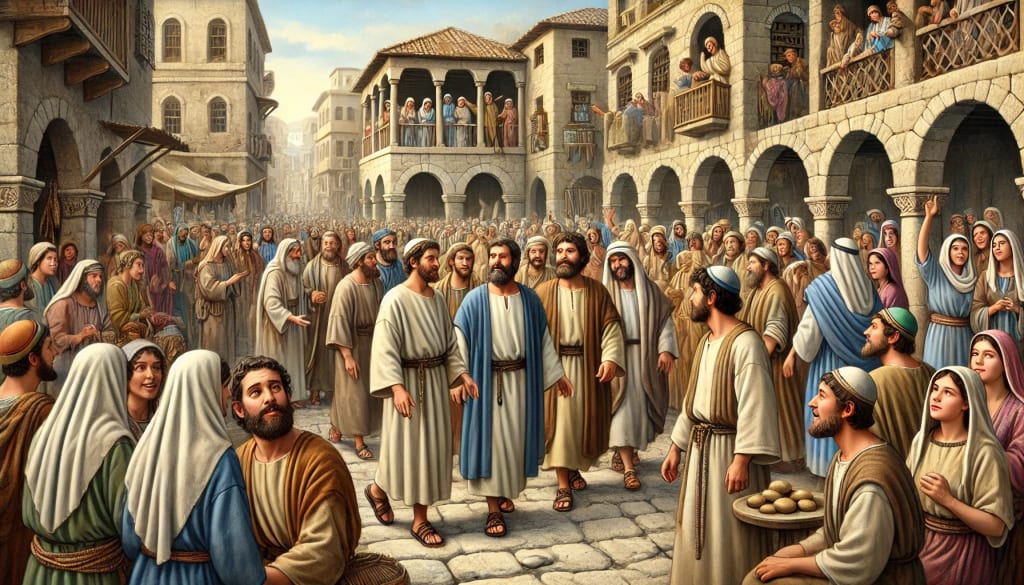
Chapter 1: The Visit from Jerusalem
It was a warm afternoon in Antioch when a group of men arrived from Jerusalem. Their presence was notable; these were not just any visitors but apostles and leaders of the early Christian church. As they made their way through the bustling streets, whispers spread like wildfire among the believers.
“Peter and his brethren have come from Jerusalem,” the people said excitedly.
Antioch had become a thriving center for Christianity, a place where Jews and Gentiles worshiped together under the leadership of Paul and Barnabas. The arrival of these prominent leaders from Jerusalem was seen as an opportunity for unity and growth in the fledgling church.
That evening, a grand gathering was arranged in the house of one of the prominent believers. The room was filled with a diverse group of people—Jews and Gentiles, rich and poor—who had come to hear from the visitors. Peter, known as the rock upon which Christ said He would build His church, stood up to speak.
“Brothers and sisters,” Peter began, his voice carrying the authority and compassion that made him a revered leader. “We have come from Jerusalem to see the great work that the Lord is doing here in Antioch. It is evident that the Spirit of God is moving powerfully among you.”
His words were met with nods of approval and murmurs of agreement. The people of Antioch were proud of the harmony they had achieved, with Jews and Gentiles worshiping side by side, sharing meals, and living in unity. The Jerusalem apostles had heard about this and were eager to witness it firsthand.
Peter’s speech continued, emphasizing the importance of love and fellowship. “Christ died for all,” he said, looking at the Gentile believers with warmth in his eyes. “There is no longer Jew or Gentile, slave or free, for we are all one in Christ Jesus.”
The people felt a renewed sense of unity and purpose. The visit seemed to be a blessing, affirming that the message of Christ was spreading beyond ethnic and cultural barriers.
Chapter 2: A Change in Behavior
Days passed, and the apostles from Jerusalem continued to participate in the life of the Antiochian church. They dined with both Jews and Gentiles, showing no discrimination, just as Peter had preached. However, a subtle shift occurred when a group of men arrived, sent by James, the leader of the church in Jerusalem.
These men, known for their strict adherence to Jewish customs, began to influence Peter and the other Jewish believers. Peter, who had been eating and socializing freely with the Gentile believers, suddenly began to withdraw. He no longer sat with the Gentiles during meals, choosing instead to separate himself and dine only with the Jewish Christians.
This change in behavior did not go unnoticed. The Gentile believers, who had felt accepted and welcomed, now sensed a growing division. Confusion and hurt spread among them. They couldn’t understand why Peter, who had been a symbol of acceptance, was now distancing himself.
Paul, who was deeply committed to the unity of the church, observed this development with growing concern. He saw that Peter’s actions were having a ripple effect. Other Jewish believers, including Barnabas, were following Peter’s example and withdrawing from the Gentiles.
“Why is Peter behaving this way?” one of the Gentile believers asked Paul, frustration evident in his voice. “He used to sit with us, share meals with us, but now he acts as if we are beneath him.”
Paul knew that this hypocrisy had the potential to tear apart the unity that had been so carefully nurtured in the church at Antioch. He decided that he could not remain silent.
Chapter 3: Confrontation in Antioch
One evening, when the believers had gathered for a communal meal, Paul stood up. The room fell silent as he turned to face Peter, who was seated with the Jewish believers.
“Peter,” Paul said, his voice steady but firm, “you have been living like a Gentile, not a Jew. Why, then, do you now force the Gentiles to follow Jewish customs?”
The room buzzed with shock. It was unheard of for anyone to confront Peter so directly, especially in a public setting. Peter looked up, surprise and confusion written on his face. He had not expected to be challenged so openly.
Paul continued, his words cutting through the tension. “We who are Jews by birth know that a person is not justified by the works of the law but by faith in Jesus Christ. If we seek to be justified in Christ, why do we build again the very thing we tore down?”
The silence that followed was heavy. Peter’s face flushed with a mixture of emotions—guilt, shame, and perhaps a hint of defiance. He knew Paul was right. His actions were inconsistent with the truth of the Gospel. Peter had succumbed to the pressure from the men sent by James, allowing their rigid interpretations of the law to influence his behavior.
“I was wrong,” Peter finally admitted, his voice barely above a whisper. “I let fear guide my actions instead of faith. I am sorry.”
Paul’s expression softened, but his voice remained resolute. “The Gospel we preach is one of grace and freedom, Peter. We cannot let the traditions of men divide us. Christ’s death has broken down the wall of hostility between Jew and Gentile. We must not build it up again.”
The tension in the room eased as Peter nodded in agreement. He rose from his seat and, in a gesture of humility, moved to sit among the Gentile believers. This simple act spoke louder than any words he could have said.
Chapter 4: Settlement in Jerusalem
After the confrontation, Peter and the apostles from Jerusalem stayed in Antioch for a while longer. They worked together with Paul and Barnabas, striving to heal the rift that had been created. The unity of the church was restored, but the issue of Gentile inclusion and the role of Jewish customs in the church would continue to be a topic of debate.
When Peter and the apostles returned to Jerusalem, they shared their experiences in Antioch with the rest of the church. The leaders in Jerusalem, including James, listened intently. They realized that the situation in Antioch was a reflection of a larger issue that needed to be addressed.
Thus, a council was called in Jerusalem. The apostles, elders, and key leaders of the church gathered to discuss and decide on the matter of Gentile believers and the requirements of the law. This gathering would later be known as the Council of Jerusalem.
During the council, Peter stood up and recounted the events in Antioch. He spoke of the way the Holy Spirit had moved among the Gentiles, affirming their inclusion in the church. “Brothers,” he said, “God, who knows the heart, showed that He accepted the Gentiles by giving them the Holy Spirit, just as He did to us. He made no distinction between us and them, for He purified their hearts by faith.”
James, who had initially been cautious about the inclusion of Gentiles, now saw the wisdom in Peter’s words. He proposed a solution that would uphold the unity of the church while respecting the consciences of Jewish believers. Gentiles would not be required to follow the entire Mosaic Law, but they would be asked to abstain from practices that would be particularly offensive to their Jewish brethren.
The decision was met with a sense of relief and joy. Letters were drafted and sent to the Gentile churches, including Antioch, explaining the council’s decision. The unity of the church had been preserved, and a path forward had been established.
Chapter 5: Legacy of Unity and Growth
Peter’s experience in Antioch, and the confrontation with Paul, left a lasting impact on the early church. It highlighted the challenges of maintaining unity in the face of cultural and doctrinal differences. Peter, humbled by the experience, became a strong advocate for the inclusion of Gentiles in the church without the need for adherence to Jewish customs.
The church in Jerusalem continued to serve as a center of leadership, but it was no longer seen as the sole authority. The voices of leaders like Paul, Barnabas, and even Gentile believers began to shape the future of Christianity. The message of the Gospel spread rapidly, reaching far beyond the borders of Judea and into the heart of the Roman Empire.
As for Paul and Peter, their relationship, though strained at times, grew stronger. They recognized that their differences were secondary to their shared mission of proclaiming Christ. The unity they fought for in Antioch became a model for the broader church—a testament to the power of the Gospel to transcend human barriers.
The story of Peter’s hypocrisy and subsequent repentance became a lesson in humility and grace. It showed that even the most revered leaders were fallible, capable of making mistakes, but also capable of growth and change. This episode, and the subsequent settlement in Jerusalem, became a foundational moment in the history of the church—a moment that shaped its identity as a community where all were welcome, not by the works of the law, but by the grace of Christ.
The church in Antioch continued to thrive, and the bond between Jewish and Gentile believers grew stronger. The visit of the apostles from Jerusalem, Peter’s temporary hypocrisy, and the subsequent settlement all served as reminders that the journey of faith was one of continual learning and reconciliation.
In the end, the church emerged more united, more inclusive, and more committed to living out the truth of the Gospel—that in Christ, all are one.
Chapter 1: The Visit from Jerusalem
It was a warm afternoon in Antioch when a group of men arrived from Jerusalem. Their presence was notable; these were not just any visitors but apostles and leaders of the early Christian church. As they made their way through the bustling streets, whispers spread like wildfire among the believers.
“Peter and his brethren have come from Jerusalem,” the people said excitedly.
Antioch had become a thriving center for Christianity, a place where Jews and Gentiles worshiped together under the leadership of Paul and Barnabas. The arrival of these prominent leaders from Jerusalem was seen as an opportunity for unity and growth in the fledgling church.
That evening, a grand gathering was arranged in the house of one of the prominent believers. The room was filled with a diverse group of people—Jews and Gentiles, rich and poor—who had come to hear from the visitors. Peter, known as the rock upon which Christ said He would build His church, stood up to speak.
“Brothers and sisters,” Peter began, his voice arrying the authority and compassion that made him a revered leader. “We have come from Jerusalem to see the great work that the Lord is doing here in Antioch. It is evident that the Spirit of God is moving powerfully among you.”
His words were met with nods of approval and murmurs of agreement. The people of Antioch were proud of the harmony they had achieved, with Jews and Gentiles worshiping side by side, sharing meals, and living in unity. The Jerusalem apostles had heard about this and were eager to witness it firsthand.
Peter’s speech continued, emphasizing the importance of love and fellowship. “Christ died for all,” he said, looking at the Gentile believers with warmth in his eyes. “There is no longer Jew or Gentile, slave or free, for we are all one in Christ Jesus.”
The people felt a renewed sense of unity and purpose. The visit seemed to be a blessing, affirming that the message of Christ was spreading beyond ethnic and cultural barriers.
Chapter 2: A Change in Behavior
Days passed, and the apostles from Jerusalem continued to participate in the life of the Antiochian church. They dined with both Jews and Gentiles, showing no discrimination, just as Peter had preached. However, a subtle shift occurred when a group of men arrived, sent by James, the leader of the church in Jerusalem.
These men, known for their strict adherence to Jewish customs, began to influence Peter and the other Jewish believers. Peter, who had been eating and socializing freely with the Gentile believers, suddenly began to withdraw. He no longer sat with the Gentiles during meals, choosing instead to separate himself and dine only with the Jewish Christians.
This change in behavior did not go unnoticed. The Gentile believers, who had felt accepted and welcomed, now sensed a growing division. Confusion and hurt spread among them. They couldn’t understand why Peter, who had been a symbol of acceptance, was now distancing himself.
Paul, who was deeply committed to the unity of the church, observed this development with growing concern. He saw that Peter’s actions were having a ripple effect. Other Jewish believers, including Barnabas, were following Peter’s example and withdrawing from the Gentiles.
“Why is Peter behaving this way?” one of the Gentile believers asked Paul, frustration evident in his voice. “He used to sit with us, share meals with us, but now he acts as if we are beneath him.”
Paul knew that this hypocrisy had the potential to tear apart the unity that had been so carefully nurtured in the church at Antioch. He decided that he could not remain silent.
Chapter 3: Confrontation in Antioch
One evening, when the believers had gathered for a communal meal, Paul stood up. The room fell silent as he turned to face Peter, who was seated with the Jewish believers.
“Peter,” Paul said, his voice steady but firm, “you have been living like a Gentile, not a Jew. Why, then, do you now force the Gentiles to follow Jewish customs?”
The room buzzed with shock. It was unheard of for anyone to confront Peter so directly, especially in a public setting. Peter looked up, surprise and confusion written on his face. He had not expected to be challenged so openly.
Paul continued, his words cutting through the tension. “We who are Jews by birth know that a person is not justified by the works of the law but by faith in Jesus Christ. If we seek to be justified in Christ, why do we build again the very thing we tore down?”
The silence that followed was heavy. Peter’s face flushed with a mixture of emotions—guilt, shame, and perhaps a hint of defiance. He knew Paul was right. His actions were inconsistent with the truth of the Gospel. Peter had succumbed to the pressure from the men sent by James, allowing their rigid interpretations of the law to influence his behavior.
“I was wrong,” Peter finally admitted, his voice barely above a whisper. “I let fear guide my actions instead of faith. I am sorry.”
Paul’s expression softened, but his voice remained resolute. “The Gospel we preach is one of grace and freedom, Peter. We cannot let the traditions of men divide us. Christ’s death has broken down the wall of hostility between Jew and Gentile. We must not build it up again.”
The tension in the room eased as Peter nodded in agreement. He rose from his seat and, in a gesture of humility, moved to sit among the Gentile believers. This simple act spoke louder than any words he could have said.
Chapter 4: Settlement in Jerusalem
After the confrontation, Peter and the apostles from Jerusalem stayed in Antioch for a while longer. They worked together with Paul and Barnabas, striving to heal the rift that had been created. The unity of the church was restored, but the issue of Gentile inclusion and the role of Jewish customs in the church would continue to be a topic of debate.
When Peter and the apostles returned to Jerusalem, they shared their experiences in Antioch with the rest of the church. The leaders in Jerusalem, including James, listened intently. They realized that the situation in Antioch was a reflection of a larger issue that needed to be addressed.
Thus, a council was called in Jerusalem. The apostles, elders, and key leaders of the church gathered to discuss and decide on the matter of Gentile believers and the requirements of the law. This gathering would later be known as the Council of Jerusalem.
During the council, Peter stood up and recounted the events in Antioch. He spoke of the way the Holy Spirit had moved among the Gentiles, affirming their inclusion in the church. “Brothers,” he said, “God, who knows the heart, showed that He accepted the Gentiles by giving them the Holy Spirit, just as He did to us. He made no distinction between us and them, for He purified their hearts by faith.”
James, who had initially been cautious about the inclusion of Gentiles, now saw the wisdom in Peter’s words. He proposed a solution that would uphold the unity of the church while respecting the consciences of Jewish believers. Gentiles would not be required to follow the entire Mosaic Law, but they would be asked to abstain from practices that would be particularly offensive to their Jewish brethren.
The decision was met with a sense of relief and joy. Letters were drafted and sent to the Gentile churches, including Antioch, explaining the council’s decision. The unity of the church had been preserved, and a path forward had been established.
Chapter 5: Legacy of Unity and Growth
Peter’s experience in Antioch, and the confrontation with Paul, left a lasting impact on the early church. It highlighted the challenges of maintaining unity in the face of cultural and doctrinal differences. Peter, humbled by the experience, became a strong advocate for the inclusion of Gentiles in the church without the need for adherence to Jewish customs.
The church in Jerusalem continued to serve as a center of leadership, but it was no longer seen as the sole authority. The voices of leaders like Paul, Barnabas, and even Gentile believers began to shape the future of Christianity. The message of the Gospel spread rapidly, reaching far beyond the borders of Judea and into the heart of the Roman Empire.
As for Paul and Peter, their relationship, though strained at times, grew stronger. They recognized that their differences were secondary to their shared mission of proclaiming Christ. The unity they fought for in Antioch became a model for the broader church—a testament to the power of the Gospel to transcend human barriers.
The story of Peter’s hypocrisy and subsequent repentance became a lesson in humility and grace. It showed that even the most revered leaders were fallible, capable of making mistakes, but also capable of growth and change. This episode, and the subsequent settlement in Jerusalem, became a foundational moment in the history of the church—a moment that shaped its identity as a community where all were welcome, not by the works of the law, but by the grace of Christ.
The church in Antioch continued to thrive, and the bond between Jewish and Gentile believers grew stronger. The visit of the apostles from Jerusalem, Peter’s temporary hypocrisy, and the subsequent settlement all served as reminders that the journey of faith was one of continual learning and reconciliation.
In the end, the church emerged more united, more inclusive, and more committed to living out the truth of the Gospel—that in Christ, all are one.
About the Creator
John Kwasi
Born in Ghana, I pursued my education from primary to university, majoring in Maths and Agric. Further studies at Bicton College refined my skills. I dedicated 25 years to teaching Maths, and now, as a writer, I passionately create ebooks.
Keep reading
More stories from John Kwasi and writers in Humans and other communities.
Life Lived as a Stutter
In the span of fifty years, my life has been a journey marked by challenges and triumphs, a testament to the indomitable spirit that resides within every human being. Born into a family of three men and five women, my early years were defined by a struggle with asthma that rendered me unable to speak until the age of four. Little did I know that this was just the beginning of a unique journey filled with obstacles, resilience, and unexpected opportunities.
By John Kwasi2 years ago in Humans
Autonomy Is The Real Privilege
Good morning, freedom-seekers! Today we’re gonna be looking at autonomy. A strange word, I know; one many would probably look at blankly and run away from on sight. We’re gonna figure out what it actually means, consider how it’s achieved, and decipher just how deeply most of us are tangled up in dependence without realising it.
By That ‘Freedom’ Guy5 days ago in Humans
I’m Feeling the Generation Gap
Funny thing, as you get older, everything changes. We start to regress. I call it the cycle of life. We start out as infants who are dependent on our parents. As we get older, we regress and become dependent on our children. Now, I don’t have children, so I am going to be in real strife in the not-too-distant future.
By Calvin London5 days ago in Humans
The Path to Salvation
The late autumn evening air filled the monk's lungs, but it wasn't the season that chilled his bones. The heavy-handed presence of evil he had sensed upon entering the woods surrounding this mountain village had not bothered to conceal itself from him.
By Made in DNA4 days ago in Fiction




Comments
There are no comments for this story
Be the first to respond and start the conversation.