
The Under-Represented Minorities in Our Society
The bi-racial, multi-racial, people with disabilities, etc.
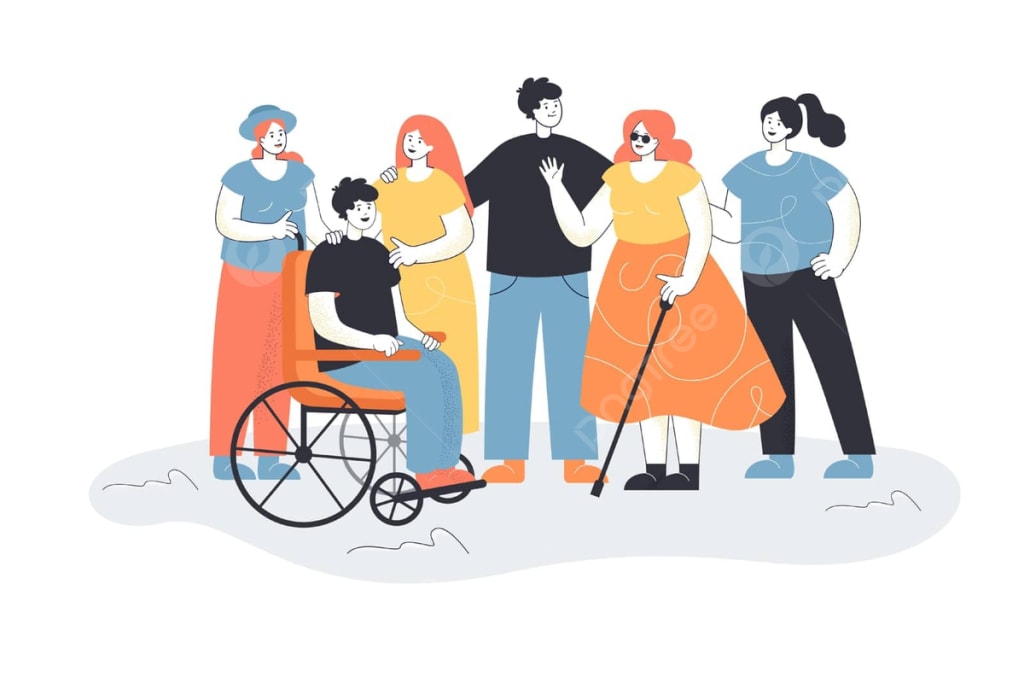
In conversations about diversity, equity, and inclusion, it's easy to get swept up in broad categories—race, disability, gender, or socioeconomic status—without acknowledging the factors that fall between them.
One group that often slips through the cracks whenever racial diversity is being talked about, is the multiracial category.
Another group that does not get as much importance or can get neglected unintentionally is the global disability inclusion, particularly those who also identify as part of other historically marginalized communities.
Moreover, those with intersecting identities, such as multi-racial with disability.
_______________________________________________
Advantages of identifying under-represented minorities.
By centering people with intersecting identities, we push systems — like healthcare, education, and social services — to be more inclusive, flexible, and responsive to real-world complexity. This leads to better outcomes not just for those at the margins, but for everyone.
When we collect data and build policies that reflect intersectionality, funding and services are more accurately directed.
Prioritizing intersectional voices ensures that those most affected by inequality are leading the solutions.
The disadvantaged current situation.
People who are either or both multiracial and disabled often find themselves navigating a landscape where their full identities are rarely acknowledged, much less supported.
They face compounded barriers in education, healthcare, employment, and representation—not only because they are disabled, but also because their multiracial and minority identities are misunderstood or erased.
Data on multiracial individuals and those with disability is scarce, partly because most studies and institutions still view race and disability through a singular lens.
Representation matters.
Representation in media, politics, and advocacy spaces continues to fall short. When disability is represented, it’s often within a white-centric framework. When race is represented, disability is left out of the picture. And when multiracial identity is represented, it’s frequently flattened into ambiguous aesthetics rather than fully explored lived experience. Very rarely do we see someone who embodies all these identities on screen, in leadership roles, or leading conversations about policy and justice.
This lack of representation has real-world consequences. It impacts funding for disability services in communities of color. It limits the cultural competence of healthcare providers. It shapes school discipline policies and special education programs. And it leaves those living at these intersections without a clear space to voice their needs or build solidarity.
_______________________________________________
Recognizing multiracial individuals and/or disabled individuals within communities—isn’t just about representation; it’s about justice, equity, and truth. These are people who live at the intersections of multiple systems of oppression, yet whose voices have too often been sidelined. When we choose to see and support them fully, we do more than right a historic wrong—we design systems that reflect the true diversity of the human experience.
By embracing recognition, inclusion and fairness of all racial groups, including those with bi-racial of multi-racial ethnicity; as well as people with disabilities that belong within intersectionality or not, we move closer to a world where no one has to hide part of who they are to be seen, heard, or supported. The advantages are clear: smarter policies, stronger communities, and a deeper, more compassionate understanding of each other. If we want to build a future that includes everyone, we must start with those who’ve been left out the longest.
Published on 4/21/2025.
About the Writer:
Hi, I'm Gemma Tomei. I’m a junior in high school and I started to become more aware of diversity. While I was born in the U.S., I look almost fully White and was raised predominantly under a white family and relatives, my mother is fully of Southeast Asian descent. Growing up I went through some unfamiliarity with regards to my race as to whether I should lean more towards being white or Asian. I've met a few similar people of my kind. They were always respectful of their Asian peers and culture. When I was curious about one of those people and what they identify as-- they said mostly Asian yet being white-passing. I appreciate this since they did not just associate themselves as Asian when it's convenient. There are times I would identify as Asian due to a huge part of my social circle. And there are times when I struggle to feel like I belong anywhere. The very reason I began to write such an article, is to express myself, and how people like me will fit into our society. Most especially, as I’ve recently been visiting places outside of my U.S. hometown, I’m becoming more aware of how global diversity is becoming. Outside of the racial diversity, it strikes me how other groups are represented. E.g. would be the women in our society, as well as people with disabilities. I look forward to sharing more thoughts in the future regarding similar relevant topics.
About the Creator
Keep reading
More stories from Goldcart Solutions and writers in Humans and other communities.
The Growth of the Multi-Racial Crowd
As cultural diversity grows in America, society is greatly impacted in the workplace. Studies have shown that with a more diverse workplace, it is more likely to outperform other companies, and makes people feel more welcome to join.
By Goldcart Solutions2 years ago in Humans
Autonomy Is The Real Privilege
Good morning, freedom-seekers! Today we’re gonna be looking at autonomy. A strange word, I know; one many would probably look at blankly and run away from on sight. We’re gonna figure out what it actually means, consider how it’s achieved, and decipher just how deeply most of us are tangled up in dependence without realising it.
By That ‘Freedom’ Guyabout 18 hours ago in Humans
Multinational Crisis Part 4: Who Cares?
“Frankly, my dear, I don’t give a damn!” Facebook. Silent. TikTok. Silent Instagram, Threads, Lemon8, and every other social media, are not concerned with what is happening to you, women and men, on their platforms. They care only, for the mighty dollar and statistics.
By Alexandra Granta day ago in Humans




Comments