
"The Truth They Never Told Us: What School Forgot to Teach About Life"
"From emotional intelligence to financial survival—discover the real-world skills we all needed but never learned in class."
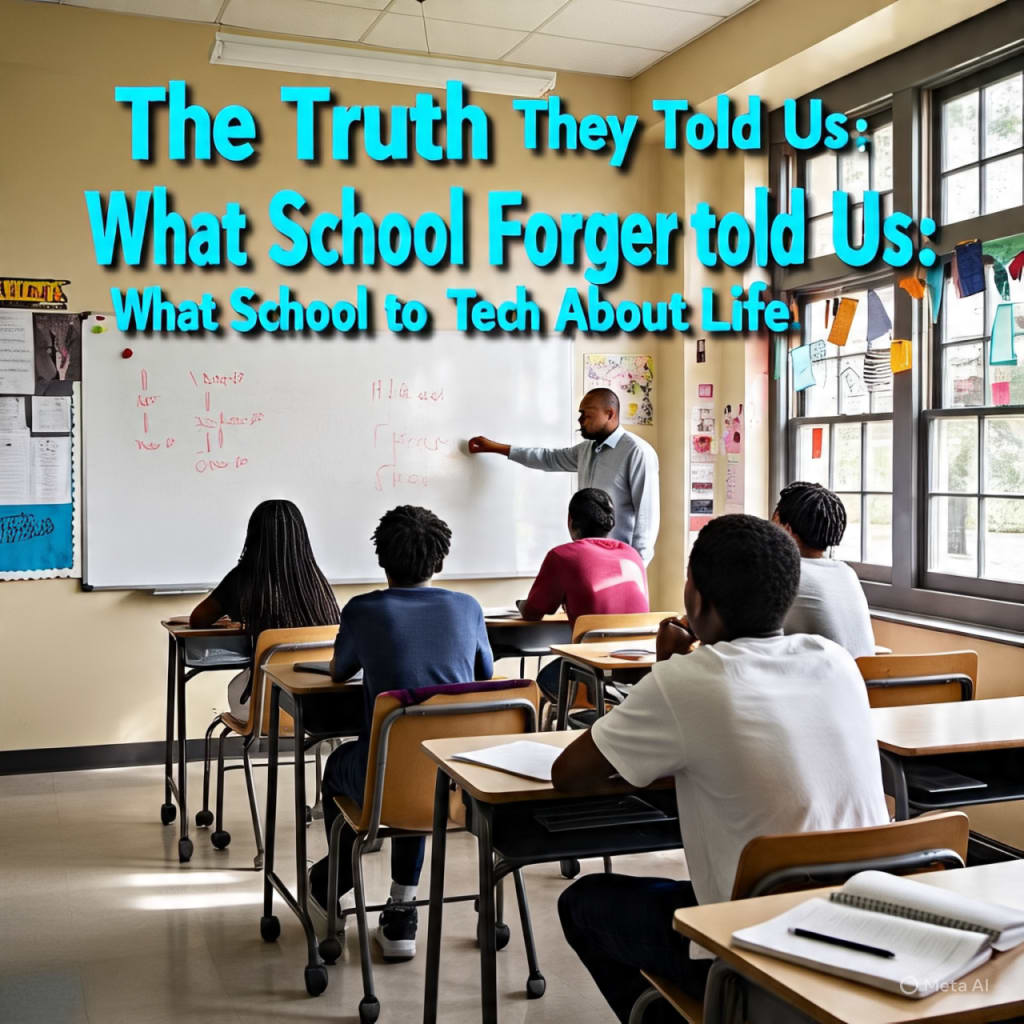
In a classroom lit by fluorescent lights and filled with the hum of busy pencils, I once sat memorizing the Pythagorean theorem. I could calculate the hypotenuse of a triangle, recite the stages of mitosis, and name all the rivers in South America. But when I stepped out of school and into real life, I was left wondering: why didn’t anyone teach me how to actually live?
No one ever explained how to manage money—how credit works, why debt snowballs, or how a simple budgeting app could save me years of stress. I learned about the Great Depression in history class, but no one taught me what a credit score was, how to build one, or why missing a $30 payment could haunt me longer than a bad breakup.
Taxes? That was a total mystery. I remember feeling proud after my first job at 18, holding that paycheck like it was made of gold. Then came tax season. W-2s, deductions, withholdings—I was lost. I turned to Google and TurboTax, because school had left me blank. I could write a five-paragraph essay on Macbeth, but I had no idea what "filing jointly" meant.
Then came relationships. School taught us about the biological mechanics of reproduction, but not about emotional intelligence. No one told me how to communicate when I felt overwhelmed, how to listen without judgment, or that love wasn’t supposed to feel like anxiety. I could diagram a sentence, but I couldn’t untangle the messy feelings that come with being vulnerable.
Mental health? Not a topic. We had gym class to stay fit and alert, but no one taught us how to manage anxiety, cope with depression, or even recognize burnout. I learned about Newton’s laws of motion, but no one prepared me for the emotional laws of adulthood—the inertia of stress, the friction of failure, the acceleration of pressure when everything feels urgent.
And then there’s the job hunt. Resumes, interviews, cover letters—all blank pages to me. I didn’t know how to write a compelling summary about myself. I was told to “follow my passion,” but no one explained how to negotiate a salary, build a personal brand, or even ask for a raise without sounding ungrateful.
Life didn’t care that I graduated with honors. Life asked me if I could adapt, self-regulate, plan, and persist.
I don’t say this to blame teachers—they did what they could with what they were told to teach. But the system itself seemed built for test scores, not for thriving. The education system taught me facts and figures, but life demanded resilience, adaptability, and self-awareness.
Ironically, I’ve learned more from podcasts, YouTube tutorials, late-night Google searches, and trial-and-error than I did in years of structured schooling. I’ve learned how to invest by watching free webinars. I’ve figured out how to repair credit by reading blog posts. I’ve developed emotional tools through therapy and journaling—none of which were ever part of my curriculum.
So why does this gap exist?
Because for decades, we assumed that academic knowledge equals success. That memorizing equals mastery. That straight A's equal a straight path. But that’s not the full picture. Success in life is less about what you know, and more about how you apply, adapt, and connect.
Imagine a curriculum that includes:
Financial literacy 101: budgeting, investing, understanding debt.
Emotional survival skills: conflict resolution, setting boundaries, mindfulness.
Practical independence: cooking, apartment hunting, reading contracts.
Digital literacy: cybersecurity, online reputation, personal branding.
Career building: writing resumes, interview practice, networking strategies.
This isn’t fantasy—it’s necessity.
Because the truth is, we’re all students of life long after we graduate. We’re constantly figuring it out. And maybe, just maybe, if we start valuing life skills as much as academic ones, the next generation won’t feel so lost at 25, wondering why nobody warned them.
They’ll know that success isn’t about memorizing the map—it’s about learning how to read the terrain.
About the Creator
Keep reading
More stories from Muhammad Saad and writers in Humans and other communities.
"The Measure of a Nation: What Population Really Tells Us"
In the center of a crumbling village in eastern Europe, there is a rusted swing set. It creaks gently in the wind now, though once, it echoed with the laughter of children who filled the air with life. My grandmother used to live there. She said the village once had four bakeries, a school with two floors, and a market that bloomed every Saturday with colors and noise. Now, only the post office remains, and even that’s more memory than utility. When I visited last summer, I counted exactly 27 people. Twenty-five of them were over sixty. In cities, we worry about overpopulation—about crowded trains, rising rent, and vanishing personal space. But in places like my grandmother’s village, the opposite is true: there are too few people, and the silence is what spreads. And somehow, both of these realities are part of the same global story. More Than Just Numbers When people hear the word population, they think statistics—birth rates, death rates, immigration flows, charts and graphs. But what population really tells us is a story: of how people live, where they move, what they leave behind, and what they’re dreaming of next. The measure of a nation isn't just in its GDP or its landmass. It’s in the faces of those who walk its streets. It’s in the lullabies whispered in the early hours and the factories buzzing just before dusk. It's in the quiet of a village fading away, and in the chaos of a city being born. The Growing and the Emptying In Lagos, Nigeria, over 2,000 people move in every day. The skyline stretches higher each year. Children grow up dreaming not of leaving, but of building within. Meanwhile, in rural Japan, entire towns are becoming ghost-like. Local governments have started offering abandoned homes to foreigners for free—just to keep the lights on. It’s tempting to call this progress or decline. But it's more complex than that. Population changes reflect who we are becoming—what we value, what we fear, what we hope for. We are a species in motion. A Personal Reckoning I remember one night during my stay in the village, I met a man named Tomasz. He was 78, the former mayor, and the unofficial historian of the town. He invited me into his home, poured some tea, and pointed to a yellowed map on the wall. “There used to be 1,400 people here,” he said, his finger tracing the outline of a now-defunct school. “Every family had four, five children. We had dances in the square, festivals in spring. You couldn’t walk a block without greeting someone.” “Where did they go?” I asked. He shrugged. “Where they had to.” Cities, other countries, jobs—places where life promised something more. His own children now lived in Berlin and Warsaw. He didn’t blame them. Before I left, he said something that’s stayed with me: “Population doesn’t just measure growth. It measures connection.” Why It Matters It’s easy to see population as abstract—too big, too broad, too political. But behind every demographic shift is a story: a mother deciding whether she can afford another child, a young adult choosing between tradition and opportunity, a nation deciding who is welcome and who is not. The most populous countries in the world are also the most diverse, the most conflicted, the most dynamic. That’s not a coincidence. Where people gather, stories collide. Innovation is born. So is tension. And resilience. The places with shrinking populations, like my grandmother’s village, carry a different kind of wisdom—a quiet testament to what happens when people leave and don’t come back. There’s beauty in that too. A dignity. A Shared Future The future of population isn’t just about how many of us there are. It’s about how we choose to live together. Will we hoard opportunity, or spread it? Will we build megacities that welcome all, or walls that keep out the unfamiliar? We often think numbers tell us everything. But they don't. Not really. What they do is ask us questions: Who are we becoming? What are we leaving behind? And how do we make space—not just for more people, but for better lives? The Final Thought When I left the village, Tomasz waved from his porch. The swing creaked behind him. And I couldn’t help but wonder: What happens to a place when no one remembers it? What happens to a story when there’s no one left to tell it? Maybe that’s the real measure of a nation—not just how many people it holds, but how well it remembers, and how willingly it dreams.
By Muhammad Saad 8 months ago in Humans
5D Planet Explained. What It Means for Your Relationships and Career.
Have you ever felt like something fundamental is shifting inside you, even while the external world looks the same? Many people today are experiencing this inner transformation and searching online for answers. The concept of the “5D planet” describes a shift in human consciousness—from what is commonly called 3D awareness to 5D awareness.
By Wilson Igbasiabout 7 hours ago in Humans


Comments
There are no comments for this story
Be the first to respond and start the conversation.