
The Train Was on Time. Spain Was Not Ready.
A high-speed journey in southern Spain, and the moment ordinary lives were split in two

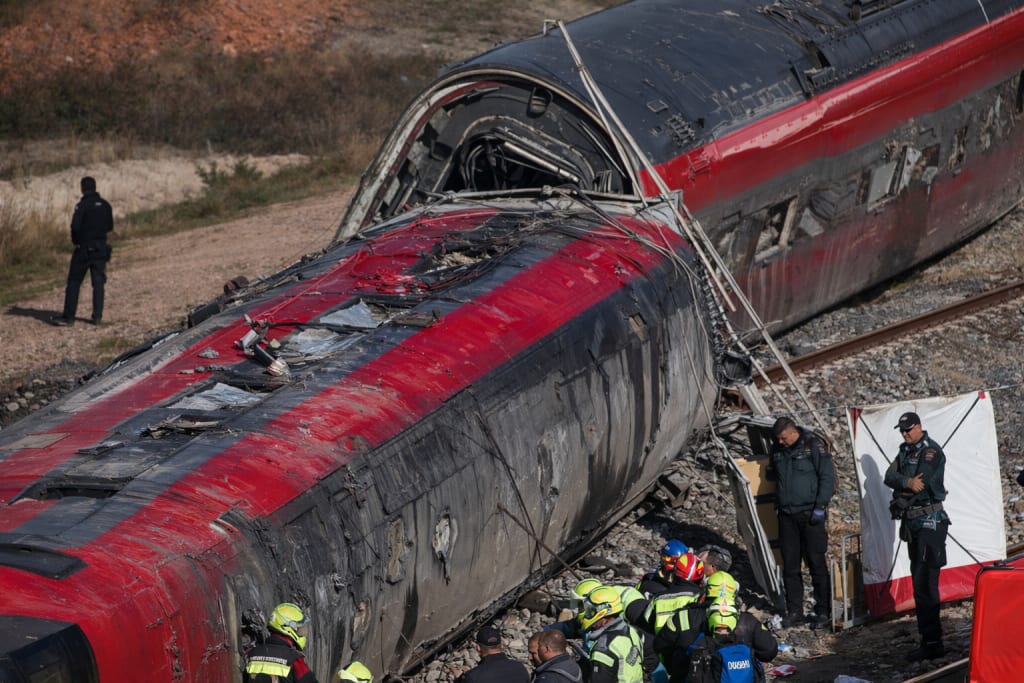
At 7:45 p.m. in southern Spain, a high-speed train followed its schedule like it always had.
It cut through the countryside with practiced precision, carrying commuters, families, students, and strangers who trusted that steel tracks and modern systems knew what they were doing. Some were returning home. Some were leaving. Some were just passing through Córdoba province on an ordinary evening that gave no warning it would be remembered.
There was no announcement.
No alarm.
No time to understand what was coming.
And then the train derailed.
The Second Everything Changed
Survivors would later struggle to explain the moment of impact, because language doesn’t prepare us for reality collapsing without notice.
One second, there was motion.
The next, there was violence.
Metal tore against metal. Carriages buckled. Luggage flew. The kind of sound that doesn’t just reach your ears, but rearranges your body. A high-speed system designed for efficiency became chaos in seconds, as one train derailed and collided with another moving in the opposite direction.
People were thrown forward into futures they never agreed to enter.
Phones fell silent. Lights went out. Time stopped behaving normally.
Inside the Wreckage
In the aftermath, survivors didn’t think in sentences. They thought in instincts.
Find a way out.
Help whoever is closest.
Listen for breathing.
Smoke filled the carriages. Seats twisted. Familiar spaces turned unrecognizable. Some passengers crawled through shattered windows. Others stayed still, afraid movement would make things worse. Names were called into the darkness, sometimes answered, sometimes not.
This is the part of disasters that rarely fits into headlines: the minutes where people become first responders because there is no one else yet.
Outside, Spain Held Its Breath
Emergency crews arrived to a scene that was difficult to access and impossible to process quickly. Twisted carriages lay across tracks that had carried thousands safely before that night. Heavy machinery was brought in, not just to clear debris, but to search for those still missing.
As news spread, Spain shifted into a different rhythm.
Hospitals prepared for mass casualties. Families waited for confirmations that came too slowly. Authorities spoke carefully, knowing that every word would be weighed by people desperate for certainty.
By morning, the numbers told a brutal story: dozens dead, many more injured, and countless lives altered beyond repair.
Trust Is the First Casualty
Spain, like much of Europe, prides itself on modern rail infrastructure. High-speed trains are symbols of progress, safety, and reliability. They are systems people trust enough to sleep on, read on, let their children wander the aisles of.
That trust was shaken.
Because this crash did not happen in a place associated with neglect or decay. It happened on a line meant to represent precision. Early investigations pointed toward possible track failure, not recklessness or speed. In other words, the system itself may have failed the people inside it.
That realization cuts deeper than fear.
The Survivors Will Carry This Quietly
There are people alive today who should statistically be dead.
They will replay the journey endlessly.
Why that seat?
Why that carriage?
Why that moment?
They will board future trains with a new awareness that safety is never absolute. Some will never board again. Others will, but with clenched hands and alert eyes, listening too closely to every unfamiliar sound.
Survival is not an ending.
It is a beginning shaped by memory.
After the Mourning Ends
Spain declared days of national mourning. Flowers appeared at stations. Names were read aloud. Investigations promised answers.
But after the ceremonies end, the deeper questions remain.
How fragile are the systems we depend on without thinking?
How quickly does “routine” become tragedy?
And how many warnings exist in infrastructure before disaster finally forces us to listen?
The tracks will reopen. Trains will run again. Schedules will resume.
But for the families who received final phone calls, for the survivors who still hear metal screaming in their sleep, time will never return to its previous speed.
An Ordinary Journey, A Permanent Scar
No one boarded those trains expecting history.
They boarded with groceries, plans, unfinished conversations, and the assumption that modern life had removed certain risks from the equation.
Spain’s train crash reminds us of an uncomfortable truth:
progress reduces danger, but it never erases it.
Sometimes, the train is on time.
And life still isn’t.
About the Creator
Aarish
This account has been compromised for now.
For new pieces, Join me here. VOCAL MEDIA
Support my work .
Join my publication on Medium for self-help advice. (fragments of growth)
Autonomy Is The Real Privilege
Good morning, freedom-seekers! Today we’re gonna be looking at autonomy. A strange word, I know; one many would probably look at blankly and run away from on sight. We’re gonna figure out what it actually means, consider how it’s achieved, and decipher just how deeply most of us are tangled up in dependence without realising it.
By That ‘Freedom’ Guyabout 7 hours ago in Humans
Valentine's Day Ideas That Build Real Connection
Valentine's Day is not about grand gestures alone. It is all about being present, having an intention, and sharing meaning. Bloom Boldly believes that the best Valentine's Day ideas emphasize emotional closeness rather than perfection. When couples slow down and prioritize connection over performance, the day becomes memorable in ways that will last well beyond February.
By Bloom Boldlya day ago in Humans




Comments
There are no comments for this story
Be the first to respond and start the conversation.